Monthly Archives: August 2026

Further Discussion on The Griffin Incident

.

A friend left a lengthy comment on my post about The Griffin Incident over on Twitter. Since over there I am restricted to 280 characters, I will respond here.

First off, I want to say it was not my intention, nor do I think I stated, that science fiction and horror are incompatible genres.  While most people, and I fell into that easy trap myself, call horror a ‘genre,’ it is more like a mood and an intention. Like a romance (lower case R), horror is about what the recipient of the art is intended to feel and experience over the mechanics or rules of the genre. Science fiction can be horror, with A Dance to Strange Music, the short story by renowned hard SF author Gregory Benford, as a perfect example. It is horror and in the author’s note afterwards, Benford explains all of the very detailed science behind the strange events of the tale.

@gunsandrockets wrote, I think what defines science fiction is not rationality, not an explicable story, but instead the presumption that the universe is a material universe, absent of the spiritual, absent of magic. I agree, but I would also point out that a material universe absent spirits and magics is a universe that is explicable and one that can be understood by reason.

So, is Alien science fiction or horror? It is clearly both, though with the somewhat dodgy science we have allowed cinema to get away with. Aliens is not horror; it is action/adventure. With the ‘rules’ of the creature understood by the audience, it is hard to return back to horror; the films following Aliensdid, but mainly by reducing the once terrifying beast into an outer space slasher.

Horror, as a style of cinema, has terribly fuzzy borders that encompass and exclude based almost entirely upon the viewer’s own internal definition. Is Jaws horror? Is The Silence of the Lambs? How about Seven or Manhunter or Mulholland Drive? What is or is not ‘horror’ is a very difficult thing to nail down and even the filmmaker’s intention doesn’t cleanly answer that question. Both the writer and the director of The Exorcist do not consider either the novel or the film to be ‘horror,’ but rather supernatural detective fiction.

I was also asked what about the works of H.P. Lovecraft, science fiction? horror? or both? Clearly both, but I do think many people confuse the nature of the horror at the center of his work, mistaking tentacles and monstrosities for the horror and not that humanity is not only insignificant in the vast universe but that the nature of that universe is beyond our ability to sanely comprehend. Consider the opening paragraph of his novella The Call of Cthulhu.

The most merciful thing in the world, I think, is the inability of the human mind to correlate all its contents. We live on a placid island of ignorance in the midst of black seas of infinity, and it was not meant that we should voyage far. The sciences, each straining in its own direction, have hitherto harmed us little; but some day the piecing together of dissociated knowledge will open up such terrifying vistas of reality, and of our frightful position therein, that we shall either go mad from the revelation or flee from the deadly light into the peace and safety of a new dark age.

Lovecraft is stating, rather plainly, that the nature of existence is, to the human mind, inexplicable. To try and understand it is to invite either madness or willful ignorance. It is why the recent film Backrooms strikes me as very Lovecraftian. In the end, the nature, the reason, of the backrooms lies beyond our ability to decipher. It simply is and that alone is enough to unship a person’s sanity.  To be fair, this is also a point raised by @gunsandrockets.

That the true nature of the universe is unknowable to lowly mankind. An ignorance which is a mercy, since even getting close to the truth either drives a person insane or turns them into a monster.

To my interpretation, this is saying that the universe is inexplicable. The universe is not rational in any manner that is comprehensible by humanity.

The Griffin Incident promises no explanation at all for the ship and its terrifying manifestations. That puts the story beyond the realm of science fiction. It is not a story that exists in a place without spirits or magic of some kind.

Share

The Griffin Incident is not Science Fiction

.

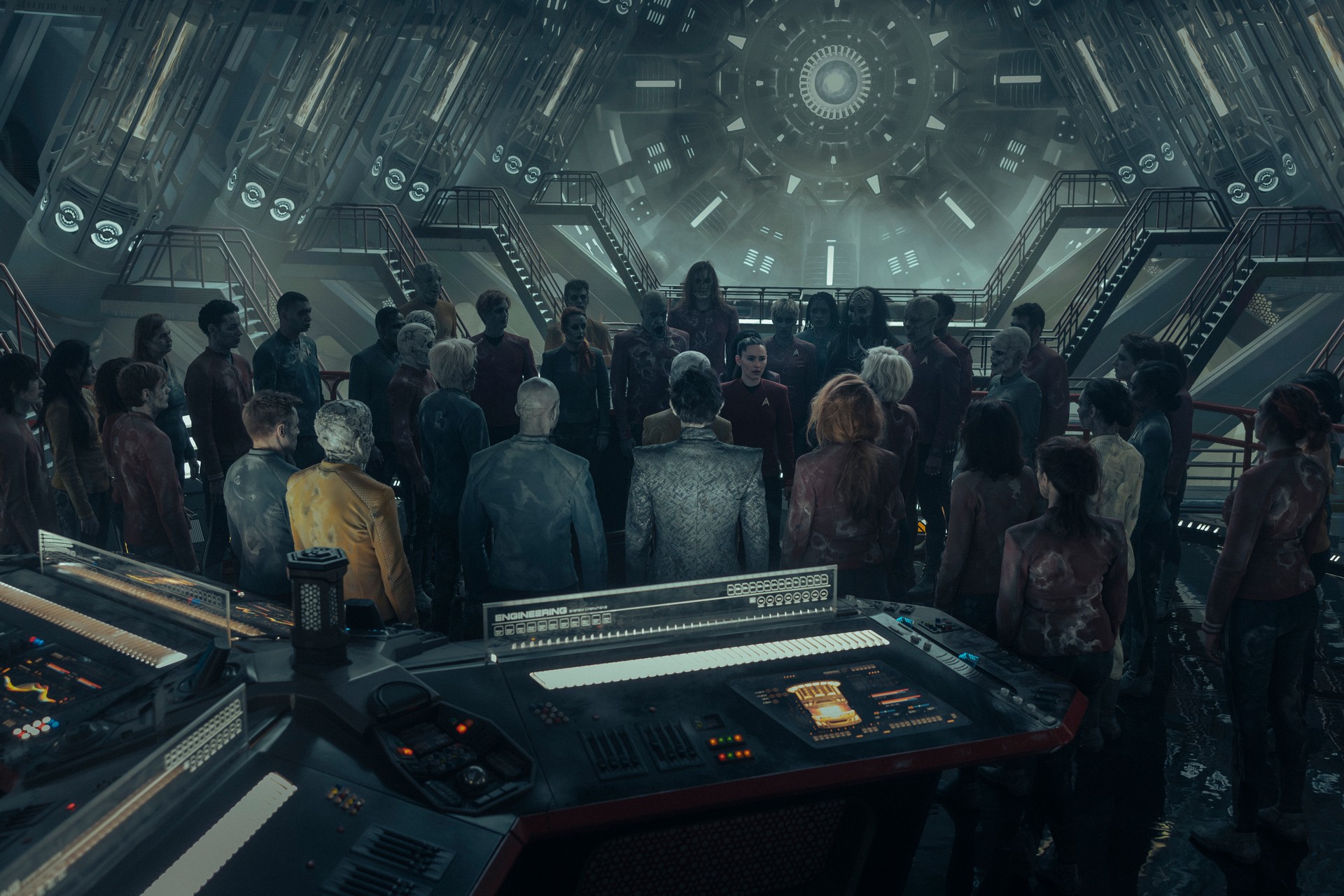
Star Trek: Strange New Worlds boldly left the confines of its genre of science fiction with the third episode of its fourth season, The Griffin Incident. While some have used the episode’s horror genre as a source of criticism, I instead want to praise the production for slipping free of constraints and having the courage to explore fascinating new realms for its characters.

Paramount+

The Griffin Incident has been, correctly, described as Star Trek meets Event Horizon, the 1997 horror movie that takes place aboard a haunted and terrifying derelict at the outer regions of the solar system. In the Star Trek episode, three characters, Spock, Jim Kirk, and La’An, discover the wreck of a lost Federation starship, the Griffin, and after becoming trapped aboard are visited, much like the characters from Event Horizon, by terrible specters and visions exploiting their unresolved emotional issues. In terms of graphic violence and explicit horror, particularly for television that is not produced for a premium channel, The Griffin Incident pulls no punches and is a quite satisfying bit of horror media, but is it science fiction?

No.

Science Fiction is, at its core, a rationalist genre and all the tales and stories within that genre exit within a rationalist, understandable, and explicable universe. This ranges from the ‘hardest’ of science fiction stories where absolutely no known understanding of the physical universe may be contradicted, no telepathy, no faster-than-light travel, and so on to the stories with the flimsiest of ‘scientific’ justification, often when the strangeness of quantum mechanics are used in place of just flat out magic. Star Trek, from its very inception and earliest pilots, has never resided in the hard science fiction territories and it’s never productive to force ‘real-world’ science on any episode of the series. (It does not bear to consider the thousands and thousands of nuclear bomb’s worth of energy that is released when the rest mass of an entire person to converted is energy for the mere act of transportation.) Even when it is employed as a form of magic to put the characters into an episode that obeys the rules of musicals, some ‘scientific’ explanation is used to justify the strange and wondrous events. That act of justification by way of warped and tortured science is what keeps a story within the pastures of science fiction.

Horror, on the other hand, works best when reason and rationality are lost and the characters, along with the audience, are suddenly thrust into a situation that is inexplicable and perhaps is even beyond comprehension. There is a style of horror where the supernatural is bent out of shape to conform to the universe as we understand it, a style where mass is conserved when werewolves transform from men into wolves and where blood for vampires is simply a nutrient, allowing them to substitute pig’s blood from a butcher for the essence of human life. That is a disservice to the genre, moving it from the uncanny to just a set of rules that can be followed and understood.

The Griffin Incident provides no explanation for why the ship is haunted, such as that the ship’s crew, driven insane by the very nature of space/time in the region, quantumly entangled with the material in the hull, imprinting psychic echoes that appeared as phantoms but were perfectly explicable.

Nope. It’s just a haunted ship and the characters survive but have no understanding of just what transpired in their lives, only that they survived. Science fiction demands that in the end every phenomenon has a cause-and-effect that is understood, but this episode, in the very best tradition of horror, abandoned such comforts leaving the characters and the audience in the terribly uncomfortable space where reason had no purchase.

Share

Airplane! and Anita Bryant’s Cultural Irrelevancy

.

Last night on YouTube I watched a Canadian millennial couple react to the 1980 absurdist comedy film Airplane! As with the many of the reactors who have engaged with this piece of silly cinema, much of the chaotic comedy still worked 46 years later, and some were too fixed to their time and place to have any meaning to people born more than a decade after the movie’s release. It is a strange quirk of comedy that the ‘Jim never has a second cup of coffee at home’ gag is rewarded with laughs because of the strangeness of the spouse’s thoughts, and without any context to the Yuban coffee commercial it is lampooning.

While references to Gerald Ford and Ronald Reagan spark some recognition in younger viewers, and the use of serious dramatic actors in farcical skits has little to no impact on those who are watching this movie from the last century, this is not the issue that is sticking with me today. One target of the filmmaker’s sharp critique stirs no reaction and is nothing but a forgotten cultural relic, Anita Bryant.

Anita Jane Bryant, beauty pageant queen, singer with multiple top-ten hits, and ubiquitous citrus spokeswoman for much of her career, was a popular but not stellar figure in the American cultural landscape, often traveling with the legendary Bob Hope on tours to support and entertain the Armed Forces, and finding herself welcome at both the Democratic and Republican national conventions. She hosted parades, performed at half-time shows for the Super Bowl, and even at the funerals of Democratic presidents, and yet today her name, except for whom politics is a passion or who either in or adjacent to the gay community, is almost entirely forgotten.

In 1977, Dade County, Florida, passed the first ordinance in the nation that prohibited discrimination in housing based upon sexual orientation, protecting gay men and women from prejudicial treatment when it came to renting homes, igniting the ire of Bryant, a fire that would consume her career and, in the end, erase her from cultural memory.

Bryant successfully led a campaign that overturned the ordinance, but that victory raised the issue to the wider culture, and while gay rights were not an unknown thing before Bryant’s crusade, (Stonewall was 8 years earlier,) her actions made the cause much more salient to the national conversation. Sponsors dropped her from their advertising campaigns, networks rescinded offers to host weekly television programs, and her career over the next decade functionally ceased to exist. In order to legally allow bigoted people to refuse homes to those whom she despised, Bryant self-immolated to the point that by the time of her death in 2024 she had ceased to be known by the wider public at all.

Both sides waged the political fight in Dade County with ferocity, Bryant deploying the slanderous, vile label that gay men preyed upon children to ‘recruit’ new homosexuals, while some among the fight for rights resorted to political violence. Yes, that violence was shaving cream pies to her face, but it remained political violence, and in my opinion, one only employs violence when no other path remains open and the physical threat from the dominant political actors is very real. While a direct line cannot be drawn from these pie attacks to the January 6th insurrection, the indirect lineage is there.

Anita Bryant’s obscurity is, in the end, the best of all possible victories over her bigoted political warfare.

Share

Friend-Zoned in the QueryTracker Meat Market

.

A common metaphor used in the writing community for those of us on the hunt for representation by a literary agent is that we are ‘in the trenches.’ I can see the appeal of this device and have even used it myself. The trenches of World War I seemed like an impossible-to-win and impossible-to-escape situation for the poor men trapped in that years-long stalemate. Sending out endless queries about your novel to overworked and overwhelmed agents has a distinctly similar vibe to it. An agent can easily get hundreds of queries each month, thousands by the year, and of those they might sign up as new clients less than a dozen. I can see how that feels, from the author’s perspective, like going ‘over the top’ and into ‘no man’s land’ to face mounted machine guns of which very few survive.

But lately, particularly with the passes I have been getting from agents, I wonder if such a violent and combative metaphor is the right one for the process. After all, we authors are not trying to take the ground from the agents, we are not trying to annihilate them as an enemy but hopefully find an artistic partnership that can grow and flower for years and years to come. Perhaps it is more akin to romance than warfare.

Instead of the corpse-littered fields of France and Belgium, this is the crowded discos and singles bars of the 1970s. The agents are like the single attractive women who have high hopes of finding that special person, that match that works on every level. Authors are the swarms of men, dressed as snappily as they are able, deploying their practiced ‘lines’ in hopes of gaining that look, that, as Dolly so eloquently put it in her song, ‘when a glance becomes a stare,’ desperate to find some way, some ‘trick’ that can make them stand out from all the hustlers vying for that woman’s attention.

And if that metaphor works, then we can see its applicability over the death and destruction of the battlefield. Between the firm rejection and the exploration of a relationship there is a netherworld derisively labeled ‘the friend-zone.’ Now, this metaphor should not be pressed too far or adhered to too devoutly. In relationships far, far too often men are seeking a simple sexual ‘conquest’ and are not seeking a partner to share life with. Such men, with their fragile and brittle egos bruised when rejected by a woman who has proclaimed that they see those men as ‘only friends’ or ‘like a brother,’ vanish, never seen again because all that they wanted was the physical and not the emotional. Writers seeking representation are very, very rarely seeking it for just one book and as such this metaphor breaks down in its analogy. Agents are not conquests but partners, and no one is looking for a ‘one-night stand.’

But it is not without some service and, in my opinion, some emotional value.

This has come to me because lately I have been getting a different style of ‘pass’ from some agents. In these emails and responses, the agents are making it clear that while they did not ‘fall in love’ with the submitted project, they know that someone out there will and encourage me to continue querying and submitting.

Oh, how this feels precisely parallel with ‘I like you as a friend, but there’s some girl out there who is perfect for you.’ This is the rejection I have felt many times before I was so fortunate to find the woman who became my sweetie-wife and the way these passes rhyme with those failed dates of yesteryear is powerful. It fits so much better and resonates so much more truthfully than a battlefield strewn with artillery craters flooded with water and bodies that lay nearly half a century before my time.

Share

Streaming Review: The Day of the Owl

.

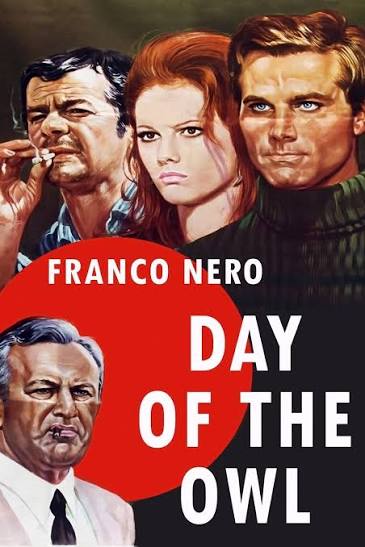
We were flipping through the thumbnails on the ad-supported streaming service Tubi when my sweetie-wife, a lover of birds, noticed the title The Day of the Owl, and we stopped to investigate.

An Italian/French crime drama from 1968, the film intrigued us enough to start the stream, but on that evening Tubi’s service must have been pushed to its limit because the film stuttered and stopped. We decided to try again another night, and when we did it played perfectly.

les films corona

The Day of the Owl focuses on the new police captain, Bellodi (Franco Nero), recently transferred from Northern Italy to Sicily, and his investigation of an organized crime murder of a local contractor who refused to play along with the region’s rampant corruption. With witnesses who refuse to come forward and informants who work both sides of the conflict, Bellodi soon moves beyond acceptable police work in his attempt to link the murder to the local mafia leader Don Mariano (Lee J. Cobb).

One of the issues one can run into when discovering a film on Tubi is that the service does not always get the most pristine copies to stream, but this was not the case with The Day of the Owl. Image and sound were perfect, though I had the opinion that the sound mix had the foley track too loud; compared to some of the other foreign films we watched on the service, this was like having a Blu-ray in the player. Franco Nero looked fantastic: his intense blue eyes shone brightly, and he cut a fine figure in his uniform. This was also an exception in that the film was presented with its Italian language soundtrack and not dubbed, as is the case with the majority of the films on Tubi. This is not a story for anyone looking for simply good guys and a world where evil is always and easily vanquished, but for those who like more challenging plots, it is worth at least one watch.

The writing is sharp, with a biting sense of humor present throughout most of the film. Sardonic and cynical is the script, and while this movie was released in 1968, it has the tone and resolution of a movie from the deep, dark mid-70s.

Share