.
Star Trek: Strange New Worlds boldly left the confines of its genre of science fiction with the third episode of its fourth season, The Griffin Incident. While some have used the episode’s horror genre as a source of criticism, I instead want to praise the production for slipping free of constraints and having the courage to explore fascinating new realms for its characters.
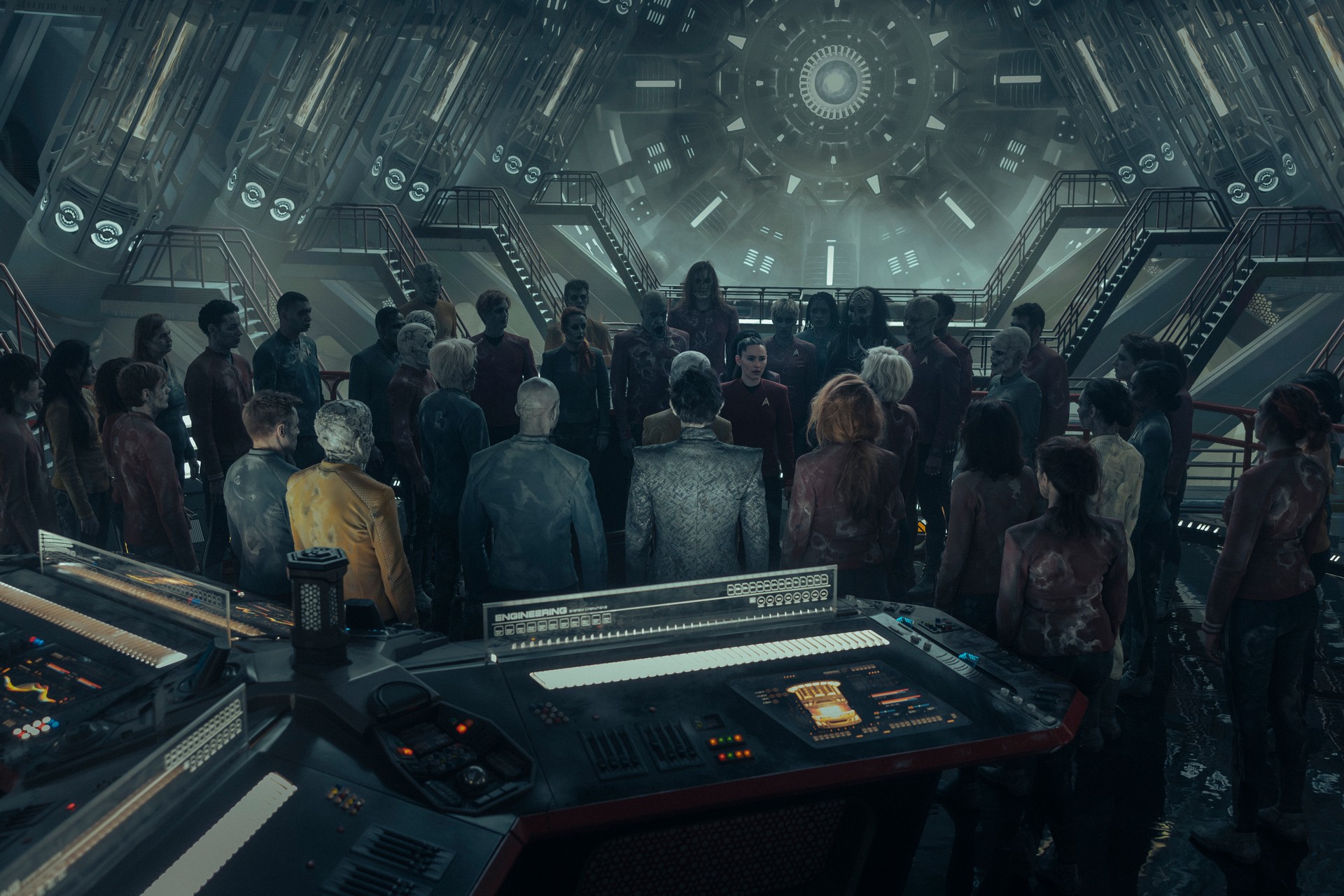
Paramount+
The Griffin Incident has been, correctly, described as Star Trek meets Event Horizon, the 1997 horror movie that takes place aboard a haunted and terrifying derelict at the outer regions of the solar system. In the Star Trek episode, three characters, Spock, Jim Kirk, and La’An, discover the wreck of a lost Federation starship, the Griffin, and after becoming trapped aboard are visited, much like the characters from Event Horizon, by terrible specters and visions exploiting their unresolved emotional issues. In terms of graphic violence and explicit horror, particularly for television that is not produced for a premium channel, The Griffin Incident pulls no punches and is a quite satisfying bit of horror media, but is it science fiction?
No.
Science Fiction is, at its core, a rationalist genre and all the tales and stories within that genre exit within a rationalist, understandable, and explicable universe. This ranges from the ‘hardest’ of science fiction stories where absolutely no known understanding of the physical universe may be contradicted, no telepathy, no faster-than-light travel, and so on to the stories with the flimsiest of ‘scientific’ justification, often when the strangeness of quantum mechanics are used in place of just flat out magic. Star Trek, from its very inception and earliest pilots, has never resided in the hard science fiction territories and it’s never productive to force ‘real-world’ science on any episode of the series. (It does not bear to consider the thousands and thousands of nuclear bomb’s worth of energy that is released when the rest mass of an entire person to converted is energy for the mere act of transportation.) Even when it is employed as a form of magic to put the characters into an episode that obeys the rules of musicals, some ‘scientific’ explanation is used to justify the strange and wondrous events. That act of justification by way of warped and tortured science is what keeps a story within the pastures of science fiction.
Horror, on the other hand, works best when reason and rationality are lost and the characters, along with the audience, are suddenly thrust into a situation that is inexplicable and perhaps is even beyond comprehension. There is a style of horror where the supernatural is bent out of shape to conform to the universe as we understand it, a style where mass is conserved when werewolves transform from men into wolves and where blood for vampires is simply a nutrient, allowing them to substitute pig’s blood from a butcher for the essence of human life. That is a disservice to the genre, moving it from the uncanny to just a set of rules that can be followed and understood.
The Griffin Incident provides no explanation for why the ship is haunted, such as that the ship’s crew, driven insane by the very nature of space/time in the region, quantumly entangled with the material in the hull, imprinting psychic echoes that appeared as phantoms but were perfectly explicable.
Nope. It’s just a haunted ship and the characters survive but have no understanding of just what transpired in their lives, only that they survived. Science fiction demands that in the end every phenomenon has a cause-and-effect that is understood, but this episode, in the very best tradition of horror, abandoned such comforts leaving the characters and the audience in the terribly uncomfortable space where reason had no purchase.
