Category Archives: Television

And Now the End is Near (For My TV)

.

March 2018, using the money I earned in overtime working the Annual Enrollment Period for Medicare from the previous 6 months, I purchased a 55″ 4K LED smart TV by Chinese manufacturer TCL.  I launched my new bigger video experience by hosting friends for a Cold War mini-Marathon of three films. (The Manchurian Candidate, The Spy Who Came in From the Cold,and Dr. Strangelove.)

For the past 8 years this television has performed quite well, though for the last 12 months or so it has seemed that the app running through the Roku interface have become more sluggish often with a delay on some streamers that can be very annoying. When you hit ‘pause’ on a Netflix program you want it to pause right then, not a second and a half later. Honestly though, the lag in some responses is a minor inconvenience.

What is becoming evident is that the screen may now be showing premature signs of wear and age. I have noticed very faint but still visible lines running vertically on the far-left side of the monitor. During dark or even rapidly changing sequences they are so faint as to be nearly, but only nearly, imperceptible. The same cannot be said for brilliantly lit or lightly colored scenes which make the line stand out.

My research has indicated that there is the possibility that the board controlling the backlight for the set may be at fault and a period of absolutely no power, not merely switched off, may correct the issues by allowing the logic in the controller to reset.

However, should that fail, then I must begin preparing to replace the television. At the moment the lines, however annoying, are actually faint enough that for most of the time I can ignore them, letting them slip from my notice, but if it is the backlight, the problem will not diminish but grow until it forces me to replace the set with a newer model.

Share

Detective Hole Can’t Stop Digging So I Will

.

Mentioned some weeks ago on The Late Show with Stephen Colbert, Netflix began streaming a new Nordic noir Detective Hole and, being fans of Nordic noir, my sweetie-wife and I gave the series a go. And, after four out of nine episodes, we have let the show do its merry way unconcerned with its resolution.

Working Title Television

Detective Harry Hole is a haunted alcoholic detective in Norway trying to live down killing his partner in a drunken car crash while in hot pursuit of a murderous bank robber. Now, with a new partner, a new significant other, and trying to stay on the wagon, Hole is presented with a fresh set of crises, his new partner is murdered while trying to locate a low-level drug dealer and a serial killer is stalking the streets of Oslo, pushing Hole back into the bottle and off the force.

That single paragraph synopsis could be for almost a countless number of second-rate, trope-filled, cliche-riddled police procedurals of which Detective Hole is merely a foreign language example.In addition to the stock characters, settings, and situations the series presents with a nearly comical lack of understanding of modern forensic work and evidence.

When Hole’s partner was killed, it was an on-screen scene so we the audience know that the murderer was in actuality fellow detective Waller who was the low-level drug dealer’s upper management. Waller shot the dealer in the stomach, then pursued the partner who had witnessed it, fought with her, put her in a sleeper chokehold, before arranging for the still dying dealer to be holding the pistol that killed the partner. Waller then presented himself as the heroic cop who came in just too late to save her fellow officer, shooting and killing the dealer.

None of the physical evidence supports such an outlandish lie. The dealer has a gunshot to the stomach which bled for several minutes into his abdominal cavity before being killed by a shot to the head. He also would present with no bruising, scratches, or any other signs of a life and death struggle which the dead partner does, or at least would, have.

I grumbled and, not happily, let them have that however that bit of silliness, but it got far, far worse.

Investigating the serial killer, Hole asks the forensic team if the same pistol was used to kill both women and he is told that it is ‘very difficult’ to determine if the same gun fired both rounds.

What the actual fork? Are the writers so ignorant of modern police procedures that they are unaware of rifling? That the grooves of a gun barrel are like a firearm’s fingerprints?

Unwilling to let their absurdity rest there the creatives, in addition to the serial killer sub-plot, the crooked cop sub-plot, and the cliched drunk cop plot, added yet another layer, a secret society of cops and politicians flooding the streets with weapons, provoking gangland warfare so that regulations would be changed allowing police to go about armed.

That was too much for me and my sweetie-wife, there are far better shows to watch.

Share

Do Not Think About Timeline of Star Wars

.

I am sure that there are some devoted Star Wars fans out there that can conjure some twisty and convoluted explanation for the compressed and strange timeline that flows through the main sequence of the Skywalker saga in Star Wars, but if you sit and think about the years and the characters it really doesn’t quite add up.

20th century studios/Disney

Before I continue let me stress that there is much of the franchise that I am a fan of. I am an old fart and saw the original release in the theaters and when people mention Star Wars, much like with Star Trek, the images that fly to mind are of that original late 70s and early 80s adventure films. All the assorted material in comic books, novels, and television programs, both live action and animated, held little draw for me except for Andor, which I adore and is brilliant, even as it exposes the fault line in the ‘canon’ history of the saga.

The saga of Star Wars from the prequels, through the various programs, and the original trilogy, is the story of the fall of the Galactic Republic, the rise of the Empire, and, the restoration of the Republic by a dedicated rebellion. A story that in the films is principally told through the viewpoint of the Skywalkers, Anakin and his son Luke. When we meet Luke in Star Wars he is nineteen and ready to apply to the ‘Academy’ desperate to leave his life as a farmer and see the wider galaxy.

Nineteen.

Luke was born simultaneously with the Galactic Empire, Emperor Palpatine’s entire reign as the despot of the galaxy is about 24 years from start to his death on the second Death Star. In terms of Empires that’s a very short time, though it beats out Nazi Germany that lasted a mere dozen years, and Fascist Italy that managed to squeeze out 21 years. However a quarter of a century is still a very short period of time, you have only the youngest cohort of adults that know only the Imperial system with a much larger segment of the population that lived in the Republic era.

This was really brought home to me while watching Andor. (And again I adore Andor I think it is a masterpiece of television.) The character Dedra Meeroa, played beautifully by Denise Gough, announces that she has no family. Her parents were criminals and she was raised in an ‘Imperial Kinder Block.’ Ms. Gough was born in 1980. Andor  had its principal photography in 2020 making the actor 40 years old when she first portrayed Meero. Now, even if the character is 5 years younger than the performer that makes her 35 at the start of the series and by the ‘canon’ calendar with this being a mere five years before the destruction of the first Death Star, making the entire Imperial system just 14 years old. This makes Dedra 16 or so when she goes into the Imperial Kinder Block, provided that the systems starts with the Empire and still this is hardly ‘raised in a Kinder Block.’ The numbers simply do not add up.

And you know what — I don’t really care. It is a great bit of character building and backstory that explains the cold hard and dedicated Dedra Meero. I will always take good story over slavish devotion to ‘canon.’  Of course it is always best if you make everything fit neatly, but given the choice, give me great characters and great stories over a perfectly fitted history.

Share

Starfleet Academy Canceled and My Disorganized Thoughts

Paramount+

.

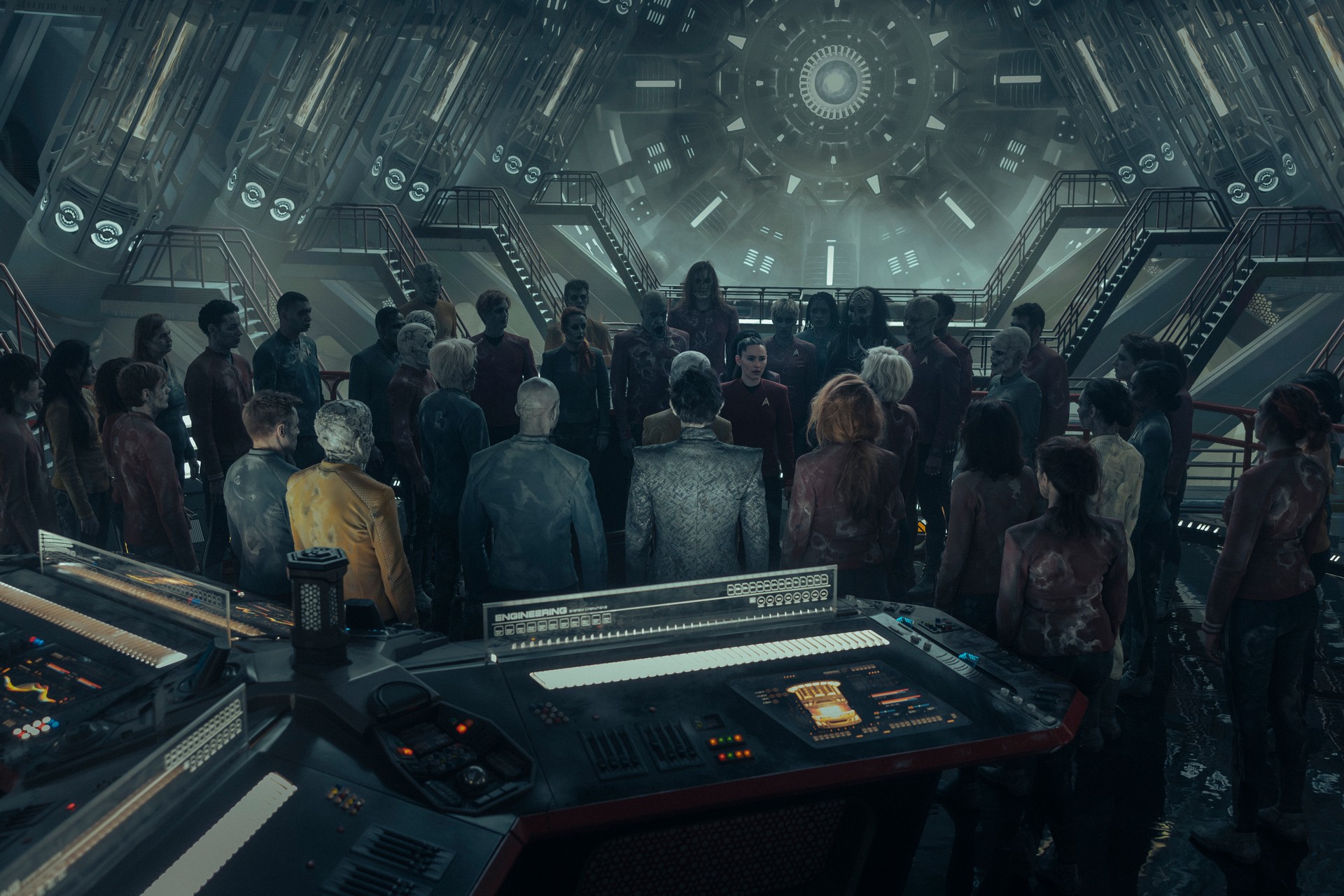
The newest series entry in the Star Trek franchise, Starfleet Academy got its cancelation announced yesterday to cheers from the quarters that despised the program and tears from those who adored it. If you populate or have visited the SF and Trek communities online then it’s no news flash that the series prompted some intense feelings with many going on extended ‘explainer’ videos dissecting the show’s faults, failures, and lack of respect for the ‘good’ Trek that had preceded it. This was a discourse that I did not participate in and avoided consuming whenever possible. Not because I had any particularly strong love or any emotion for the show but because such emotionally driven tirades are tiresome and not worth the energy to even briefly consider them.


Star Trek to me has always first and foremost been the original series produced and broadcast in the 60s, a very different time from today in nearly every major way. Next Generation presented a new crew and several seasons where I enjoyed the program but also several seasons where it was tedious, tiresome, and quite preachy. Deep Space Nine had some interesting ideas and characters and I watched a few episodes here and there, but it failed to fully hook me as a viewer. Voyage? God, that was stuff I simply could not swallow with the exception of a couple of episodes I watched out of loyalty to my friend that had written them, I abandoned the series after the third episode. The next series, Enterprise I abandoned after the pilot as it was quite clear to me that the creatives behind that project had a very different vision for how SF and Trek in particular should be written than myself.

Discovery tempted me back with some very interesting casting choices and there was much I found intriguing about its set up – I have never been one overly concerned with ‘canon’ for a series that was never designed to have it — but ultimately I lost interest and the series just slipped out of my viewing habits. Without a deep devoted sense of nostalgia Picard failed to keep me engaged (pun very much intended) and again after a few episodes it slipped away.

Strange New Worlds is a very different story. The first ‘new Trek‘ series that gave me the feeling of that original series, even as they took their own quite large liberties with the supposed canon. Not only did i follow the show and watch every, admittedly too few, episode, I purchased the first two seasons on physical media.

So, with that background established I watched Starfleet Academy with an open but wary mind and heart, hoping for a new Trek that I could be a fan of. Sadly, Starfleet Academy prompted in me the worst reaction any film or television program can generate in the viewer, apathy. There is no worse reaction that indifference.

The series did not repel or offend me, even as it offered up recycled ideas from some of the previous programs that I certainly did not like, but neither did it engage me. None of the characters hooked me with an interest to know them any better, the situation didn’t pull me in, and the cast choices were at best a distraction. I did not avoid episodes but other programming kept displacing it as my sweetie-wife and I decided on which things to watch for our evening’s entertainment. The news of its cancelation brought no disappointment only a sense of acknowledgement. At the time of this writing, we hadn’t finished the first season and last night we made the decision to not finish. It wasn’t out of animosity, the program didn’t provoke enough to generate such a response but simply a recognition that we didn’t care enough to keep at it.

I am sorry for those who did find a connection with this series, it is always a bitter blow when the forces at networks remove from the offerings the thing that spoke to you. To those who are celebrating its demise, really? Is that the best use of your brief and valuable time on the planet, taking joy in even the minor suffering of others? There are better things to do, go do them.

Share

That Firefly Announcement

If you have not been in the SF fandom community very long you may not have heard or experienced the devoted base of fans, known as ‘Browncoats’ for the failed television series Firefly.

Created by disgraced talent and Buffy creator Joss Whedon, Firefly a space western inspired by Whedon’s reading of The Killer Angels ran for 11 episodes on the Fox network before being canceled mid-season. Three years later Universal released feature film, Serenity, written and directed by Whedon, who hadn’t yet torched his reputation and career, wrapping up one of the show’s central plot lines while dispatching a couple of the main characters. From there the cast dispersed to their various projects and careers, while fandom possessed enough of an interest and hunger for the series that it lived on primarily in comic book and graphic novel form.


Now, more than two decades after the show’s aborted run on television and its middling performance as a feature film its central star Nathan Fillion has announced that the series is being revived as an animated series with all of the surviving cast returning to voice their characters. Ron Glass who portrayed the mysterious Reverend Book passed away in 2016. Whedon reportedly has blessed the project but also is reportedly not involved with this reincarnation of his creation.

I was a fan of the series when it aired way back in 2002. I recognized some of its shortfalls and limitations and thought it leaned a little too heavily into its mashup of the Western genre with the SF elements. Its science was patently preposterous but that I had long accepted as the price for seeing any SF on television at all. I mourned its premature cancellation and attended ComicCon in San Diego to see the panel discussion with the cast prior to the release of Serenity, so while I am not a ‘Browncoat’ I am not hostile to the series. I even own it and the feature film on BluRay, but for me this announcement stirs no excitement.

All art is a product of its time.

The people who made Firefly in 2002 lived in a different world than the one we live in today. Everything that is in the artist’s world, the grand and world changing to the small and scarcely noticed impacts on who they are influencing how they perceive humanity and its place in existence. Making Firefly or Doctor Who or Star Trek today will not recreate those properties as they existed in the early 2000s or in the 1960s. That presumes that the creative team on the animated series, sans Whedon, were the team that crafted the original series, and I haven’t seen any reports that those writers are returning. Which means that the writing will be done by people whose connection to the characters and settings is one driven by nostalgia, creating yet another layer of transformation beyond that imposed by the passing years. The actors have been changed by time as well and that will change how they interpret their characters, it is an inevitability.

Perhaps this animated Firefly will fly high and stun everyone who watches with its insight and engaging stories, but it will not and cannot be the same as that beloved cult series. Time flows onward and you can never truly go home.

Share

The Spy Spectrum

.

While the Spy craze of the 60s is long behind us with only the property that ignited that boom, Bond, James Bond, still commands the attention of popular culture — that phrase always implies to me that there is an unpopular culture. Stories of spies and espionage continue to be written and produced. In my opinion there is a spectrum upon which stories of the covert services are told and the ends of that spectrum are anchored by the authors that towered over the field during the height of the ‘spy boom’, Ian Fleming and John le Carré.

Ian Fleming created James Bond, the first novel, Casino Royale, written just before Fleming’s marriage with the author plucking the character’s name off a birding book because he felt the name had a grey forgettable quality to it. While that originating novel had a few not too spectacular gadgets and battled the spy services of the Soviet Union not global criminal empires it wasn’t long before those elements were introduced, then became mainstay tropes of Bond’s adventures. Bond’s stories are adventures, filled with colorful characters, beautiful willing women, fantastic technology and always with clear heroics both in the nature of the threat and the heroic people fighting evil, unredeemable bad guys. (We will set aside that in Casino Royale Bond in the confines of his private thoughts muses on the ‘sweet tang of rape’ an aspect of the character that was mercifully never translated to the screen.)

John le Carré, real name David Cornwell, crafted espionage fiction that very much reflected the real world. His characters were not the fantasy of ‘gentlemen spies’ but working people trying to do their best in a system that in order to achieve its goals often employed the same despicable tactics of the enemy until recognizing one from the other became nearly impossible. Disillusionment is a common theme in le Carré’s work, work which questioned whether our methods define us no matter the nobility of our ends. What gadgets exist in le Carré’s world are ones that actually exist or at the very least are very possible, here you will not find powerful electro-magnets that can pull boats to you from yards away. Heroes often find at the end of the missions not that they have triumphed over evil but rather that they have employed evil, often for questionable results. It is a world so thoroughly gray one wonders if any color can be found anywhere.

The explosive success of the Bond movies dictated that swarms of spy thrillers would flood the screen chasing that sweet, sweet box office money. Most of these, The ‘Matt Helm’ and ‘Flint’ movies sit quite comfortably near the Fleming end of the spectrum, attempting to dazzle the audience with derring-do and fantastic gadgets. Len Deighton’s ‘Harry Palmer’ series mixed the style of Fleming’s fantastic plot with le Carré’s cynicism placing this series near the middle of the spectrum. Get Smart the successful spy parody series is clearly at the Fleming point, if not far beyond it. It would be difficult to imagine a similar program for le Carré’s style of fiction, after all how funny can a parody of the dark, cynical, and morally gray world of le Carré be?

Slow Horses, currently adapted into a quite successful series on Apple TV, hews closer to le Carré than to Fleming, there is a distinct lack of gadgets, and the world the characters inhabit very much mirrors the gray and morally questionable world that is found in works such as The Spy Who Came in From the Cold, but overlaid with a modern ironic sense. Here there isn’t the common mistake of confusing cynicism for wisdom, but rather a recognition of the flawed world, the flawed systems, but an understanding that beyond all that somethings are right and somethings are wrong.

I find this spectrum a very handy method of classifying espionage fiction, how likely it is to resonate with me. It’s even applicable at the espionage genre is adapted in all sorts of new and exciting way, such as Charle Stross’ Laundry Series which clearly take it’s parody aspects from Fleming with all sorts of fantastical gadget, combined with a sharp satire of office and corporate culture while battling Lovecraftian forces beyond comprehension.

The spy trope is alive and well, even if we don’t have as many as we used to and its pleasing that we still get both our glorious heroes inspired by Fleming and dark cynical take that follow le Carré.

Share

Life, Uninterrupted

.

Not a lot going on at the moment in my life, just the usual day to day action, reactions, and observations that is the slow steady passing of time from today to tomorrow. Certainly, there is a tremendous amount going on in the world but I am far from inclined to write even short posts about the terrible state of the United States. Those inclined to see it my way already do and those who are not so inclined are for all effective purposes immune to any arguments I might make. This is the reason why I am so terrible at Twitter. I see a stupid post from some random person I scroll right on by.  There’s nothing to gain from arguing with strangers on the internet. When I do respond to a post it is nearly always because I personally know that person. Even then I merely note and move on from most of their posts without interaction.

I have started a new novel but it’s very vague at this time and I am just sort of feeling my way through the opening chapters to see if I can uncover the voice for this book before committing myself to its creation.

My Sweetie-Wife and I watched Predators: Badlands a film I suspect will slip quietly and quickly from my memory. It is not bad; it is very competently crafted but I never crossed the gulf of empathy between myself and the characters. Taking us into the Yautja culture robbed them of most of their power as a force and the character came off as pretty one-note.

In anticipation of the next season, I have begun a  rewatch of Dune: Prophecy  the HBO series about the founding of the Bene Gesserit, and it’s just as wonderful on the second watch as it was on the first and like The Godfather, a rewatching actually helps me with the tangled and dense plotting.

Last night I watched the trailer for the Netflix series How to get to Heaven from Belfast and had the most enjoyable reaction to a trailer that I have experienced in a very long time. This quickly shot up the list for something for us to watch in our household.

You know when the manufacturer suggests a part should be replaced annually, that’s something to listen to, I was shaving Monday morning and felt a strange sensation against my cheek and something pinged off the countertop. A part of the electric shaver head had abandoned its post and one of the two metal foils that cover the cutting surface had sprung up. I wasn’t cut in any way and a replaced head showed up quickly via Amazon. My order history showed that it had been two years to the month since I had replaced the head that should be replaced annually.

And that, my friends is my life, mostly dull, somewhat creative, and at least a little entertaining.

Share

Spider Noir

.

Spider-Man: Into the Spider-verse introduced to the silver screen a number of Spider-Man variants with its central protagonist being the young Miles Morales but one of the favorites to emerge from the strange, animated team up was Spider-Man Noir, a 40s styled, film noir, detective enhanced with spider-like abilities, and voiced with manic perfection by internet favorite Nicolas Cage.

Last night I stumbled across the trailer for a new television series premiering on Amazon Prime in May 2026, Spider Noir, a live action continuation of the adventures of Spider-Man Noir, starring Nicolas Cage.

Much as my love of Warner Brothers’ gangsters movies and classic Universal monsters is making it impossible for me to sidestep The Bride! this mash-up of film noir tropes with the over-the-top manic style of Cage makes Spider Noir equally irresistible.

Just as the trailer was reaching its end, I thought to myself, it is a bloody shame that the series is not in glorious black-and-white. One of the more amusing aspects of the Spider-Man Noir character in the animated film was his puzzlement over things with color as he continued to be rendered in a stark greyscale. Then the trailer’s image suddenly shifted to black-and-white accompanied by text indicating the program could be watched in either format.

Man, I hope they pull that off well.

A few films in the last decade have released black-and-white versions to home video going for that vintage film noir aesthetic, three notable ones were Logan, Mad Max: Fury Road, and Nightmare Alley. I have seen all of these movies, which are each exceptional examples of the cinematic arts, but honestly only one of them really worked in Black-And-White.

Both Logan and Mad Max: Fury Road looked simply like the film’s color data had been deleted, the greyscale nature of the image had none of the life or vibrancy of a shot composed and production designed for Black-and-White cinematography. del Toro’s remake of the film noir classic Nightmare Alley on the other hand, looked better in its Black-and-White version than it did in the full color rendering. I do not know this for a fact, but I would bet dollars to donuts that del Toro guided every aspect of production design and photography with a monochrome sensibility in mind, but, aware that the studio would balk at releasing it solely in that format. Nightmare Alley, though dragged down by a bit of casting, in both color and in Black-and-White looks fantastic, just better in the monochrome that evokes both the pre-war period of the story and the associations with classic cinema.

Monochrome cinematography is not just shooting with B&W film, or digitally removing the color data, it is understanding that color itself registers differently when photographed in Black-and-White. It is knowing that blood looks too pale and something dark brown is more ‘realistic’ than photographing a crimson liquid or knowing that colors that may garishly clash when seen in their full hues can be very complimentary in greyscale. There lies the real challenge of making a production for both color and Black-and-White, resolving those conflicts between the different requirements.

Did the production team of Spider Noir design from the ground up for both color images and Black-and-White? I do not know but man, oh, man I really hope that they did.

.

youtube placeholder image

Share

Pluribus: Season 1 Thoughts and Theories

.

I have finished all the episodes of Pluribus season one and all of the mainline companion podcast episodes and as such I am ready to expound on the series.

Apple TV

First off, I really liked it. Its premise, that a radical infection, induced by an alien signal, unifies nearly all of humanity into a single group consciousness that is compelled as a biological necessity to non-violence and an irrational reverence for life is unique and compelling. That of the dozen or so ‘survivors’, individuals who due to their genetic makeup are immune to the ‘joining’, our protagonist is a person who, at least in her former life, was quite the anti-people person and now finds herself as the agent to save humanity is also very compelling. Carol Stucka, played by Rhea Seehorn, is a different kind of hero and that is welcome. I look forward to season two and what it brings. I have no doubt that show runner and creator Vince Gilligan has an ending in mind, just as he did with Breaking Bad.

So, theories.

I think the Pluribus effect is an alien weapon system that has been targeted on Earth. The signal originated from a stellar system 640 lightyear distant, meaning even if we caught the broadcast just as it started the aliens that transmitted it did so when the Earth was in the year 1386, without the technology to receive much less interpret the alien signal and its recipe for an RNA virus. It was transmitted blindly for whoever and whenever the people of Earth became able to utilize it,

The Pluribus effect is pretty devastating, both in the short term, where nearly a billion people died from the sudden global disruption, to the long-term effects which look to be an extinction level event.

The effect renders the ‘joined’ or the ‘others’ go with whichever term your prefer, pacifistic and compliant to the transformed. They seek to satisfy every desire and whim of the people who are cut off from the group mind, even delivering weapons of mass destruction if that is what they desire. The ‘joined’ seem wholly and utterly incapable of engaging in violence even in self-defense. A planet so infected presents no threats.

The ‘joined’ are also unable, by biological compulsion, to willingly and knowingly take any action to end any life. About halfway through season one we learn that this prohibition extends to plant life as well, rendering the ‘joined’ unable to harvest anything for food. Once the planet’s population has been transformed, their food source is what was harvested and manufactured before the event and the bodily remains of those that have died.

This means extinction.

The planet, post-event, has a store of calories available for consumption and a population consuming those calories without replenishing that store. Consuming the dead only delays the inevitable mass starvation of the population but with a planet untouched and unmarred by warfare. A far better result than even with Neutron bombs if you want nice welcoming planets around but without their pesky inhabitants.

This dire situation is exacerbated by the fact that the ‘joined’ are also compelled to ‘share the gift.’ That is to construct the massive antennae and power-supply to transmit the signal onto new stellar systems dooming other civilizations to the same fate as Earth, With the fantastic resources required for such a project (neatly described in episode one before anything has really transpired), the ‘joined’ population is diverted from working on a technological solution to the caloric conundrum the event has thrust them into.

The final element that leads me to believe that this is a weapon system is the fact that Carol learned that the process of the ‘joining’ is reversible. So, if the originator or an ally of theirs became infected, it could be undone. Safety for the initiator of the infection, death for the infected, that makes for a pretty good weapon.

I will wrap up this post with what looks like an oversight and a scientific error in the series.

As I discussed above, the ‘joined’ seemingly are prohibited from taking any action that would end any life, but they are more than willing to administer antibiotics, the very word means ‘contrary to life’. Apparently, their prohibition doesn’t apply to single cell organisms. I think more likely is that the series writers simply forgot that life goes all the way down to single cells. (A very competent argument can be made it does not extend to viruses.)

The scientific error deals with a major plot element. The ‘joined’ discover that they can tailor the RNA strand to the un-joined, bringing them into the single consciousness but the process requires stem cells from the individual. Carol refuses to give them the consent to collect her stem cells and believes herself to be safe.

Stem cells are cells that can be differentiated into any kind of cell in the body, they can become nerve cells, liver cells, blood cells, from a stem cell you can produce any tissue of the host.

Okay, I can buy needing stem cells, it is a little bit of a stretch but not a terrible one. The ‘joined’ reveal to Carol that they are using her frozen eggs, human eggs not chicken, to create stem cells to bring her into the collective.

Umm, I cannot see any way for that to work.

Human egg cells do not have the entire DNA of their host. They have only half of the chromosomes which will combine with the half of chromosomes provided by the father to create the full set of a new human being. You cannot create a stem cell with only half of the chromosomes required.

But all SF shows have their errors, some more than others, and this one I can look past as I wait for season two.

Share

Nordic Noir Review: Freezing Embrace (Hautalehto)

.

Having finished Arctic Circle and Reindeer Mafia my sweetie-wife and I turned to a series new to us on the streaming service MHz Choice, Freezing Embrace (Hautalehto in Finland).

Solar Films

Adapted from a novel by Christian Ronnbacka, Freezing Embrace follows Chief Inspecter Annti Hautalehto (Mikko Leppilampi) as he deals with a number of issues, the finalized divorce from his wife, his police chief’s potential slide into alcoholism, his best friend’s potentially unstable son joining the police force while a serial killer who targets and murders young men by drowning them in the icy river. As bodies pile up, the evidence more and more begins pointing to his best friend’s son, a skilled diver, as the murderer.

While I found Freezing Embrace less engaging than either of the other two series I mentioned at the start of the post, and despite in many ways it being a by-the-numbers drama of serving on a police force, the disrupted personal life, the troublesome superiors, the seemingly willful blindness of the national forces, the characters and performance kept the show from feeling routine. I was particularly impressed by Leppilampi in the series. He had been a supporting player in Arctic Circlewith a very different character and quickly with this series I wholly accepted Antti as a distinct person with nothing that overlapped with the character from the other show.

I did find it amusing that when the entire mystery has been resolved and everything about the murderer’s motivation laid bare that the plot for this season was, in fact, a serious, dramatic rendition of the plot of the original Friday the 13th.

Share