Author Archives: Bob Evans

A Weekend of Cinema … or at Least Movies

.

Friday has arrived bringing the weekend, and I, provided I do not manage to injure myself by performing the terribly risky action of turning my head, the weekend should contain two trips the theater for in-auditorium cinematic experiences.

Last weekend I had planned to see the horror film Hokum Saturday evening. Hokum has been getting good notices, though I have been burned before by movies being talked up — I am looking at you X and Barbarian — and it looks fascinating. However, when I went out to pick up the takeaway food for me and my sweetie-wife’s dinner, I twisted my neck in a wrong manner, pinched something, and found the pain too intense to allow me to submerge my mind into a film. So, I canceled my AMC theater’s A-List reservation and suffered at home. This weekend, on either Friday or Saturday, I shall once again try to see this Irish-set horror film about an unpleasant man and a haunted hotel.

In addition to creepy isolated locations and unsettling events, I also plan to enjoy a comedic murder mystery with The Sheep Detectives.

Co-written by Craig Mazin, the creator of the astounding limited series Chernobyl and showrunner for the equally well-received The Last of Us, Mazin returns to his comedy roots with a tale of a herd of sheep determined to solve the murder of their beloved herder. With a fantastic cast and a plethora of good reviews it promises to be entertaining, funny, and heartfelt. I had planned on seeing this film long before any of the reviews had arrived. Mazin also co-hosts the podcast Scriptnotes for screenwriters and things interesting to screenwriters, and has talked, without spoiling any of the details, about this script for years, naming it his personal favorite.

Aside from those two excursions to the cinema I plan to sit down and watch the next film in the Dead Men Don’t Wear Plaid catalogue, Keeper of the Flame, here at home. It will be perhaps the last feature film to be shown on my dying LCD television.

Share

A Lethal Literary Trope

Tropes, in prose and in cinema, are commonly used ideas or conventions that are at once familiar and if overused trite and cliche. Enemies-to-Lovers, The Real Enemy is the Best Friend, The Chosen One, The Hidden Society or World, are but a tiny sampling of well-worn tropes. The Harry Potterfranchise makes extensive use of two, Harry is the Chosen One, destined by prophecy to end the villain’s reign and life, and the entire ‘Wizarding World’ is hidden from the rest of humanity, existing in a secret space just outside of the public’s knowledge.

Used correctly tropes can make the world building of a piece of fiction faster and more easily grasped by the reader or audience; subverted they generate surprise and a fresh perspective that can illuminate actual reality; and badly deployed or overused they become cliches that tarnish and degrade a work. But something that is less considered is the danger a trope can present to the world that the reader or audience lives in, when a trope ceases to be a device for fiction and is taken on as a representation of reality.

The hidden but vast conspiracy, such as vampires, aliens, or a cabal of ultra-wealthy Satanists, who manipulate the world’s events, is, in my opinion, a terribly dangerous trope because it aligns so closely with actual paranoid delusions held by far too many.

In 1988’s John Carpenter’s They Live, adapted from the short story Eight O’clock in the Morningby Ray Nelson, a down on his luck itinerant worker, Nada, stumbles onto the fact that human society is being managed by extraterrestrial aliens who keep humanity in a perpetual state of perceptional blindness in order to craft the global capitalist culture by which they extract the world’s resources with the assistance of a small cabal of quislings that have betrayed the rest of the world for personal wealth and power. Nada, after a brief spree of killing the aliens as he encounters them, joins a band of resistance fighters and, in clear trope fashion, succeeds in revealing the vast conspiracy to the wider population.

Carpenter, whose political leanings are clearly on the left side of the accepted spectrum, intended his film to be a critique of capitalism and specifically the culture around the American Republican Party and the head of that party at the time President Ronald Reagan. However, not everyone interpreted his satire in the manner that Carpenter intended.

American neo-Nazis saw a very clear metaphor in the film, one that reflected and validated their own twisted conspiratorial delusions. To them the movie was very boldly speaking about the international influence and control exerted by ‘the Jews.’  Carpenter augmented this interpretation by not only having the aliens occupying the very top of American society, including the presidency itself, but they also lived and worked in the most common of professions, putting in their hours as beat cops and random businessmen on the streets — a bit of clumsy worldbuilding that validated the delusional and evil beliefs of the neo-Nazis and their ilk.

I do wonder just how much of the conspiratorial culture we suffer today was fertilized by the paranoid political thrillers of the 1970s. The movies that espoused the idea that the CIA manipulated events, that every assassination is evidence of secret plots operating behind the scene. Hell, how much of the moon landing hoax was supercharged by Capricorn One and its faked Mars mission plot? What looks ‘popcorn movies’ that only existing to pass a few hours are really ideas. Ideas that in the true sense of the word ‘meme’ take hold in people’s minds and spread like a virus.

This goes beyond the poorly thought out worldbuilding of They Live and into the heart of the story conceit, that, in the face of all reason and evidence, it is possible for a vast and all-powerful conspiracy to exist in the world. It doesn’t matter that in the end this is a silly and overly simple adventure story, the foundations of that story validates the very concept of that vast conspiracy. People may come away knowing that aliens aren’t real, but they ‘know’ that conspiracies are and the subtle effect of such tales is to reinforce and nurture such fantasies that are mistaken for reality.

Antisemitism is a live and terrible thing in our world. It is not a thing born of fantasies but one that is driven by dark and twisted ones, clumsy and ill-considered employment of conspiratorial tropes feeds into and reinforces it. There is not a direct line between stories like They Live and events such as The Tree of Life mass murder, but because the line is not straight or easily seen doesn’t mean that no connections exist. Stories shape how we see the world, what we believe to be true and what is false and they also instruct us how to fight the evil that they present. Because of this I think that vast and all powerful conspiracies need to be used in fiction with extreme caution and perhaps best of all, never.

Share

Dreams Do Not Work That Way … at Least Not For Me

.

There’s a trope in writing and even a little in the visual arts of television and film that also annoys me when it pops its head over the battlements but to unpack it, I must first talk about the way I experience dreams.

Dreaming while asleep apparently appears across species and while nearly universal are also powerfully idiosyncratic. I had one friend who described that as a child and into his teenage years every nightmare started in exactly the same manner; he was belly crawling through the tall grass of his backyard and suddenly he would come across a hideous stone idol, bats would fly, and then the scene would change as he fell into the terrifying dream his subconscious had cooked up that night.

I myself will sometimes have dreams in which I do not appear, but play out like movies with close-ups, cuts, and even recognizable stars playing parts in what are often frightening horror stories that my mind conjures up for its own amusement. Those dreams are uncommon, and the more generalized dream is one that plays out entirely from my own point of view, I am there experiencing the events and sensation of whatever the dream has crafted. And no matter how outlandish or at odds the dream is with reality, be it that I am having a grand time at an amusement park with a dear friend who in real life had passed away some years earlier, or the strange shifting scenery when walking around a corner and I find myself in a location that could not possibly have existed around that bend, such as walking from a school hallway and directly into the deep desert, the dream presents, at that moment, as absolute and uncontested reality. If something makes me question the events as impossible, that is the moment sleep slips away and I awake in my bed. Dreams, while they are playing, are unquestioned. They are what is.

That very unquestioned nature, that aura of total acceptance, bring us to the trope that annoys me so very much.

When a character in a book or in a show or movie finds themselves suddenly confronted with events that are far beyond their daily life and who mutters or exclaims ‘I must be dreaming,’ my suspension of disbelief shatters. That’s not how it works. If you are dreaming you do not know that you are dreaming and you accept it. So this trope, not only is it tired and worn, something that should be rejected on those grounds alone, it also breaks character for me and I would be so very happy if I never ever come across it again.

Share

Revisiting: The First Omen

.

This past weekend the Irish-set horror film Hokum, which I had been looking forward to, opened to its theatrical run, but after pinching a nerve or something in my neck by doing the idiotic thing of turning my head, and with the pain forcing me to abandon my plan to go see the film, I stayed home, nursing the protesting area.

20th Century Studios

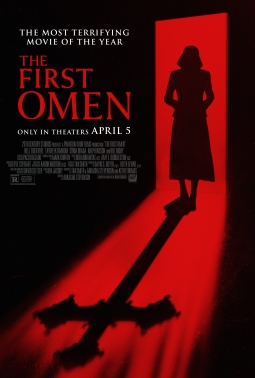
I got my weekend horror fix by rewatching The First Omen, a 2024 prequel to the wildly successful Richard Donner film The Omen which, like The Exorcist, inspired a franchise of mediocre to terrible sequels. (Yes, I am aware that The Exorcist III possesses a vocal fan base, but that movie is the best of the lot and for me it rises only to mediocre.)

I ventured forth a little more than a year ago to catch The First Omen in theaters and gave the film a middling review here on my blog. So, why revisit something that hadn’t been all that inspiring the first time around? Sometimes the headspace I am in when I see a movie can cause me to come away with an impression that the movie did not earn or is unjust to the feature. The first time I watched The Godfatherit did not make that great of an impression on me. perhaps I was distracted, perhaps I didn’t quite allow the film in, or perhaps it was simply the wrong movie for my emotional state. However, when I rewatched it a few years later suddenly I ‘got it.’ The film is brilliant, and I adore it.

Did the same thing happen with the unloved The First Omen?

No.

The movie remains middling. A competently crafted piece of cinema that is not terrible but failed to reach the potential that had been possible with a stronger script and a bit more attention to the story it was attempting to integrate with.  The performances remain strong, and Ralph Ineson stepping into the role originated by Patrick Troughton is inspired casting. Ineson, while physically very different from Troughton pulls in the sense of the character so powerfully and so perfectly that it is wholly credible that this is the same man who tried, in vain, to warn Ambassador Thorne that his child was in fact the antichrist. Nell Tiger Free as Margaret, a young American woman on a voyage to become a nun and who is pulled into the conspiracy to birth the antichrist, is quite good in her role and none of the failures of the feature can be laid at her feet.

No, the script is the trouble.

In addition to not melding seamlessly with the film it is a prequel to, ignoring such things as that it was very clear that the child Damien, the future antichrist, did not have a human mother but had been birthed from a jackal, or ignoring that Father Brennan had been riddled with cancer, The First Omentried too hard to reset the franchise and set itself up for sequels that could never mesh with the established continuity.

Some years ago, there had been released a remake of the original The Omen, a film I have never been able to watch in its entirety. It is proof that casting and direction are essential elements and put a step wrong there and you’ve critically damaged your production. In my opinion the best course of action as a horror fan is to consider that there is only one Omen film, the first, and ignore the existence of all the rest.

Share

The New Television Has Been Ordered

Well, as I mentioned in a previous post my 8-year-old 4K TCL smart television has been developing faults that are annoying, faint vertical lines that were apparent in some scenes and invisible in others. This past weekend, after several attempts at resetting the set in hopes that would clear up the trouble failed, I bit the bullet and ordered a new set.

Where the old set was an LED, the new one an OLED LG B5 smart TV is a technology that had been outside of comfortable financial resources in 2018. It also has better response times well suited for my casual Xbox gaming of playing Call of Duty on the weekends and getting my butt kicked by teenagers with mutant reaction times.  I ensured that the set also had a setting to display films as films and not as some unnaturally clear, motion-smoothed soap opera.

Thanks to a discount through my employer, Kaiser Permanente, and a spring sale code from LG itself, I managed to knock nearly $200 off the already discounted price. I am not sure, but I may have paid less for this far more capable television than I did for the set that will soon be recycled.

The original shipping date had it arriving this Thursday, May 7th, but that wasn’t going to work for me as I would be at the day job. I rescheduled the delivery for next Thursday, which just happens to be my birthday and part of a long weekend I had planned for celebrating the fact that I will have officially reached Medicare age. So that is when I will take down the old set, set-up the new one, and the next day have a company come out and pick up the discarded television for e-waste disposal and recycling.

OLED has superior black levels and ‘infinite’ contrast, so I will have to decide among my 4K discs, which one will christen the new set.

Share

Q-Ships and the coming Gerrymander Wars

.

In the early days of the Great War, later to be known as World War I, there existed a distinct set of rules for conducting warfare by submarines against civilian shipping. After all civilian ships are not military combat vessels and it was considered a crime to sink civilians without warning. Undersea Boat, U-Boats, were, when attacking a civilian shop, expected to surface, announce that the ship was targeted to be sunk, and provide the crew and passengers time to abandon the ship in their lifeboats, and once that evolution had been completed, then the sub would sink the vessel. All very proper and civilized warfare.

England, an island nation, quickly discovered that losing tons of shipping weighed heavily on both their economy and their population. They took drastic action to save their crucial shipping, inventing the Q-ship. A Q-ship, converted from a standard commercial vessel, boasted deck guns that could be hidden from view. (And the reason the department of hidden and special gadgets is known as Q-branch.) Once an enemy U-boat surfaced and made its intention to attack known, the hidden guns would be deployed and the submarine sunk. Imperial Germany responded rationally and stopped providing civilian ships with any warning, sinking them on sight in unrestricted submarine warfare, pushing the United States of America to enter the war.

When the sequel war came about no nation attempted restricted submarine warfare, instead sinking enemy vessels of every type without warning or mercy – evidence that any standard or norm once abandoned is forever lost.

The Constitution of the United States requires that every decade the federal government performs a census and based upon that the congressional districts for the House of Representatives are drawn.

In 2003 after the Republicans gained full control of the government of Texas, they sought to replace the district maps that had been drawn following the 2000 census, breaking the norm of only redrawing the districts each decade. Democratic members of the Texas government even fled the state in an attempt to deny a quorum and prevent the redrawing of the lines but ultimately failed to kill the scheme. In 2006 the mid-decade redistricting got the seal of approval from the US Supreme court when they interpreted the constitution as requiring a redistricting every ten years but not forbidding it at other times. Further exacerbating the issues of congressional districts is a pair of Supreme Court decisions, 2019’s call that the issue of drawing lines for partisan purposes lies beyond the scope of Federal courts to address and this year’s call that the Voting Rights Act doesn’t require majority-minority districts throws open the season for unrestricted gerrymandering warfare. Districts drawn to advantage one political party that just happen as a side-effect disadvantage any particular racial group are now perfectly constitutional.

As with submarine warfare a civilized norm once abandoned is dead. With early votes in the primary already cast, Louisiana is seeking to redraw their districts to eliminate Democratic seats and states with Democratic trifectas are speaking of drawing lines that eliminate every Republican seat within their states.

I despise the current and proposed gerrymanders, but I am also a realist and understand that the current Republican party, headed by a vainglorious buffoon who hates above all things being held in the slightest manner accountable will never ever reach a consensus to ban the offensive practice of politicians picking their voters. The only hope that exists is for the GOP to lose their hold on the Federal government and for the Democrats, should they hold all three branches in 2029, be forced, and they will have to be forced because like the ring of power having the seats is powerfully seductive, to fix this with Federal laws.

Share

Remake Hell

.

I am not one of those movie watchers who decry the very concept of remaking a film. Quite the contrary, there are several films where the remake is the classic that we revere to this very day. 1941’s The Maltese Falcon was the third adaptation of the novel, while The Thing from 1982 is a wonderful and unique adaptation of the source material while leaving the original film version standing as its own version and a classic. This applies to foreign film remade into English language version as well with Christopher Nolan’s Insomnia crafting a better film than the 1997 Norwegian production. There are also films crying out for a new version, such as Starship Troopers, which while having its fans, so thoroughly inverts the themes and point of the novel as to be like an adaptation of 1984 that crafts Big Brother as the hero.

But, with all that said, there are certainly mountains of remakes that exist for no purpose and that terribly miss the mark, skill, and heights of the films that they imitate. The made for television version of Double Indemnity drops a crucial subplot and an entire act and spends its time with a lifeless cast that only serve to remind the audience why John Huston once proclaimed that he solves 90 percent of his problems by casting the film correctly.

Last night my sweetie-wife and I began watching the 2016 production of Ben-Hur on Amazon Prime. This, like the ’41 Maltese Falcon is the third adaptation of the 1880 novel by Lew Wallace, the first being a silent film from the ’20s and the well-known and massive production which made a star of Charlton Heston from 1959. We decided to watch this 2016 version because we are fans of the director, Timur Bekmambetov who directed the Russian fantasy/horror film Nightwatch. We have watched about half of this Ben-Hur and while we will complete the movie I can already announce that it is a terrible remake that missed the point of the story and presents the audience with visuals that are meant to excite but instead provoke, at least in me, laughter, such as oar-powered galleys judging by the bow-wake that are slicing through the seas at nearly twenty knots.

In the sprawling story of Ben-Hur: A Tale of the Christ Judah Ben-Hur and the Roman Messala are friends closer than brothers, torn apart when Messala, made the military commander of the local legion, demands the names of Jews agitating against Rome and Ben-Hur refuses. Messala, following an accident that nearly kills the Roman governor of Judea, condemns Ben-Hur to enslavement aboard a galley. By a circuitous sequence of events Ben-Hur returns years later burning with hatred and a thirst for revenge for the treatment of his family at the cruelty of Roman occupation and even the death of Messala was unable to lift the hate from his heart. However, witnessing Jesus’ crucifixion transforms Juda Ben-Hur, making him a believer in the Christ and turning him away from hatred and revenge.

This version’s Judah Ben-Hur begins as a pacifist making the presumed ending as a return to baseline rather than a transformation of a hate filled man into a devout Christian. The accident from the source is changed into an actual assassination attempt with Ben-Hur giving the would-be killer time to escape, changing an unjust political conviction into one that can only be judged as fair considering Ben-Hur’s guilt in not turning the man over. The entire revenge plot of the story, both in the novel and in the previous adaptation turns on the fact that Ben-Hur and his family were actually innocent, removing that element weakens the story beyond measure.

Beyond the changes to the plot, the 2016 movie only throws into sharp relief the genius of the 1959 film. Director William Wyler never showed the face or allowed the audience to hear the voice of Jesus, but instead as in every great horror film, left it to the audience’s imagination, showing the effectthis man had on others, how this face that we never see caused hardened Roman warriors to quell their spirit and to wordlessly lower their swords.

We, my sweetie-wife and I, will finish this movie but what I have seen already is more than enough evidence that it should have never been produced.

Share

Momentum, Inertia, and My Writing Style

.

Inertia in physics is the quality of an object to resist any change in motion or direction and that property is directly related to the object’s mass. High mass items require more force to start, stop, or change their motion. Momentum is the quality of a moving object and is determined by both the object’s mass and by the object’s velocity.  A low mass item moving at high speed may very well have more momentum than a much heavier object that is moving much much slower.

How do these concepts of physics apply to the esoteric and decidedly far less physical activity of my writing?

To me, projects, be they short stories or novels, seem to possess qualities very much like inertia and momentum. The idea, the character, the plot, and the themes of the piece can all exist in that void that I call my brain, but until I overcome the inertia at my keyboard, it does not move from the fog of imagination to the concrete existence of words, sentences, paragraphs in a document.

Once that inertia is overcome and the words flow out of my mind and onto the page, then the project acquires its own version of momentum. It doesn’t want to stop but it wants to continue moving forward, gathering speed as it hurtles towards its conclusion. This is both a blessing and a curse. A blessing in that once I have passed some ineffable point the project becomes self-sustaining and the probability of it crashing and burning before the tale is told shrinks with each passing word and page. A curse in two manners, 1) I cannot work on more than one project at a time. Even a little short story can overturn a novel in progress by stealing all the momentum for itself and 2) if anything seriously disrupts the process, like a derailed locomotive the project crashes and can be very very difficult to get back onto its track and moving again.

The latter is what I am dealing with at the moment. The week I spent out of commission while I dealt with a case of RSV, get your vaccinations I sincerely believe mine kept me out of the hospital, has killed all the momentum of the novel I was working on. Now, with so much more crafted about it you might think that it would be easier to get the thing moving again but reality seems to operate in the opposite. It feels harder to get the thing rolling down the track but I am determined to do so. I am determined that before 2026 is done I will have my Cascade mountain folk horror drafted.

Share

No False Flags

.

Even as people fled the scene of this year’s White House Correspondents’ Association’s dinner, others safely at their keyboards asserted with the confidence of fools that the shooting had been manufactured as a ‘false flag’ to either generate sympathy for a historically unpopular president or distract the people from other massive troubles dogging this administration.

The WHCA shoot was not a false flag.

The Butler assassination attempt was not a false flag.

The Golf Course ambush attempt was not a false flag.

The Las Vegas mass shooting was not a false flag.

The Unite the Right March and killing was not a false flag.

Sandy Fucking Hook was not a false flag.

False flag attacks do in fact occur, but it is nearly always a state attacking another state, such as Nazi Germany claiming Poland attacked them in September of 1939 and as in that example they are also nearly always so terribly transparent as to fool no one. America is a nation of violent people with easy access to weaponry. It should shock no one that our political leaders face the threat of violence so often.

I have decried and denounced political violence repeatedly here on my blog, from the very deadly and serious attacks on any president or corporate officer to the street level assaults of ‘punch a Nazi.’ Political violence is a beast that, like cancer grows on itself, and once loosed is difficult to excise. I am glad that the assassination attempts against the idiotic, narcissistic, petty, vengeful, and cruel person have failed.  Should a major blood vessel in that rotting matter he calls a brain burst like an ancient bicycle tire, and he dropped dead, you would not find one portion of grief in me, but should you confess a plot to murder him, I would turn you in without a moment’s hesitation.

Murderers and would-be murderers must face the law in a court that resolves their matters without fear or favor, and the political troubles must be solved politically and not from high-speed projectiles.

Share

Movie Review: Over Your Dead Body

.

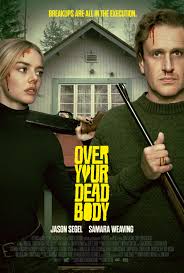
Last week I published a list of the summer movies I anticipated going out to the theaters to enjoy and here is my review of the first film on that list, the black comedy, Over Your Dead Body.

Independent Film Compan

Married couple Lisa (Samara Weaving) and Dan (Jason Segel) Burton have retreated to their isolated wooded cabin for the weekend, ignorant of the fact that each has plotted to murder the other as a solution to their marital troubles. Wholly inept as would-be killers their plans are exposed to one another but before either party can fulfill their rather simple and highly unlikely to succeed plots, the couple is confronted by a trio of strangers,  Pete (Timothy Olyphant), Allegra (Juliette Lewis), and Todd (Andre Eriksen), that present a far more credible, if not equally comedic, threat to them both, resulting in the film climaxing with over-the-top, farcical, Sam Raimi-like gore.


Over Your Dead Body, adapted from the Norwegian film, I Onde Dager, (Streaming on Netflix with the English language title The Trip) works as broad comedy with a strong sense of the absurd. All of the actors involved play their characters well, walking that fine line between believable, credible persons and exaggerated caricatures, never straying so far on either side as to damage the entirety of the story or the project. The director and the screenwriters, Jorma Taccone and Nick Kocher & Brian McElhaney respectively, played an expert level of set-up and payoff through the film, with several moments that are first presented seem minor color details later revealed to be clever and subtle foreshadowing.

Perhaps the most elegant and deft piece of screenwriting centers around the possibility of a sexual assault that threatens one of the characters. (It is not the character that you would expect that is threatened, providing an inversion of the trope, sliding away from the terrible titillation that often accompanies such sequences in lesser movies.) Once this element arose, I became seriously concerned about the rest of the film. It looked as if the writers had maneuvered themselves into a nasty, ugly little corner. If they took the scene to its conclusion the tone of the movie would irreparably rupture never to return to its comedic color and yet once begun it looked as if there was no way but to play the scene out as it threatened. Their solution displayed the genius of the scribes and saved the movie. I salute such brave and inventive writing.

The film’s final act escalated into cartoonish, wildly impossible, and, for my tastes, hilarious gory violence. I suspect for some it may be a bridge too far which shatters their suspension of disbelief but for those who had correctly calibrated their engagement and understand the movie’s attitude, it should play perfectly.

Over Your Dead Body is a movie that is best seen in a theater, with few distractions and preferably an engaged and laughing audience.

Share