Monthly Archives: November 2026

The Illustrative Example of Dave Chappelle

.

Comedians are often getting into metaphorical hot water as the nature of comedy, good comedy that is, is to push the boundaries of taste, hopefully exploring unspoken or unconsidered truths, while bringing laughter to their audiences. Of course, if you are flying your craft at the edge of the envelope, then occasionally you’ll end up on the bad side of the curve and lose control. Then it is a question whether you can recover or if you crash and burn.

I cannot say that I am overly familiar with the stand-up work of Dave Chappelle. I have caught a couple jokes and set ups back in the day when one surfed channels instead of websites, but never found his material so compelling as to stop my thumb from pressing the button and moving on. I know Chappelle’s work best as the on-screen sidekick to Tom Hanks in the rom-com You’ve Got Mail. Chappelle has a couple of times now broken out of the comedy section of popular media and into the political discourse having angered some faction and drawn their verbal fire for material that they considered “over the line”, most recently from the right for his observation that murdered conservative commentator Charlie Kirk’s afterlife is one in Hell. It has been reported that Chappelle said that since Charlie Kirk’s murder he has “feels better.” Well, no one is compelled to feel bad for any person’s murder. Charitable thoughts are not an obligation. If that is the sum total of Chappelle’s jab at Charlie Kirk, well, in my opinion that is unimaginative, pedestrian, and frankly hardly worth a moment’s consideration, but Charlie Kirk is a venerated martyr of the right, and any disparagement is met with fury and indignation. But that reaction is far from righteous.

Chappelle, however, is a perfect illustration of why any moral outrage from the right can be safely and utterly ignored as their sensitivities are attuned only to their own, with no consideration for anyone beyond their own tribe, and why their indignation is merely another tool, another weapon, in their arsenal to dominate and claim a victorious victimhood.

Just a few years ago Chappelle was once again drawing verbal fire for the insensitivity of his material. When that firestorm erupted around his work, conservatives defended the comedian, proclaiming that comedy must be allowed to be transgressive, to push the boundaries of good taste, and that those who complained with overly sensitive snowflakes unable to take a joke. At that time it was material that used the trans community as Chappelle’s punching bag, not conservative blowhards, and the political left found nothing funny in those routines. It is even reported that Charlie Kirk defended Chappelle’s trans-oriented humor, but of course such defenses cannot extend to humor when it is turned against conservatives. Insensitivities are only allowed when they are aimed at the proper targets.

The right’s defense of Chappelle’s routine had nothing to do with the transgressive nature of comedy and everything to do with seeing a community of which they did not approve of come under some sort of attack. Now that Chappelle is making jokes at the expense of one of theirs, suddenly taste and decorum are the law of the land.

This hypocrisy of the right is not confined to the stand-up’s stage but is playing out as we speak in the electoral fallout of the 2026 midterm elections. Amy Acton, the governor-elect of Ohio, has refused to take the concession call from the Republican she defeated in that contest, Vivek Ramaswamy, sending it directly to voicemail, an action that has drawn more “indignation” from the right for its “disrespectful” nature. But this is just another example from the seemingly endless list of Republican hypocrisies. In a last-minute and desperate act to try and save a campaign that was already failing, Ramaswamy seized on Acton’s mother, who was elderly and, by reports, living in her car, using this woman to cut an ad attacking Acton as a liar. Acton’s mother, according to documentation and reports from the time, fled with the man who sexually assaulted Acton when she was just twelve, choosing him over her daughter. In my opinion, Acton is rightly justified in refusing to speak with Ramaswamy and the Republican “outrage” is just the asymmetrical yardstick that they want to play by. They, the GOP, want to be as mean, as cruel as they wish, as untruthful as they wish, making vile lies about entire communities, while demanding that they be treated with a courtesy and respect that they show to no one but their own.

I do believe that it is pointless to confront conservatives with their hypocrisy. They do not care and will never acknowledge it or change their nature. Revealing their nature is useful only in affecting those who might be swayed by it, those people who are ignorant of the right’s tactics, and not in any manner those who engage in it.

Chappelle is a perfect example of this: he is their hero when he makes their “enemies” the butt of his jokes, and he is a devil when he turns that same fire on their own. Conservative “outrage” is not anything worthy of thought or consideration except as a weapon that they wield in pursuit of power.

Share

The Overtime Temptation Has Returned and a pair of Film Reviews

.

I suspect that posting will be spotty here for the rest of the year because the offer of overtime at the day job has begun, and with this season looking to be more intensive than previous years, I expect that there will continue to be a demand for overtime. The lure of all that extra cash is terribly hard to resist. So, let me try to knock out two film reviews in one post in case tomorrow I need to rise at 5:30 am for those extra hours and extra cash.

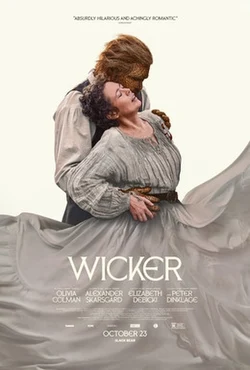
Wicker

Black Bear Pictures

With a script, adapted from a short story by Ursula Wills-Jones, writer/directors Alex Huston Fischer and Eleanor Wilson bring to life a fable of a lonely, outcast woman who has a husband crafted for her out of wicker and the disruption that brings to an isolated little village.

Because both the short story and film present this story in the style of a fable, it is not one that should be approached with a mind to rigorously examine the “world building” of this fantasy setting. This is not a J.R.R. Tolkien second world fantasy with a deep lore and expansive languages; it is a “once upon a time” fairytale meant to comment on our world by way of a wholly imagined and unreal setting. None of these characters even have names, only titles, and the women, save for the protagonist, the Fisherwoman, are all titled either as X’s Daughter, or X’s Wife, making it very, very plain upon which aspect of reality this fable is examining.

Olivia Colman, as the protagonist, the Fisherwoman, is characteristically wonderful, bringing to the screen with talent the years of abuse that she has endured at the hands of the small-minded village. Alexander Skarsgård, once again not playing something human but with deep humanity, matches her beat for beat as the Wicker Husband. Peter Dinklage and Elizabeth Debicki round out the core cast.

Wicker is a small film, not a several-hundred-million-dollar blockbuster, but it is entertaining, darkly funny, sharp in its voice, and profound in what it has to offer in commentary. It is well worth seeing.

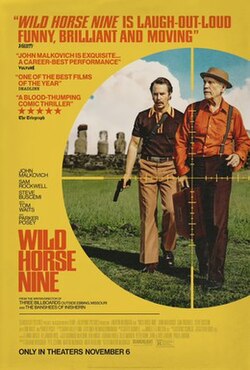
Wild Horse Nine

Searchlight Pictures

This dark comedy from Martin McDonagh is a period piece centered on a pair of CIA agents, Chris (John Malkovich) and Lee (Sam Rockwell), who take a week away from orchestrating the coup to overthrow the democratically elected Marxist government of Chile for a holiday on Easter Island. Lee has been ordered to keep a close eye on Chris who, as he struggles with a terminal illness, has both become erratic, prone to spilling secrets that the Agency prefers be kept secret, and is writing a memoir of his life, yet another threat to the Agency’s security. Lee, in addition to watching his friend slip away, also has to deal by telephone with his disintegrating marriage with Marge (Parker Posey).

Wild Horse Nine is not so much about the secrets the government keeps or the conspiracies the script uses to illustrate them, as much as it is about truth and the most important truths of all, the ones we keep with our loved ones. When a liberal Chilean college student advises Chris to stop telling lies, he does, discovering a freedom and a revelation that had eluded him.

If you have seen other Martin McDonagh films, particularly In Bruges, then you will have a very close idea of the tone of Wild Horse Nine. While there is violence and blood on the screen of the film, it is not about the violence we do with guns and bombs. It is about the violence we do when we slaughter the truth. This has been described as a “hangout” movie; it is not so much about the plot as it is about spending time with Lee and Chris and thinking about the questions these two men, who have done monstrous things, raise about what it means to be alive.

Share

Not a Wave, a Rout

.

Pundit Bill Kristol, writing for The Bulwark this morning, argued that the tired and overused metaphor of a ‘wave’ is misleading as it conjures an image of a natural force beyond the control or even influence of mere men and that the election result last night and continuing as the count does today and beyond is the work of people, of humanity. He is right on target with that observation, but it is still good to have an image that captures not only the scope and scale of last night’s results but the feeling of it as well, and I think the most on target metaphor is a rout. What happened last night was more akin to Agincourt or the First Battle of Bull Run than an ocean wave washing away a beach.

As I write this the morning of November 4th, 2026, the Democratic Party has been projected to have won control of 54 seats in the Senate with two elections too close for a victor to be decided, Alaska and Mississippi, so it is possible that the final number may be as high as 56. In the House of Representatives, the Democratic Party is currently holding a majority of 228 with a number of contests yet to be called. The midterm elections of 2026 have been a devastating defeat for the Republican Party, losing some contests that it have not lost since the election of FDR. There are a lot of lessons to be learned by both parties, and I pray that they do learn them.

For the GOP, they must come to terms with the consequences of handing power to a vainglorious buffoon for whom lying comes as often as a breath and for whom theft and betrayal are not character flaws but the defining attributes of his character. They should, if there is any justice in this universe, spend a decade or more in the wilderness. Individuals who have benefited from the corruption and the theft and the betrayal of the public trust need to be held accountable, and the politicians who chose the easy path, the one that kept their heads down and let the monsters do what they did to save their own political lives need to leave public life.

In addition to individual cases of corruption and malfeasance, the Republican Party itself needs to reorient to the future and build something new and earn the trust of the people and the world that it so recklessly squandered. There has been talk of returning to the sane GOP that existed before Trump seized control of the party. Such talk is the wishes of children who are in denial about the nature of reality. Nothing ever goes back to a previous state; time and entropy flow in only one direction. The party of Reagan’s conservatism is as much a matter of history as the Rockefeller Republicans before it or the interwar Isolationists before them. It is time to define what ‘conservative’ means for the 21st century and not try a doomed retreat to what it meant in the previous one.

The Democratic Party needs to recognize that this election is a repudiation of the Republicans and not an embrace of the Democrats. A two-party system can lead one to interpret victories as love for one’s own when that can just as easily be hatred of the opposing party. The victories in Texas and Kansas can be as easily squandered as the Republicans squandered their national victories. The Democratic Party needs to learn how to appeal to voters who are not onboard with the entire national platform and to find a way to do so with without betraying their base or their principles. There is a tremendous opportunity here for the Democratic Party, but only an opportunity, not anything assured.

I am thrilled and overjoyed by the results of this election season. A parade of cabinet-level impeachments would make my 2027 and 2028, but only time will tell what the true outcome of last night will hold. Last night was not a force of nature, a storm front that moved across the nation, or a miracle delivered by some supernatural entity, it was the result of tireless work and literally millions of people making clear their choices. This victory is thiers.

Share

The Curse and Blessing of Imagination

.

On the first day of this month a Learjet 60 crossing Florida on its way to the Bahamas suffered a catastrophic loss of control and plunged in a matter of seconds from over thirty thousand feet directly into the ground, killing all nine people aboard. By the most amazing turn of luck, despite the crash taking place in the city of West Palm Beach, Florida, and on its streets during the day, apparently no one on the ground was killed in the accident. The horrific event was, in part, captured on video from a driver’s dashboard camera with one frame showing a heavily motion-blurred image of the doomed aircraft nose down just above the street where it crashed. That image, the barely discernible outline of the sleek jet frozen in its final moment before impact, haunts my mind.

The seven passengers and two crew of the aircraft occupy my thoughts and my imagination. It is all too easy, so easy in fact that the process spontaneously occurs, for me to envision the terror that they suffered in their final moments alive. The fright as the jet encountered thunderstorm-generated turbulence, the screams as it not just fell but dove from high above Florida, the g-forces that pushed and pulled on them, all this comes easily to my mind and fills my heart with deep, deep sorrow.

There are people, vile, petty, and heartless, who have already seized on the gender of the crew, using this tragedy for their small-minded political purposes. I pity these poor, damaged specimens of humanity that appear to lack the basic empathy to have any consideration for others or anything beyond their own narrow objectives.

I do not know, nor do I pretend to know, what caused this terrible event. That is for the experts to determine, and that process is not a quick or easy endeavor. What I know is how I feel about the people, the family aboard, their friends traveling with them to a sunny beach, the nanny working her job, and the absolute and all-consuming fear that defined the end of their lives. I feel this because my mind, my riotous imagination, refuses to let the pictures of what may have transpired in their doomed cabin leave my thoughts. This happens very often with these very public tragedies and the too-frequent scenes of mass murder that take place in our deeply damaged nation. It is these visualizations that can disrupt my sleep, bringing about sorrow and depression.

But it is not without its blessing.

The same unrequested talent that envisions what it may be like to be caught up in such terrible events is the same process that brings to me characters, settings, and concepts that I explore in fiction. The pain I feel when I think about what reality has visited upon real persons I can transfer to the people who only exist in my mind. When I write about characters in danger of losing their lives, this empathy and ability to put myself so completely in another’s point of view becomes an asset and not just something to endure. This empathic viewpoint extends far beyond just fear and pain: it allows me to walk in the shoes of a woman in love with her man, of a gay man seeing the joy in discovering another who reflects his attraction, and to feel the thrill of skydiving, though that is a hobby I am far from engaging in. The benefits extend far beyond the artistic: when issues of political policy come to the fore, it is far easier to imagine what something might do to lives that are not my own.

I would not trade away that imagination that allows me to create whole worlds and peoples for the poor peace of being soulless and unfeeling in the face of tragedies. Nothing good comes for free, and the price of the best and worst things in life is very rarely in cash; it is in what they do to you as a person.

I desperately hope that something can be learned from this terrible crash in Florida that makes the world a little safer for flight, and I will continue to bear the emotional weight of this cursed and blessed mind.

Share

November is Upon Us

.

November, and in particular this November, is a strange time of change and transition. Spooky season has passed, and for most people the fascination with all things horror has passed as well, leaving the macabre, the grotesque, the gruesome, and the frightening to us true believers. The annual changing of the clocks returns, this time turning the hands back one hour so that the night follows the end of work so much more closely that many of us return to our homes in darkness. How much more fitting for those of who keep the spirit of spooky season year-round.
In the United States this is the end of our prolonged and endurance-testing election season, which more and more is not a season but a nearly endless state of affairs. For our English cousins it is a time of bonfires and fireworks as they celebrate an unsuccessful coup so many centuries past.
For writers, November used to be the time of community, when scribblers of all sorts of talent and competence entered into the contest to compose a novel of at least 50,000 words by the 30th of the month, but sadly controversy has ended that community and no collective has yet replaced it. I tried once, many years ago, to participate, but that grueling pace was one I could not sustain.
For me personally, November is a time when the workload at my day job begins to expand exponentially. My division deals with members enrolling onto our Medicare Advantage plan. During most of the year the work is steady and sometimes even quite slow, but each year the enrollments for the following calendar year begin to arrive in a tsunami of work. Overtime becomes available and often right on through first month of the new year there is lots and lots of work to be had. I make quite a bit of cash, but it is taxing, and November is the start of that marathon.
This is also the month when I revisit the Estonian folk horror film, Rainer Sarnet’s November, a dazzling and hypnotic black-and-white work of art that is more vibes than plot, more atmosphere than story, and endlessly fascinating.
The days are growing shorter, the nights are growing longer, the air cools, and in this time that so many find bleak I find a renewed vitality: welcome, November.

Share