.
I suspect that posting will be spotty here for the rest of the year because the offer of overtime at the day job has begun, and with this season looking to be more intensive than previous years, I expect that there will continue to be a demand for overtime. The lure of all that extra cash is terribly hard to resist. So, let me try to knock out two film reviews in one post in case tomorrow I need to rise at 5:30 am for those extra hours and extra cash.
Wicker
Black Bear Pictures
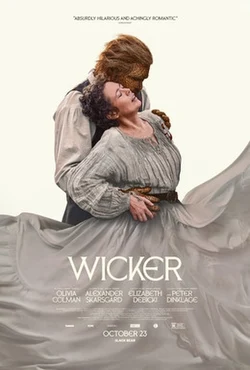
With a script, adapted from a short story by Ursula Wills-Jones, writer/directors Alex Huston Fischer and Eleanor Wilson bring to life a fable of a lonely, outcast woman who has a husband crafted for her out of wicker and the disruption that brings to an isolated little village.
Because both the short story and film present this story in the style of a fable, it is not one that should be approached with a mind to rigorously examine the “world building” of this fantasy setting. This is not a J.R.R. Tolkien second world fantasy with a deep lore and expansive languages; it is a “once upon a time” fairytale meant to comment on our world by way of a wholly imagined and unreal setting. None of these characters even have names, only titles, and the women, save for the protagonist, the Fisherwoman, are all titled either as X’s Daughter, or X’s Wife, making it very, very plain upon which aspect of reality this fable is examining.
Olivia Colman, as the protagonist, the Fisherwoman, is characteristically wonderful, bringing to the screen with talent the years of abuse that she has endured at the hands of the small-minded village. Alexander Skarsgård, once again not playing something human but with deep humanity, matches her beat for beat as the Wicker Husband. Peter Dinklage and Elizabeth Debicki round out the core cast.
Wicker is a small film, not a several-hundred-million-dollar blockbuster, but it is entertaining, darkly funny, sharp in its voice, and profound in what it has to offer in commentary. It is well worth seeing.
Wild Horse Nine
Searchlight Pictures
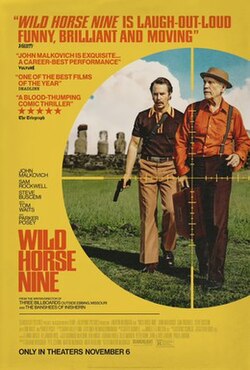
This dark comedy from Martin McDonagh is a period piece centered on a pair of CIA agents, Chris (John Malkovich) and Lee (Sam Rockwell), who take a week away from orchestrating the coup to overthrow the democratically elected Marxist government of Chile for a holiday on Easter Island. Lee has been ordered to keep a close eye on Chris who, as he struggles with a terminal illness, has both become erratic, prone to spilling secrets that the Agency prefers be kept secret, and is writing a memoir of his life, yet another threat to the Agency’s security. Lee, in addition to watching his friend slip away, also has to deal by telephone with his disintegrating marriage with Marge (Parker Posey).
Wild Horse Nine is not so much about the secrets the government keeps or the conspiracies the script uses to illustrate them, as much as it is about truth and the most important truths of all, the ones we keep with our loved ones. When a liberal Chilean college student advises Chris to stop telling lies, he does, discovering a freedom and a revelation that had eluded him.
If you have seen other Martin McDonagh films, particularly In Bruges, then you will have a very close idea of the tone of Wild Horse Nine. While there is violence and blood on the screen of the film, it is not about the violence we do with guns and bombs. It is about the violence we do when we slaughter the truth. This has been described as a “hangout” movie; it is not so much about the plot as it is about spending time with Lee and Chris and thinking about the questions these two men, who have done monstrous things, raise about what it means to be alive.
