Category Archives: Culture

Minneapolis Proclaims: Don’t Tread on Us

.

It has been heartbreaking and inspiring to watch and hear the events unfolding in the city of Minneapolis. Heartbreaking that our government flooded the streets with masked, unidentified thugs in unmarked vehicles acting with at best reckless abandon and quite arguably murderous intent against that community. Inspiring that the people of Minneapolis came together in profound unity, organizing networks to protect, assist, and safeguard their fellow community members with everything from people who stood watch in the freezing winter temperatures to those standing outside the center where the thuggish government released people into the snow and ice without cold weather gear, without their possessions, making sure each and every one was safe. That, to me, is the spirit of America, the Spirit of 1776, not the arrogant parading about with long guns trying to intimidate your fellow citizens.

It would seem that the architects of this pogrom failed to see that this sort of reaction might occur. They had no real plan to deal with a community that not only refused to assist them but actively and with deep and wide coordination opposed them. Why? Why were they so blind to this possibility?

I think it is because the people behind this heinous operation, the attempted occupation of an American city are at heart, racists.

Most people have a very difficult time getting out of their heads to see the world from another’s point of view.  People tend to think that everyone thinks and feels the way that they do, that they see the world through the same lens. In fact, they are ignorant of their own lens and assume that they objectively see reality and not an interpretation that has been filtered by their own history and biases. One of the more challenging aspects of fiction writing, and one not every author published or not achieves, is successfully climbing into that point of view that is alien to your own. It is a difficult task at the best of times, requires not only effort but sustained practice, and with a charged subject such as religion or politics it can be nearly impossible. Overlaid with the disease of racism, it becomes unthinkable.

The thought that people, particularly white people, might come together for their neighbors when their neighbors had darker skin and spoke accented English or foreign languages, risking their own liberties and lives is utterly alien to the racist. They wouldn’t get in the way; They wouldn’t risk anything of theirs for someone who wasn’t like them. As such they were blind to people who see community as something that transcends color and language.

It is not over. Not in Minneapolis, not for America, but Minneapolis shows us the way, Minneapolis gives us hope and now we must find our courage as they found theirs.


Share

Art Is Choices Not Prompts

.

With generative A.I. getting more and more capable in nearly all areas but particularly in creating video imagery there have been a number of voices, not industry voices mind you, proclaiming the death of Hollywood with some short video piece that they crafted.

The videos are impressive for what they are, a machine mimicking the data that has been fed into it, but there is so much more to a film, a novel, a painting or any other art than how it appears in its final form. Art is about the choices the artist made along the path of creation and not just the final product that was created.

Some artists are very intellectual, plotting out every detail of their art, knowing with deliberate decision why everything is the way it is, why that color was employed and not some other hue, why the character has that particular name. Other artists work more from hunches and intuition, making decisions on the fly, exploring the piece as they create it. Why that color? It just seemed right. Both types, and every type in between, are making choices, and those choices in aggregate create what is the style and voice of the artist. It is the sum of the choices that let us look at a movie and tell the difference from one directed by James Cameron and one directed by Steven Spielberg, why a song by Taylor Swift doesn’t sound like one from Danny Elfman, why a novel from Kazuo Ishiguro hits different than one from Gail Carriger.

That voice that is generated by the thousands and thousands of choices made by the artist is a product of the artist, the events of their lives, and the way they see and interpret the world around them. It is why only they could have produced that one piece of art, because it is a reflection of everything that they are, had been, and how they are interacting with the world at that exact moment of creation.

Generative A.I. does not make choices, it uses probability on what the next word, or pixel is going to be, probability that is derived from the blending of all the similar data that it has been fed. Mind you, that is still a vast powerful tool. An A.I. powered grammar review will nearly all the time catch when you have typed “tub” when you meant “tube” making it a powerful assist in catching those nasty little errors, but it has no voice. Generative A.I. has no opinions on the world, it has never suffered heartbreak of love not returned nor the heights of joyous love that is returned. It’s an impressive parrot regurgitating with stunning ability what it has been fed, but by that very nature what it creates is bland, without the strong point of view that makes art last.

Share

Life, Uninterrupted

.

Not a lot going on at the moment in my life, just the usual day to day action, reactions, and observations that is the slow steady passing of time from today to tomorrow. Certainly, there is a tremendous amount going on in the world but I am far from inclined to write even short posts about the terrible state of the United States. Those inclined to see it my way already do and those who are not so inclined are for all effective purposes immune to any arguments I might make. This is the reason why I am so terrible at Twitter. I see a stupid post from some random person I scroll right on by.  There’s nothing to gain from arguing with strangers on the internet. When I do respond to a post it is nearly always because I personally know that person. Even then I merely note and move on from most of their posts without interaction.

I have started a new novel but it’s very vague at this time and I am just sort of feeling my way through the opening chapters to see if I can uncover the voice for this book before committing myself to its creation.

My Sweetie-Wife and I watched Predators: Badlands a film I suspect will slip quietly and quickly from my memory. It is not bad; it is very competently crafted but I never crossed the gulf of empathy between myself and the characters. Taking us into the Yautja culture robbed them of most of their power as a force and the character came off as pretty one-note.

In anticipation of the next season, I have begun a  rewatch of Dune: Prophecy  the HBO series about the founding of the Bene Gesserit, and it’s just as wonderful on the second watch as it was on the first and like The Godfather, a rewatching actually helps me with the tangled and dense plotting.

Last night I watched the trailer for the Netflix series How to get to Heaven from Belfast and had the most enjoyable reaction to a trailer that I have experienced in a very long time. This quickly shot up the list for something for us to watch in our household.

You know when the manufacturer suggests a part should be replaced annually, that’s something to listen to, I was shaving Monday morning and felt a strange sensation against my cheek and something pinged off the countertop. A part of the electric shaver head had abandoned its post and one of the two metal foils that cover the cutting surface had sprung up. I wasn’t cut in any way and a replaced head showed up quickly via Amazon. My order history showed that it had been two years to the month since I had replaced the head that should be replaced annually.

And that, my friends is my life, mostly dull, somewhat creative, and at least a little entertaining.

Share

Helen of Troy Wasn’t Real

.

Later this year we’ll get Christopher Nolan’s next epic and chronologically scrambled film, his adaptation of The Odyssey. I’m a fan of Nolan’s work, in general, Interstellar mistakes cynicism for wisdom — a fault that often appears when he works with his brother Jonathan — so I expect to put my butt in the theater when this is released.

Rumors have slipped out and I do not believe that they have been verified that Nolan has cast actor Lupita Nyong’o as Helen of Troy, the mythical reason for the war and destruction of Troy. As Ms. Nyong’o is far from the Aryan ideal of feminine beauty, the usual quarters of the internet have released their hateful monkeys, pretending to be aghast at this ‘historical inaccuracy.’

Daniel Benavides – Creative Commons License

First off, Helen of Troy is a fictional character.  There is no ‘historical accuracy’ in any casting of her. She probably doesn’t look like how Homer or anyone of his time would have pictured the subject of the epics, but that hardly matters. Beauty and what is considered beautiful is such a slippery concept, shifting so quickly from culture to culture and, hell, from year to year within the same culture. No, the intense ‘debate’ has little to do with history and much more to do with weak and scared people needing something, particularly culture, to reassure them that they are the best in the universe and that their pale skin is evidence of that fact. ( I am pretty damned pale myself, but all that really means is that I consider the sun an evil force.)

This is not the first time we have been subjected to this vile nastiness cosplaying as ‘accuracy.’

When Marvel released Thor in 2011, there were the same cries and thumping of sunken chests over the casting of Idris Elba as Heimdall. Again, we were assaulted with the argument it wasn’t ‘accurate’ as though Heimdall existed in reality and not simply the product of mead-induced story-telling.

1989’s Batman saw the same thing erupt, though with far less notoriety due to that being the pre-internet age, with the casting of Billy Dee Williams as Harvey Dent. Again, a fictional character though this time one with a history of being depicted visually.

Lupita Nyong’o is not only a fantastically attractive person, she is a highly skilled and proficient actor, someone who has mastered her craft. If she is playing Helen of Troy, I will be perfectly fine with that and will find it far, far easier to suspend my disbelief than when I was assailed with Denise Richards as a nuclear physicist.

Share

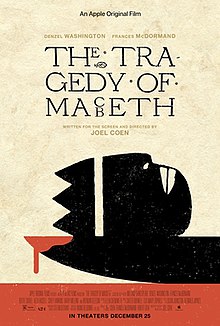
When Adaptations Neuter the Witches of Macbeth

.

I have been thinking about Macbeth lately and even revisited a partial screenplay where I adapted the play into a modern setting, preserving the text and playing with new meanings for old words.

One aspect of the play that is quite often cut down when adapted to the screen—either silver or electronic—is the scene where the witches are shown on the heath.

Apple TV

Now, the witches aren’t given much in the way of character, not even names, but they are given history and motivations that vanish when the scene is cut down.

When they “meet again” upon the heath, they bring each other up to date on what they have been doing in each other’s absence.

One has been slaughtering pigs, robbing some farm of food, or income, or both. For a farm, to lose a swineherd can be fatally disastrous.

Another witch recounts being denied chestnuts, and the trio conspire to ensure that the woman who denied the witch the desired nut suffers as his ship is blown about on the seas, lost and wrecked.

These witches are engaged in evil. They are cruel, malicious beings that delight in the terror and disaster they create for poor, pitiful humans. These are the beings that waylay Macbeth on the heath and fill his mind with prophecy of kingship.

When these aspects are removed from the adaptation, the weird sisters become nothing more than gumball prophecy machines, devoid of agency or intent. We are never left to question: Why? Why did they stop Macbeth? Why give him that foreknowledge of his future?

I think this is an artifact of our modern age. We are perfectly willing to let the witches come in and tell the character the future, but we want the tragedy to be that his ambition is his downfall, not the possibility that the tragedy is that Macbeth is trapped by fates beyond his understanding or control.

Share

Does Elon’s Vision Lead to a Dystopia?

.

I’m going to interrogate four objectives I have seen either mentioned more than once from Elon Musk or indicated by his action as desirable outcomes for America’s future and ponder what sort of future do they together create. Now, this is not either a praising of Musk and his action nor is it a condemnation of this. That is a large and volatile subject in a landscape filled with landmines of unquestioned admiration and devotion and an equal number of outright hatred that is ill-suited for this exploration. This is not about Elon the man but simply these four concepts and what they might produce if fully implemented. So, I am not interested at this time in either how great the man is for his advances in space exploration nor how terrible he is for his personal beliefs and political powers.

  1. Natalism: Musk has and continues to expound on the idea that the falling birthrate in the USA is an existential crisis, one that should not be ‘corrected’ by immigration but by more people having larger families.
  2. No Welfare State: His action as the head of ‘DOGE’ as well as his continuing comments and support for those restricting the size and scope of government make it clear that he envisions a government that acts very little in the way of spending money on social support for people either domestically or abroad.
  3. A Market and Economy with very little government action or oversight: He also clearly believes that companies and the people that run them know best for economic growth, with little to no regulation from the government both in terms of what companies can do and the accumulation of wealth by individuals.
  4. Robotics and Artificial Intelligence: Musk is firm in his belief that artificial intelligence, A.I., will soon create machine minds that exceed human capabilities in logic and creative problem solving leading to exponential growth in knowledge and capability. He is equally convinced that humanoid and non-humanoid robots will soon be cheap and plentiful freeing humanity from menial labors.

Looking at these 4 ideas and advancements, what sort of science-fiction world-building can we engage in. The world I see is not a very pleasant one save for the very rich.

There is a large and growing population as families expand in an economy where labor has been displaced by robots. Without something like a Universal Basic Income, which by many is seen as merely stealing from the rich to give to the poor, these families are left with little to no economic chances for growth, trapped in poverty. They will live in poverty and in a likely ecological ruin, a weak and emasculated government will not have the power to prevent corporations, ever seeking to expand, from polluting and spoiling the environment.

There will be little chance for peaceful change to the system as unlimited accumulation of wealth by the few creates unlimited political power by the few. Those with wealth and power will be the ones with the ability to steer the course of public discourse and the direction of governmental powers, a feedback loop of self-reinforcing wealth and political power creation that excludes the growing, starving, and sick masses. This looks pretty dystopic to me. I am sure that there are those out there who will feel that this is nothing more than doomsaying and a thinly disguised hatred for Musk. They may point out that in 1890, 90 percent of Americans were engaged in agriculture and by the late 20th century it was a mere 2 percent, so the fears of robotic displaced labor is overblown. However, in 1890 one could, and many did, see that the factories of the day would be the engines that drove the economy of tomorrow. What is the equivalent of the ‘factories’ in that economy where AI and robots can do nearly any job that humans can? What is that sliver of capability that humanity possesses which robots do not that can be employed by masses of people for economic gain? An ‘I don’t know’ but it will be there is magical thinking and not world-building.

Share

Star Wars and the Protean Honor of Old, Scared Men

Now, Star Wars is not the finest example of world building in even cinematic fiction, much less fiction in general, the retconning that took place between Return of the Jedi and The Phantom Menaceamounts to vandalism of the lore but there are still elements that are intriguing to look at even with the massive alteration to the original trilogy’s history.

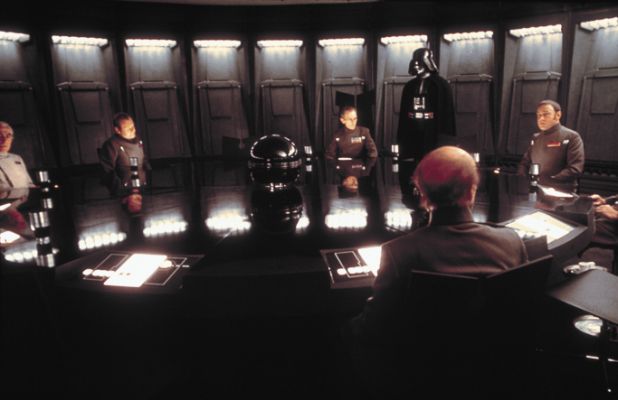
When the first film, Star Wars, takes place the Imperial system and the emperor himself have had their grubby little paws in power for less than 20 years. Luke Skywalker is in effect the age of the Empire itself. We could map this to real-world fascists with Italy, where the OG Fascists came to power in 1922 and were still there in 1942, albeit quite diminished in their geopolitical positioning. The German would not match that run their terrible regime, lasting only about a dozen years before imploding and taking millions of lives with it.

Lucasfilm/20th Century Fox

Let’s look at the Imperial Officers presented to us as characters in Star Wars. Peter Cushing as Grand Moff Tarkin is the old man of the group we see on the Death Star with the actor about 64 years of age, the rest of his command staff, is much younger but not young men. The other officers are in their 40s, 50s, with some matching Tarkin in their 60s, career men who dedicated themselves to military service — the military service of the Old Republic now enthusiastic and dedicated officers of the Galactic Empire willing to slaughter millions with the throw of a switch.

Undoubtedly it was the easier path when the emperor came to power to not buck the system, to not stand out from the crowd, to just ‘go along for now’ with the new government, the new administration, after all this won’t last forever. The oaths to the Old Republic conveniently forgotten in the harsh light of self-preservation.

Certainly, this observation has no relevance today.

Share

No Quick Solutions to America’s Gun Death Problem

No Quick Solutions to America’s Gun Death Problem

In the novel I am writing, taking place in 1984, that summer in reality witnessed the first of the modern era of mass shootings with the San Ysidro McDonald’s massacre. I have struggled to work out how this should play into a novel of supernatural threats, ghosts, and terrible dark gods beyond the stars. In the end I think I may just wrap up the story before that terrible day in August, though it means I won’t have an in-story salute to my girlfriend at the time who slapped someone for a tasteless joke as a callback during that weekend’s screening of The Rocky Horror Picture Show.

Since that day and since Columbine, the pace of mass shootings in this nation has accelerated so horrifically that now not only do we have frequent mass shooting events, they have become background noise in the media maelstrom, sometimes passing unnoticed.

The right will make actionless pleas for “thoughts and prayers,” decry the mental state of the individuals, and lately look for even the slimmest evidence that the murderer came from their political opponents’ camp.

The left will decry that the right will not let them make even the smallest move to control the sale and ownership of firearms, mock the thoughts and prayers even as some offer them sincerely and not in the same cynical move as the elected officials, and also engage in the “it was one of them” hunt now so popular.

In my opinion, both sides are wrong and deluded.

Part of the humor in the horror comedy from New Zealand, Black Sheep (2006), is that in that island nation there are more sheep than people. In the United States there are more guns than people. I think the current estimate is 1.2 firearms for every man, woman, and child, and of course they are not evenly distributed. The guns are out there, compliance with any new laws will be resisted and lax, meaning those guns will be there for any foreseeable future. Prohibition is a legal tactic that never eliminates the forbidden actions or possession. What prohibition does is license the state to use its monopoly on violence to selectively, and it is always selectively—ask any African American in America if the law is applied without favor or bias—as a punishment and message on the subject. If we were starting from a much lower ratio of guns to people, maybe perhaps the supply side could be effectively tempered, but that ship has long since sailed.

Anyway, the gun is not the trouble; the person using it is. Now, this sounds very much like the right’s argument that guns don’t kill people, people kill people, but that’s merely a verbal dodge to change the subject and preserve their beloved hobby. (And it is a hobby. I doubt any of the firearm militia enthusiasts would answer a call from Governor Gavin Newsom to put their bodies on the line for California, which is the duty of the militia in ensuring “the security of a free state.”)

The trouble with the person who easily moves to murder, or to suicide, which accounts for nearly half of all gun deaths, is the culture and society which produced that person.

Suicide and mass shootings I feel are psychological siblings, with most mass shootings acting as vicious, hateful forms of suicide. The psychological forces driving people to despair and or hate so deeply that murder and death become seemingly rational are powerful sociological storms which we cannot change overnight.

The way I see it, two major factors are at play: a sense that the future is hopeless. When someone, particularly young men, sees the future as futile, despair and depression find fertile ground to blossom. Despair and depression can turn inward, becoming entirely self-destructive, or they can turn to hatred, lashing out at perceived victims.

In previous generations, young men moving into productive adulthood could see paths that led to stable lives, good middle-class jobs and incomes, and a social structure that valued white men more than any other category. The destruction of labor unions, the shattering of the social connections between employer and employee, killed the middle-class dream. Economic growth concentrated more and more in classes that the young men perceived as the enemy. Social changes bringing about equality they perceived as “demotions” of their status. Is it any surprise that this turned into epidemics of suicide and murder?

Rebuilding unions, the engine that drove the economic miracle of midcentury America, requires that the conservatives abandon their current policies, and even if they did, the damage which took generations to incur would take generations to heal.

The other clear factor that separates America from the rest of the world on this issue is that when it comes to healthcare, America’s bootstrap system leaves far too many people wallowing in pain, both physical and emotional, without any hope of relief. More despair to transform into hate.

Again, conservatives, intent on transferring economic gains to the upper ends of the bell curve, have no incentive or taste for an expensive universal healthcare system.

With the current political parties and system, we are trapped, and for generations we will see more murder and more pointless deaths.

Share

Yesterday’s Murder

Yesterday, September 10th, a gunman shot and killed Charlie Kirk, a political activist known for inflammatory rhetoric, a disdain for empathy, and a verbally vicious manner. I will not bother to pretend that Charlie Kirk’s absence from American political life will cause me the slightest element of concern. He struck me as a petty, cruel man that monetized hate, and did little to nothing to actually make life better for people and actively made it worse for the targets of the hate from which he profited so generously.

I have sympathies for his children. It is never easy to lose a parent, and their tragedy is quite real. The majority of my sympathy is for the United States and the American people. Not because they are deprived of Charlie Kirk’s rancor and rabble rousing, as I have said I do not think in any manner that he was even within the same galaxy as the definition of a ‘good person,’ but the growing politically driven violence in our culture is a terrible infection that may have now grown beyond any quick and decisive treatment.

A few hours after the killing, writer Ezra KlEin posted a list of political violence this nation witnessed over the last few years with victims from both ends of the political spectrum. Political violence is an infection; in the absence of political antibiotics it grows and spreads eventually, if unchecked, becoming gangrenous.

I’m not going to spend time laying the blame to one faction or another. For the most part, persuasion has vanished from the political discourse and examples of hypocrisy or ill intent are only deployed now to burnish one’s own side or to soothe the feelings one might have because deep down they know theIR guilt lies there.

I do not mourn Charlie Kirk, but I do mourn our nation and what will be, I suspect, a long and painful road back to something like normalcy.

Share

Epstein, Trump, & the Conspiracist’s Trap

.

The first rule of being a conspiracist is that you were never wrong. No fact, no evidence, can ever be admitted to have undermined in any way the fantasy you have told. A conspiracy fantasy is forever treated as fact.

The second rule is that having the secret knowledge of the conspiracy makes you special. You are wiser than those naive yokels believing what the system and the man tell them. Your cynicism against the system is proof of your wisdom. This reinforces the first rule because you can never be the naive one, and as such, your adherence to the “truth” is further evidence of your intelligence.

The third rule is that you are always on the side of the angels. The system and the man are lying to everyone for their own terrible and evil purposes. The conspiracy fantasy “exposes” the truth that the powerful are hiding, and your fight to tell this “truth” makes you heroic. You aren’t an idiot who accepted a fantastic tale of space lizards invading the world—you are the archetypal hero freeing your fellow people from that space lizard tyranny.

These three rules have trapped Trump in a snare of his own devising, and one that he may find terribly difficult to escape.

It is an accepted legal fact that wealthy financier Epstein, with the assistance of at least one person, Maxwell, groomed and sexually abused young girls. It is a matter of record that when faced with legal repercussions, he first received suspiciously lenient treatment and, following that, died in prison before a more serious legal hammer fell upon him. It is also a historical fact that Trump and Epstein enjoyed each other’s company for a number of years, as did numerous other wealthy and politically powerful people. These facts are not conspiratorial fantasy but are its foundation.

The fantasy is that there is a vast and organized group of selected powerful people who engaged with Epstein in the sexual and ritual abuse of children. This cabal includes some of the world’s most influential people, who all happen to be opposed to the political posturing of the conspiracists. Epstein’s lenient treatment is taken as evidence of the shadowy cult’s power and not simply the sad fact of life that in modern America, the rich are never held to the same accountable standard as the rest of us.

Trump, and his surrogates, fed this conspiratorial fantasy to energize their base of voters against the Democrats. The more the base believed, the more energized they became, and the more likely that Trump and company would be swept into power. The fact that it is fantasy would be irrelevant.

Except the rules say otherwise.

The conspiracy cannot be untrue, and Trump supporters know this. It has to be true, and he and his squad of righteous people were going to expose all of it.

Only they didn’t.

They tried to sweep it under the rug. The released information fell far short of what they promised. They lied about it, and for the first time, Trump told them lies that they did not want to hear.

The conspiracists are on the side of the angels. They are defending and saving children by exposing the “truth,” and that is why this story will not die like so many other examples of Trump’s blatant corruption. For the base to accept that there is nothing there and move on to something else, they must accept that they were the naive fools and that they never were on the side of the angels. People don’t work that way—hence the trap.

Maybe Trump will still squirm out of it. Like Clinton before him, he’s proved an evolutionary marvel at escaping political pitfalls, but every story comes to an end, and maybe, just maybe, this is his.

Share