Author Archives: Bob Evans

Movie Review: Superman (2025)

.

Writer/Director James Gunn and cinematographer Henry Braham powerfully diverts from the grim, grounded, and gritty aesthetic of recent DC Comics superhero film gives the audience in Superman a colorful and gloriously goofy rendition of the iconic ‘Man of Steel.’ A trailer featuring the super canine ‘Krypto’ coming to a battered and beaten Superman sets the tone audiences should expect with this movie.

Eschewing re-harvesting the overly tilled fields of the character’s origin story or Marvel Studios’ course of building a cinematic universe element by element introduced in features focused on individual character Gunn drops the audience into a comic inspired universe already in progress and populated by ‘metahumans.’

DC Studios

What writers refer to as ‘the inciting incident’, Superman’s (David Corenswet) intercession into a war and losing in a battle against a new supervillain, happens before the film even starts the character crashing into the frame beaten and defeated. Gunn skips many of the familiar beats found in stories of these characters, hurling the audience into a film where Lois Lane (Rachel Brosnahan) is already aware of his dual identity, allowing the story to focus on their relationship instead of secret identity shenanigans.

This new DC Cinematic Universe is one where the heroes of the ‘Silver Age’ are already present and active. Gunn, rightly, in my opinion, understands that the audience, after 17 years of the MCU, is ready to accept a world of comic book characters without the need to establish and detail each and every origin. As such the Guy Gardner Green Lantern (Nathan Fillion), Hawkgirl (Isabela Merced) and Mr. Terrific (Edi Gathegi) simply fly into their scenes without the scrip stopping to explain them.

Quickly the plot develops as manipulated public opinion turns against Superman and the hero finds himself questioning his purpose on Earth and the challenges doing the right thing in a complex morally grey world. Lex Luthor (Nicholas Hoult) fueled by a fiery envy and hatred to destroy Superman is here presented in a composite of attributes that the character has exhibited in various media, he is scientifically and technologically brilliant, a billionaire businessman, politically influential, as well as having a predilection for land and its ownership.

There are a number of nods and references to 1978’s Superman The Movie, most notably even in the trailer is that the score by John Murphy and David Fleming is inspired and around the well-known theme written by the legendary John Williams. There are more subtle callbacks, in the background of one scene Perry White (Wendell Pierce) can be heard shouting ‘Don’t call me Chief!’ This Lex Luthor has a large number of people assisting his villainous plot including one referred named Otis a nice Easter egg but one that is expanded in the credits where his surname is revealed to be ‘Berg.’

There is a major change in the canon of the character, one on which a great deal of the plot revolves about that is sure to upset some fans. To avoid spoilers, I cannot reveal it here but when it unfolds people familiar with the history and lore of Superman will see it. Personally, I was fine with it, but others may not be.

James Gunn’s Superman is about as far as one can get in tone and style from Nolan’s Batman Begins, but both are crafted by talented director/writers who knew exactly the kind of film that they wanted to see on the screen. It was a fun frolic but one with heart and soul and a powerful theme that we are not tools of our parents designs but of our own.

Share

The Accidental Hero of Superman ’78– Otis

.

WB Studios

I was 17 years old and in my senior year of high school when Richard Donner’s Superman: The Movie hit the screens in the United States. Despite never being a deep fan of the comic books and possessing only a surface knowledge of the character, this was still a movie that I rode my bicycle a couple of miles to the local twin cinema to see. I can recall quite vividly pumping the pedals quite hard and fast with John Williams’ icon score replaying in my head as I went home from that screening. While not as campy as the Batman television series of 1966 and a far cry from the grounded, gritty DC superhero movies of the ‘Snyderverse’ to come in the next century, Superman: The Movie set a high bar for superhero films in general, and Christopher Reeve’s excellent portrayal as Clark Kent/Superman remains in the minds of many unmatched.

What is surprising is that after 47 years, the number of people who do not quite grasp that the plot of the film and its resolution rotates around the fumbling failure of one henchman.

Otis (Ned Beatty), while a seductively costumed and faux-injured Ms. Teschmacher (Valerie Perrine) distracts the Army’s security detail escorting a nuclear-armed ICBM, alters the missile’s targeting at the behest of his supervillain boss, Lex Luthor (Gene Hackman.) Later, Lex learns that Otis bungled his assignment inputting only three updated coordinates instead of the required four. When it comes to the second missile, this time being transported and guarded by the US Navy, it is Ms. Teschmacher whom Lex sends to corrupt the missile’s targeting, ensuring it hits his intended target: the San Andreas Fault line to create ‘New West Coast’ that he will own and control.

Lex Luthor’s plan is when both missiles are launched Superman, due the missiles divergent courses, will be able to intercept only one. But to ensure even that outcome does not come to pass, he chains lethal kryptonite to Superman and drops him in a pool to drown.

When Ms. Teschmacher learns that the other missile will detonate its nuclear warhead over her mother’s town of Hackensack, New Jersey, she betrays Lex Luthor and rescues Superman but only after he promises to save her mother first.

It seems an idiotic mistake for Lex Luthor to send his expendable nuclear warhead to the hometown of his expendable girlfriend but of course that was never Lex’s plan. That missile is the one whose targeting was charged by the bumbling Otis, who failed to input the coordinates correctly. Because it was not the warhead that would create the ‘New West Coast’ Lex never bothered to correct that mistake leading to the targeting of Hackensack and Ms. Teschmacher’s betrayal.

Without Otis’ ineptitude, Superman would have perished, and Lex Luthor’s plan would have succeeded. Otis is the accidental hero of Superman: The Movie.

Share

Schoedinger’s 5th Amendment

.

There’s been a bit of a celebratory mood on the right side of the political spectrum with the report that President Biden’s doctor pleaded the 5th Amendment against self-incrimination during recent congressional testimony. This is taken as evidence that supports the conservative accusations of Biden’s mental decline.

However, when Trump pled the 5th Amendment more than 400 times during his testimony, that is only evidence of prosecutorial misconduct and not any evidence of actual guilt or wrongdoing.

Here’s the truth: When a person pleads the 5th Amendment, it is a null result revealing and supporting nothing. There are plenty of reasons why someone’s lawyer would advise them to take the safer course even when they are not concealing any crimes of their doing. For many people, being investigated by the government is a financially ruinous event, and it’s best to avoid opening any avenues for someone, particularly political enemies, to start such an investigation.

When someone draws an instant conclusion from a person taking the 5th Amendment, that reveals much more about the preconceptions they hold than it does about the person testifying.

Share

Star Trek’s Canon

.

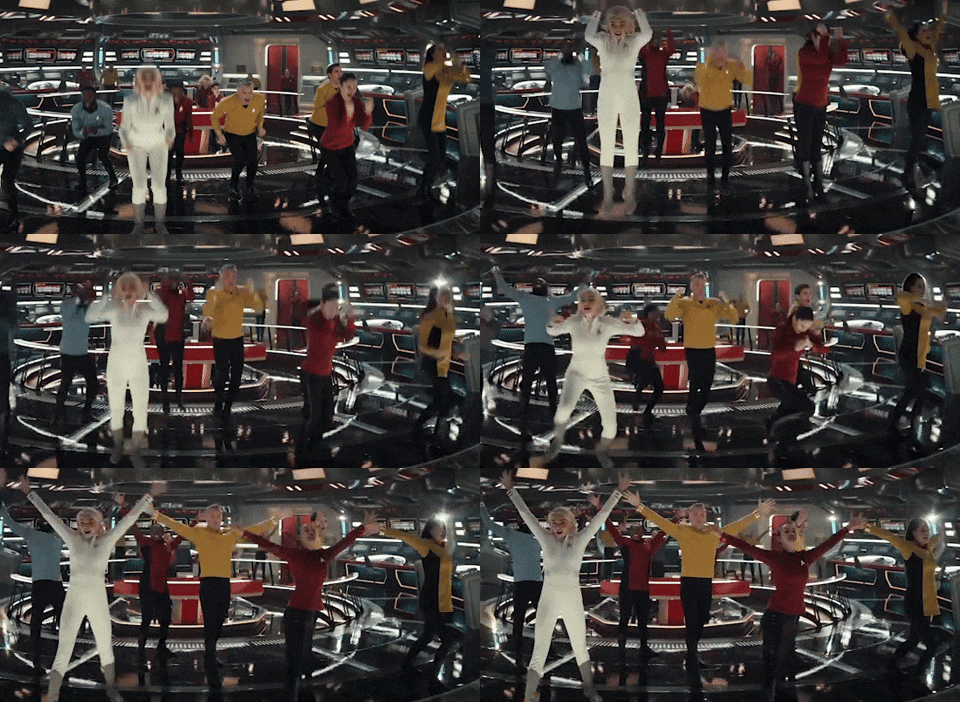
The other day I was engaged in a discussion, not an argument mind you, on Twitter concerning Star Trek: Strange New Worlds and its violation of Star Trek’s established canon.

I myself am not bothered by violation of ‘canon’ if the result are more interesting character, deep stories, and compelling plotlines.

Paramount Studios/CBS Home Video

It is interesting to remember that Star Trek was not designed to have a rigid history with a lore and a canon well-defined. The original series is a product of 1960’s television and, in that day and age, television worked quite differently than it does today at the end of the first quarter of the 21st century. A program was deemed successful if it ran for at least 5 seasons of 20 plus episodes. That produced enough episodes that the series could be ‘stripped,’ run on weekday afternoons in random order. Season five episodes might precede season one episodes so there were no continuing storylines, one episode rarely affected the events in another.

Star Trek, and here I am referring to the original run, the original cast feature films, presented a contradictory and inconsistent ‘canon’ for its future history. Here are some examples.

In The Conscience of the King when McCoy asks Spock to share a drink with him, Spock comments his father’s race was spared the dubious benefits of alcohol to which McCoy replied, “Now I know why you were conquered.”  Who conquered Vulcan? No one, this bit of history was discarded.

Pon Farr the mysterious and secretive collection of rituals and biological drives surrounding Vulcan reproduction. Which is it: the thing that ‘no outworlder may know, save for those few who have been involved’ or something Saavik can just casually explain to David Marcus? Additionally with this aspect of Vulcan biology is it something that Spock hoped he would be spared as he said in Amok Time or is it a predictable cycle of every seven years as mentioned in The Cloud Minders and again in Star Trek III: The Search for Spock?

In Space Seed it is established that in the late 20th century a cadre of scientists employing eugenics bred a number of humans with superior abilities creating dictators that sparked the Eugenics War. Eugenics is directed and controlled breeding in human to produce desired traits. In Star Trek II: The Wrath of Khan Chekov explains to his captain that Khan was the product of later 20th century ‘genetic engineering.’ Eugenics, which is breeding for traits, and genetic engineering, which is gene alteration for traits is not the same thing, however advances in science and the public’s understanding of science made the genetic engineering a much more likely scenario, so ‘canon’ changed to fit public perception.

Here’s a biggie. Is it Federation policy to leave planets and cultures to adhere to their own destinies without coercion or as in A Taste of Armageddon or do they have standing general orders for the genocide that any ship’s captain can employ?

My point with these examples is not to ridicule or mock the original series, which I adore, but to demonstrate that a rigid lore or canon has never been an essential element of Star Trek. Strange New Worlds does break accepted ‘canon’, but it does that to give us wonderfully complex and interesting characters and stories so in my book it’s a plus not a minus.

Share

Movie Review: Magic (1978)

.

For many people, the astounding acting skills of Anthony Hopkins exploded into their perceptions, despite decades of on-screen performances, with his Oscar-winning turn in 1991’s The Silence of the Lambs. That is not the case with me. I was wowed by his portrayal of William Bligh in 1984’s The Bounty, but I first experienced Hopkins in 1978’s Magic.

20th Century Fox

Adapted by legendary screenwriter William Goldman from his novel of the same title and directed by legendary actor and director Richard Attenborough, Magic is a psychological horror film centered on Corky Williams (Hopkins), a stage magician who utilizes a ventriloquist’s dummy, ‘Fats’ (also voiced by Hopkins), as part of his performance. When his agent Ben Greene (Burgess Meredith) informs Corky that a medical exam is required for his upcoming television network special, Corky flees the city for the isolated Catskills town of his childhood, reconnecting with his high school crush Peggy Ann Snow (Ann-Margret). But ‘Fats’ may have other ideas about what is best for Corky.

The trailers and commercials for Magic hinted at possible supernatural causes for the film’s horror, and Attenborough used a deft and light directorial touch to keep things off balance concerning ‘Fats.’ But this story and movie is essentially a horror of the human mind and how it betrays itself when faced with crushing psychological trauma and an inability to escape it.

With limited settings and cast, Magic is a film that could have been produced for television, but Goldman as writer, Attenborough as director, and cinematographer Victor Kemper use the limitation to create an atmosphere of dread and claustrophobia even in the open woods of the Catskills.

I was seventeen when I walked to the local twin theater to see Magic, and the film has stuck with me over the decades. Unnerving and powerful in its use of what would become known as ‘the uncanny valley,’ Magic is a prime example that horror is not always found in ghouls, ghosts, and vampires but sometimes within the tortured soul of the outcast.

Share

More Thoughts on Severancev

.

Apple TV +

In May I posted that I had begun watching the Apple+ series Severance. It’s about a group of workers for the vast and powerful Lumon corporation who toil under a condition called ‘severance’ where their work-selves, called ‘innies’, exist with no knowledge or memory of their lives outside of work, called ‘outies’, and their ‘outies’ have no memory or knowledge of anything that their ‘innies’ experience.

At the time I wrote that post, I had watched two episodes, and now I have watched the entirety of seasons one and two. I had commented that the series, while stimulating my intellectual curiosity, hadn’t really grabbed me emotionally. While my emotional investment has grown, it has never reached the levels that it has with other genre programs. I remember dreading the ending of Andor because some of my favorite characters are never mentioned in the film Rogue One: A Star Wars Story and therefore would likely end up dead by the end of Andor. Severance is fascinating and the characters have grown on me, but I think this division of their nature, central and essential to the show, is also creating a barrier to full engagement.

That said, I do not regret watching and have thoroughly enjoyed the ride that is Severance. The show’s creative team is also doing a bang-up job handling what is in essence a mystery show. The first season ended with a massive revelation for the viewers and the characters that created a cliffhanger, which I despise. I watched season two dreading what sort of cliffhanger they would craft for this ending.

And they did not.

Oh, they certainly did not wrap up all the various storylines and threads. There are a ton of things to propel the show into a third season, but there was also resolution to the reveal from the first season, some clear explanation of some of the strange and mysterious work that the corporation commissioned from the severed, along with expansion of the world and the characters. Instead of another stupid cliffhanger, they properly teased the next phase of the story without making it feel as if they were never going to resolve the issues already raised.

Well done.

Share

Halfway There

.

Friday, I passed 45 thousand words on my gay, cinephile, ’80s, horror novel set in the lovely city I call home, San Diego.

This has been and continues to be quite a different adventure in writing from what I have experienced with any of my previous novels. As I have mentioned in other posts, this one is being written without an outline, without a predetermined list of characters, with a terribly vague sense of how the five-act structure will work, and with only the concept of the darkest magic operating through old and dangerous nitrate motion picture film stock.

I am reaching sections of the novel where I must make definitive choices about some of the elements that have only been hinted at in the text as the characters’ investigation will begin uncovering some of the mysteries at work around them.

Because at heart this is actually a ghost story, with the ghost given ‘life’ by the old film stock, it is also essentially a mystery. Nearly all ghost stories are mysteries, often with some old and buried evil to be uncovered in order to clear the spirits’ torment and allow them to progress to whatever lies beyond life and death.

Ghost stories have always been my favorite genre of horror, and I cannot honestly say why. It is not because I was touched by death at an early age. Well before my father’s passing, I had books of ghost stories for children. One branded to Alfred Hitchcock and another of ‘Tar heel’ ghosts, Tar heel being the state nickname for North Carolina, the state of my childhood home. So, the fascination with ghosts has seemingly always been there, but I have written very few ghost stories. This untitled novel is the longest and most complex attempt at the sub-genre.

When it is completed, I will need a couple of sensitivity readers to make sure I have approached the lives of gay men in San Diego with respect and not stereotyping, but I feel I have made a good effort on that front.

Share

Twin Peaks: The Entire Shebang

A year ago, Mike Muncer, podcaster behind the excellent Evolution of Horror series launched a new show The Detective & The Log Lady, a Twin Peaks rewatch podcast. I decided to rewatch the series along with episodes of the podcast and my sweetie-wife came along for the ride as well.

This past Sunday we completed the voyage watching part 18 of the Twin Peaks‘ third season, also known as Twin Peaks: The Return which aired on the Showtime premium cable channel in 2017.

ABC Television

It has been quite a ride. I have not rewatched the original series in decades, watched the prequel film Fire Walk With Me only once in the theaters and retained very little of it, and did not even know of the existence of Twin Peaks: The Missing Pieces, a feature film length collection of deleted scenes from the prequel film. Watching it all week in, week out for a year, keeping the characters and story elements fresh in my mind as I experience the 27-year journey was an entertainment journey unlike anything I had experienced.

Twin Peaks when it aired in 1990 on ABC became a national and cultural phenomenon but the second season, adrift after the creators stepped back because the networked forced them to reveal the solution to mysteries they preferred not to, lost that grip on the nation’s imagination and the series ended on a cliffhanger that would not be resolved until 2017.

Freed from network constraints and interference the series’ third and final season presented almost nothing that the fan base demanded, instead diving deep into the abstract dream-logic that so defines the work of director and co-writer David Lynch. The entire series defies easy explanation or interpretation. Is it about the evil and corruption that lies just under the surface of American life? Is it about trans-dimension beings waging a war for humanity with entities such as ‘Bob’ and ‘The Fireman’? It is merely a strange dream held by television characters where some of them are actually aware of their nature as fictional constructs?

Arguments can be made for any and all of these premises, often with all of them playing a part in interpreting the program.

What is undeniable is that Twin Peaks had a massive impact on television going forward from the 1990s. Not only did programming become more experimental in their plots and conceptions but Lynch and co-creator Mark Frost showed that it was possible to bring feature film cinema quality to television, paving the way for today’s prestige TV.

I may not understand it all, but I admire it all just the same.

Share

I Really Like This Photo

.

This past Sunday there was no weekly trip to the Zoo because my sweetie-wife and I went to see 28 Years Later and there was no zoo expedition the previous Sunday because that was my weekend of migraine headaches. That’s not a recommended weekend, by the way.

However, we did go to the zoo on June 19th. My sweetie-wife has that federally recognized holiday off and I took the day off to share it with her.

The bird in this photo is a Western Bluebird and it is not an animal on exhibit at the San Diego Zoo but a wild creature that came into the enclosure with California Condors and the Common Raven. I really like the way the photo turned out. The subject is really nicely isolated from the background both by color and by the depth of field. None of the other picture I snapped that day are even close in how much I like them.

Western Bluebird

Share

A Plutonic Understanding of Some Transphobia

.

March of 1930 saw the announcement that astronomer Clyde Tombaugh discovered the ninth planet of our solar system, Pluto. Despite controversy at the time of discovery concerning the object’s apparently quite small size, for the next three generations, school children learned the names of the nine planets. In the 1990s, discovery of larger bodies in the Kuiper Belt added to doubts concerning the proper classification of Pluto, followed by the discovery of Eris, an even larger body in the outer reaches of our planetary system. In 2006, the International Astronomical Union (IAU) released three criteria for a body to be considered a planet: 1) It orbits the sun, 2) It possesses enough gravitational pull to be roughly spherical in shape, and 3) it must have cleared out its orbit of other large bodies. Following these new parameters, Pluto was moved from the classification of planet to dwarf planet, igniting public outrage that burns to this day.

While there is debate among the astronomers and other scientists over detailed points such as what exactly qualifies as having ‘cleared out’ its orbital volume, the most intense defenders of Pluto as a planet are laypeople without scientific expertise or training. I find this a curious phenomenon. Pluto’s status has zero impact on their lives, their day-to-day activities, or even outside of the fierce controversy, their conversations. With the body’s status so irrelevant to their lives, why do people demand its status so vigorously?

Because it’s what they learned as children. The ‘facts’ we learn when we are young are the most difficult to discard when new data or ideas come along to displace them. It doesn’t matter that classifying Pluto as a planet would mean adding a lot more planets to the roster. They do not want to do that; they want the nine planets that they learned in grade school. That’s it, that’s the entire argument and goal, to have what they were taught decades ago to be the same today as it was then.

For some, certainly not all, the debate surrounding transgender people operates on the exact same mechanism as the insistence that Pluto is a planet. They were taught that the world and people worked a certain way, a very simple model of humanity, and they find it impossible to discard the model impressed upon them in childhood. It doesn’t matter that the truth of the spectrum of human sexuality and identification is self-evident; they want the simple, but false, binary definition they understood when they were six. (For those who wish to deny the spectrum and insist on a binary understanding, that would mean you could not define the character of John Rambo as more masculine than the character of Peewee Herman. That judgment only exists if there is a spectrum of masculinity—in a binary system they would be equally masculine.)

This explains only some people’s transphobia and insistence on strictly binary understandings of gender. There are those who harbor more hateful and bigoted views. Their issue is simply being unable to unlearn what they have learned. Their views are more aligned with evil than ignorance.

I wish there were a simple and direct way to enlighten people to acceptance of others in all their dazzling diversity that life presents. We live only once. For a very brief time, we walk this Earth seeking love and happiness. To inflict pain and suffering upon others because they don’t live as you think they should is a terrible crime, robbing them of precious time that can never be recovered.

Share