Monthly Archives: October 2026

A Companion Disorder for ‘X’ Derangement Syndrome

Notes:

1) Current practice is that mental health issues are disorders, derangement is out dated terminology and its use is considered prejudicial.

2) A.I. was utilized to affix the format and style of the entry to conform it to the manner of a DSM entry.


DIAGNOSTIC AND STATISTICAL MANUAL OF MENTAL DISORDERS

SECTION III: PROPOSED CONDITIONS FOR FURTHER STUDY


300.99 (Q00.0) Partisan Oppositional Disorder

Diagnostic Criteria

  1. A persistent and clinically significant pattern of political behavior characterized by an irresistible compulsion to oppose, reject, or vote against any measure, candidate, or policy associated with an identified opposing political party (“The Rivals”), regardless of the proposal’s actual merit, underlying principles, or personal utility.
  2. The pattern of opposition is manifested by at least three (or more) of the following symptoms occurring consistently over at least one election cycle (or 6 months of active legislative sessions):
  3. Ideological Flip-Flopping: Sudden, unexplained reversal of a long-held ethical, fiscal, or personal belief immediately upon learning that the opposing party shares or has endorsed that belief.
  4. Policy Reflexivity: Immediate, reflex-like condemnation of a proposed bill or ordinance prior to reading or understanding its contents, driven solely by the party affiliation of the primary sponsor.
  5. Spite-Driven Balloting: Expressing high emotional satisfaction after voting for a candidate whose platform directly harms the individual’s own economic or social interests, provided the outcome causes distress to supporters of the opposing party (commonly referred to in clinical literature as the “Owning the Opposition” phenomenon).
  6. Affective Hyper-Fixation: Expending excessive cognitive energy, daily conversation time, or social media engagement reacting to the opposing party’s minor figures, slogans, or aesthetic choices.
  7. Double Standard Somatization: Visceral physical or emotional outrage when the opposing party engages in a specific conduct, accompanied by total apathy, cognitive dissonance, or rationalization when one’s own preferred party engages in identical conduct.
  8. Hyperbolic Demonization: A persistent and omnipresent verbal tic resulting in an inability to discuss the opposing party without characterizing them as uniquely existential, dangerous, or malicious, routinely conflating all factions of the opposition with historical totalitarian regimes based on faint or superficial political overlap.
  9. The behavior causes marked distress or clinically significant impairment in social, occupational, or interpersonal functioning (e.g., severe breakdown of family holiday gatherings, unfriending long-time neighbors, or inability to discuss local municipal park maintenance without invoking national party politics).
  10. The disturbance is not better explained by a genuine, coherent political philosophy, well-reasoned policy critique, or actual economic self-interest.
  11. The symptoms are not attributable to the direct physiological effects of consuming 24-hour cable news or outrage-driven social media algorithms (though these frequently act as exacerbating environmental triggers).

Specifiers

Specify current severity based on the degree of functional impairment:

  • Mild: The individual consistently votes against the opposing party but can still maintain civil conversations with neighbors of the opposite affiliation regarding non-political topics (e.g., lawn care, weather).
  • Moderate: The individual actively alters purchasing habits, media consumption, and sports fandom based solely on the real or perceived political alignment of corporate sponsors or athletes.
  • Severe: Total cognitive capture. The individual’s entire personal identity, daily vocabulary, and social routine are governed by reacting to the opposing party. Incapable of agreement on basic empirical facts if stated by an opponent.

Specify if: With Intra-Party Purging — Accompanied by aggressive turning against members of one’s own party who demonstrate even brief moments of bipartisan agreement, nuance, or legislative compromise.

Diagnostic Features

The essential feature of Partisan Oppositional Disorder is an externalized, purely reactionary locus of control. Individuals with POD do not evaluate ideas, candidates, or legislation based on intrinsic content, projected outcomes, or an underlying ethical framework. Rather, the party identity of the proponent serves as the sole heuristic for value judgment. If the opposing party advocates for Position X, the individual feels a compulsive necessity to adopt Position Not-X. Hyperbolic demonization (Criterion B6) frequently serves as the psychological justification for this reactivity, allowing the individual to frame mundane political disagreements as existential battles against historical evils.

Differential Diagnosis

Genuine Ideological Commitment: Unlike individuals with principled, deeply held political stances—who maintain consistent core values regardless of who occupies public office—individuals with POD will routinely abandon or reverse their stated core values if maintaining them would require agreeing with the opposing party.

Oppositional Defiant Disorder (ODD): ODD is typically diagnosed in pediatric populations and directed toward general authority figures (parents, teachers). POD occurs almost exclusively in adults and is strictly targeted at opposing political campaigns, commentators, and fellow citizens wearing conflicting political paraphernalia.

Development and Course

Onset is typically insidious, beginning with casual exposure to partisan talk radio, opinion columns, or social media commentary. Symptoms accelerate dramatically during midterm or presidential election cycles. Full remission is exceedingly rare without significant digital detoxification, algorithmic intervention, or temporary removal from family group chats.

Comorbidity

Partisan Oppositional Disorder frequently co-occurs with Doomscrolling-Induced Insomnia, Doom Posting, Excessive Yard-Sign Display Syndrome (EYDS), and Acute Social Media Agitation.


Share

Movie Review: Beware Boiúna

.

Friday night, with a hankering to see something in the theaters to kick off this year’s spooky season, I did something I have not done in a very long time: I saw a movie knowing so little about it I had not even watched a trailer. Scanning through the AMC app on my phone, I read the bare details about Beware Boiúna: “deep in the Amazon, a medical mission spirals into a fight for survival when Boiúna, a colossal ancient predator, awakens to reclaim her domain in the jungle were nature holds absolute power, she decides who lives and who dies.”

Lionsgate Films

Okay, so Beware Boiúna was a creature feature, a monster movie, and frankly that was just the sort of shallow horror film that suited my mood. I clicked on a show time, confirmed it as one of the subscription screenings, which came at no additional cost, and after my sweetie-wife had retired for the evening, drove to Fashion Valley mall for the film. I seated myself in the nearly empty theater with quite low expectations. Monster movies along with slashers are not known for deep and engaging stories, often populated by caricatures of people rather than characters, and ones that make the most idiotic of decisions. This sub-genre can be fun in a silly, campy sort of way. (Though it is possible to be just bad enough that the movie is painful to watch without any redeeming camp value.)

Beware Boiúna surprised me.

While it clearly does not carry the heft of more celebrated recent horror films such as Obsession, Backrooms, Midsommar, or Nosferatu, this movie is smart enough and entertaining enough to be counted among the rare category of good monster movies. It possesses just enough story within its plot to have something to say about the human condition but without becoming a meditation on grief, or loss, or identity.

The plot of the film is straightforward: a team of doctors and medical students travel by chartered boat deep along the Amazon River in Colombia, delivering medical supplies and care to impoverished villages. The team comes into conflict with a commercial survey/prospecting team which rapidly spirals into violence. When both groups find themselves on an isolated tributary, they are forced to reckon with a serpent of gigantic stature, Boiúna, and it is unclear who, if anyone, will survive.

In my opinion, Beware Boiúna, while not reaching the heights of these films, carries the genetic heritage of three great films of the horror canon: Jaws, Alien, and Aliens.

Like that Spielberg classic Jaws, this film doesn’t overexpose the audience to the monster at the center of the story. Boiúna makes her appearances in the first half of the movie without fully exposing her horrific nature. Like ‘Bruce’ the shark, her presence is represented by the things she affects instead of blatant CGI. It isn’t until the final act of the film that the creature is fully seen and even then, the director, Mike P. Nelson, and the VFX teams wisely restrict these scenes to the forgiving nature of well-shot night sequences.

Alien is famous for hiding just which character is the actual protagonist of the tale. It isn’t until Dallas’ foray into the airshafts that it becomes clear that Ripley is the story’s main character. Beware Boiúna performs a similar sleight of hand, revealing its protagonist at the film’s midpoint.

The connection to Cameron’s Aliens is more tenuous but struck me as plain when our surviving protagonist battles the enormous creature with massive claw-equipped machinery, echoing Ripley’s power-loader battle with the alien queen.

Well-directed by Mike P. Nelson and well-scripted by writer Alan B. McElroy, Beware Boiúna is a rare thing, a rather decent creature feature that doesn’t try for too much or overstay its welcome with a slim 104-minute running time. Cinematographer Nick Junkersfeld shot the film well; there are no overly showy flourishes of photography but rather a simple and direct style that helps ground the fantastic premise.

Overall, I found this film worth my time, and while it is not getting as wide a release as it deserves and will be overshadowed by films such as Obsession, Beware Boiúna is a film that horror fans should see, and if possible, in a theater.

Share

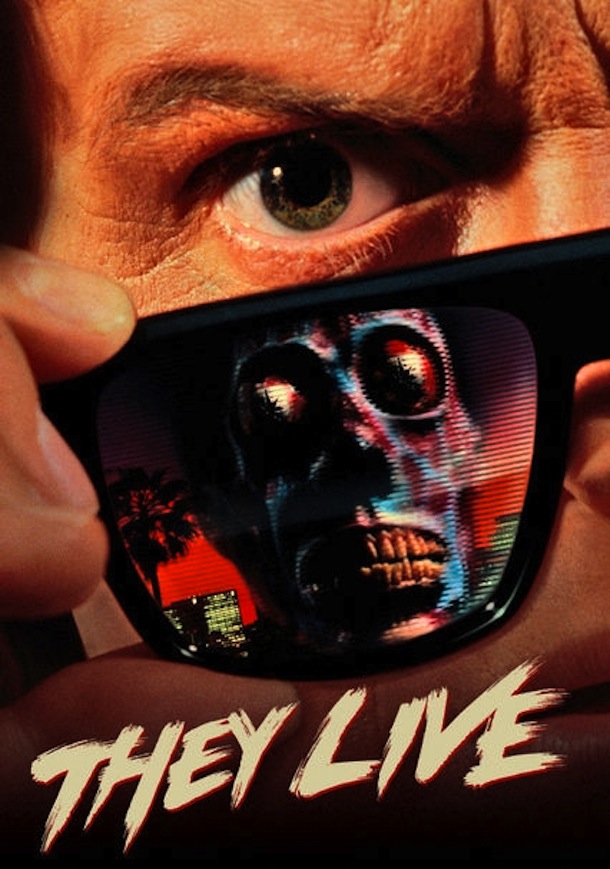
They Live Is Overrated

.

They Live (1988) was the 11th feature film from celebrated writer/director John Carpenter, and, in my contested opinion, halfway through the movie it becomes evident that Carpenter’s talent had fled, never to return. (Do NOT try to argue that In the Mouth of Madness is a great or even good film. A story where a shotgun-armed angry mob of men are chased off by mere dogs is stupid and expects its audience to be stupid.) I will be spoiling an already spoiled story.

Universal Pictures

A conspiratorial mess, the story follows Nada (Roddy Piper), an unnamed and unhoused itinerant worker who has come to Los Angeles and is drawn into a vast alien plot to subjugate humanity and transform the planet to an environment more suitable to their lifeforms. Nada and another displaced worker, Frank (Keith David), join up with a resistance group and eventually destroy the single satellite transmitter that has hypnotized humanity in a walking sleep that has prevented anyone from perceiving the aliens or their subliminal manipulation.

The first half or so of They Live is actually quite good, subtle, with a growing unease that creates an uncanny valley as the audience remains as ignorant of the reality of the story as the protagonist. However, once the vast conspiracy is revealed, all semblance of intelligence flees the pages of the script, replaced with overly extended fight sequences and action movie tropes that, even by 1988, had become tired, worn out, and cliché. The descent into formula is further degraded by the ham-handed nature of Carpenter’s political preaching. Meant as a commentary on Conservatism as Reagan’s second term drew to a close, They Live delivers its message with all of the subtlety of a cocaine-addled bull elephant. Compounding this clumsy critique is a level of world building that cannot stand even a moment’s analysis and consideration.

The unnamed alien race has come to Earth to extract wealth and convert the planet’s climate to their own by way of industrial pollution. Okay, a metaphor for capitalism: it’s not particularly original, but it’s serviceable enough that Carpenter is not the only storyteller to have stumbled upon it. I will even accept the hand-waving over exactly how that wealth is being extracted, as, one, a film has no time to delve into interstellar economics and, two, we have no clue how such an economy would function anyway. The idea that aliens are covertly manipulating humanity is hardly original; too many people already accept it as a true thing, but it can be made to work.

But not in this movie.

The aliens have covered incomprehensible distances to come to Earth, but after that terrible expenditure of resources, what do they do? They become beat cops in Los Angeles. Oh, sure, they are presented at the very top of society and government, with one shot meant to imply that Reagan is one of them, but so, so many are walking about as working-class and lower-upper-class individuals. This is patently ridiculous. Yes, you might make the argument that this echoes humanity’s own action as European nations colonized much of the world, but colonization is not Carpenter’s metaphor. He is explicitly playing on the secret forces that really control society, using aliens as a metaphor for capitalism, but that idea doesn’t work if the secret masters of the economy are also the ones driving the patrol cars. This is the reason that, while he had aimed his satire at capitalism, the metaphor was handled so clumsily that Nazis took the aliens as a stand-in for Jews. Carpenter warred with them online about this reading, but he left that door open with his slipshod world building. Of course, if Carpenter had reserved his aliens for the ones pulling the strings from secret positions high above the common rabble, then he couldn’t have had his glorious scenes of Nada gunning down aliens in public, scenes that have become only more and more disquieting as America experiences an endless horrid parade of mass shooter events.

Even if you accept the concept that aliens have come across light-years to hold down street-level jobs, They Live is still a deeply flawed mess of a story.

Nada, shortly after learning the truth and going on his spree of murdering aliens that to everyone around him look as human as anyone else, takes a hostage, Holly (Meg Foster), to escape downtown Los Angeles. In her expensive hillside home, Holly puts Nada at ease and then, shattering a champagne bottle across his skull, ejects him from the structure and down the steep embankment.

Later, when Nada and Frank attend their first resistance meeting, Holly is there, presumably because she has had her eyes literally opened by the magic sunglasses left behind after Nada was thrown from her home. She is all doe-eyed and sympathetic to Nada, despite her only interaction with the man having been as his hostage at gunpoint.

The evil controlling forces show up, some deus ex machina shit goes down, transporting Nada and Frank to the local cable station that manages the vast interstellar conspiracy. They regroup with Holly, last seen at the resistance meeting in a bad section of town and now present without explanation, and hustle to the roof where the final plot coupon, the transmitter, waits. In the stairwell Holly wordlessly murders Frank, but on the roof she, with more doe eyes, pleads with Nada, while holding him at gunpoint, not to destroy the transmitter. Apparently, in addition to selling out humanity, she has a very specific kink about being kidnapped and held at gunpoint. Nada destroys the transmitter and dies, but exposes the entire global plot because aliens smart enough to not only traverse light-years but manage a decades-long cultural conspiracy are too stupid to avoid a single-point-of-failure system.

I cannot for the life of me understand why this film is held in such high regard. I found it trite, preachy, and stupid when I first saw it in ’88, and that opinion has only grown with the decades.

Share