A Thematic Problem with The Red Shirt Issue

.

Yesterday evening, I came across a post from a friend online that expressed their middling reaction to del Toro’s Frankenstein prompting a return of my own thoughts that del Toro had worked so hard to make his monster sympathetic that no one of consequence died at its hands, a major deviation from the source text.

del Toro’s use of nameless crew to be killed in a thrilling and exciting opening combat scene with an unstoppable monster makes for a great opening to his luscious film but becomes hollow when the rest of the time the monster is presented melodramatically sympathetic and without emotional or ethical flaws. One could be forgiven for forgetting that the movie opened with mass murder. After all, they were literally nobodies.

Now, I have written about this before calling it his ‘Red Shirt’ problem. For those who are unaware, ‘red shirts’ refers to the often unnamed and wholly uncharacterized extras presented as security officers in Star Trek. These day players came onto the scene and in popular (but exaggerated) opinion died in droves.  The essence is still on target, they were essentially nameless characters brought on to dramatize the danger of that episode, a necessary evil of the time as no network program could go about killing its major and central characters. (This was decades before Game of Thrones would make it a drinking game.)

Western literature and oral tradition stretching back into prehistory is corrupted with a nasty little idea, that some people are simply born better than the rest of us. The nobility deserves their castles, their rich food, and the product of our labor, our bodies, and our lives because of the blue blood that courses through their veins. The ‘Chosen One’ narrative so popular in everything from religion to Star Wars is a product of this form of thinking. Luke and Aragon are good people because they were born to it, not from choice, not from making a decision to be good, but by their very blood. The force and the right to rule flows from their heritage and not their choices. We, the non-chosen, need to step aside and let out betters make the choices that will rule our lives. Our duty is to serve and to be thankful.

And here is the poisonous subtext in the ‘red shirt’ problem, it perpetuates this division of people into those worth and deserving of sympathy, consideration, and ultimately power from those lower, nameless people of the great ‘unwashed masses’ whose existence only matters in the moment that it impacts the monied and good-blooded people worthy of names. There are your ‘betters’ to whom you must defer with titles such as my lord, sir, mister — and to whom you must pay your obedience or suffer the lash and then there is everyone else, ‘red shirts’ to be used and discarded either on the battlefield or the factory to advance the lives and lifestyles of their ‘betters.’ The subtext of nameless victims in horror and action movies is that some lives are inherently more valuable than others.

“Red shirts” are not only a lazy and cheap play for a short cut to dramatic stakes, the practice subtly subverts the egalitarian ideals that all lives are valuable regardless of the accident of their birth or their importance to any particular narrative by regulating some characters to nameless and forgettable disposal.

Share

The Streaming Services for Science Fiction Fans

.

I have been a science fiction fan ever since my older sister caught me trying to write a book report on a non-fiction book about Mars and took it away and put Red Planet by Robert A. Heinlein in my hands. Now, in the era of streaming, the streaming wars, and the dominance of geek culture with so many SF movies and shows the question can be posed: which is the best service to subscribe to for science fiction?

To me, the answer is pretty plain: Apple TV.

While Paramount+ boasts pretty much the entire Star trek Franchise from the original series to the newest iterations, it’s really no deeper than Trek.

Apple TV has an impressive catalog of original and interesting SF. (In addition to even more beyond genre fiction such as Slow Horses and Bad Sisters.)

Here is a partial list of the SF you can find on Apple’s streaming service. I have bolded the ones that I have watched and as you can see the unwatched outnumber the viewed.

  1. For All Mankind
  2. Silo 
  3. Foundation 
  4. Severance 
  5. Dark Matter
  6. Invasion
  7. See
  8. Monarch: Legacy of Monsters 
  9. Hello Tomorrow!
  10. Constellation
  11. Amazing Stories
  12. Brain
  13. Sunny
  14. The Last Days of Ptolemy Grey
  15. Circuit Breakers
  16. Murderbot
  17. Pluribus

Of the six shows that I watched, and I watched at least the entire first season for all of them, only one did not work for me and left me cold and uninterested in continuing, Silo. While it had a cast that I enjoyed and an intriguing concept there were world building issues that I simply could not get past to suspend my disbelief. The underground world of the show is simply not run with the absolute need to recycle everything, most of all biological material, that such a system would demand. All the other programs have worked at levels from simply enjoyable to shows that I love. Foundation, while diverging significantly from the source materials, source materials I found too dry to hold my interest, has been forking fantastic. Murderbot hewed much closer to the novels and managed to capture the inner monolog that is so essential to the property’s comedic tone. It took me a little longer to get into Severance. The split nature of the characters, I suspect, created an emotional distance, but once past that and especially once the big reveal of season one was deployed, I was hooked. Monarch was just monstrously fun and I cannot wait to see where Gilligan takes Pluribus.

I initially enrolled with Apple TV because a package deal with Apple music, storage, and TV cost less than the satellite radio services in my car, but now you can have my Apple TV when you pry the remote from my cold frozen fingers.

Share

Pluribus Questions

.

I am only 3 episodes into Pluribus and it is possible that these questions bouncing around my skull have been addressed in some manner later in the series. If that’s the case, then I am looking forward to Vince Gilligan’s take on the matter but if not, I am deeply curious how it all shakes out.

Apple TV

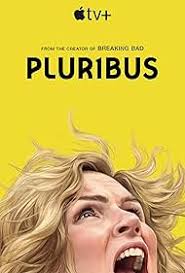
In Pluribus a global event has melded nearly every human into a single consciousness sharing all of their thoughts, skills, experiences, and emotions as one. The protagonist of the show, Carol, along with roughly a dozen others, is for some reason immune and is decidedly not pleased with the new love and harmony of a world at peace with itself. Carol’s reasons are intense and understandable, but are not the subject of my ponderings.

Each individual of the new human collective presents as a serene, happy individual with a unified goal of making Carol happy in whatever way possible, all while espousing the utter contentment of their new states of existence, hoping that they can eventually bring Carol into this magnificent joining.

So, peace on Earth and perfect brotherhood for all of humanity, right?

I hate to break it to people, but humanity can be a right nasty bastard.

Pluribus’ thought experiment creates a unified human mind that would also include all the horrible experiences people around the globe have suffered; everyone is both the victim and victimizer. What exactly is that like? To be both a sexual assault victim and your assailant? To be both war criminal and war crime victim? What does it mean now that all of humanity has the direct emotional and psychological experiences of every serial killer on the planet?

I wonder if the series will get anywhere near these questions. It sort of reminds me of Data in Star Trek: The Next Generation and his quest to fully understand humans, but how can you fully understand if you aren’t engaging with the terrible darkness humans are so easily capable of?

Share

The New Year, as We Reckon it, Has Begun

.

I think it is important to remember that the dominant calendar of the world, this Gregorian Calendar is not the only marking of the passing years utilized on this planet. While it is the new year for many of us it is not for all of us. But still, it is here in the United States and so I am observing that personally while keeping in mind that my perspective is not the rules of the universe.

I am not one for making resolutions at the turn of the year. It has never held a great deal of weight for me and the few times I have done so the matter was quickly discarded or forgotten. In their place I like to put objectives that are measurable and within my control but do not attempt a ‘re-invention’ of oneself. I also like to look at achievements, even if they are small from the previous years.

2025 was not the best year I have experienced but by far it was not the worst. I completed the first novel where I used no outline of the plot or characters. Now, I am not proposing that writing a novel without an outline is superior to one that was carefully plotted. Both approaches are valid and what matters is if the process works for the author. Outrageous Fortune could not have been written sans outline if I had not written so many novel projects before it with careful outlines. Structure, the use of five acts, a sense of pacing dictated by the flow of the plot, all came from experience that had been born from those outlines.

With Outrageous Fortune completed, edited, and proofed by my lovely sweetie-wife, I have yet another novel to try and win me an agent and another shot at traditional publication.

For 2026 I endeavor to write a new novel, but I think I shall shy away from a concept that I love but do not feel ready to tackle quite yet.

2026 will also see a fresh assault from me and my doctors on this persistent chronic cough left over from my COVID infection of January of 2024. Towards the end of 2025 I seemed to be responding to therapy, but a sinus infection has wiped out all the progress we made.

I also will try, depending on schedules and such, to attend more meetings of the San Diego chapter of the Horror Writers Association. They are good people, I have kept my membership active, and post on the Facebook page but attended zero meetings during 2025.

This is my look forward to 2026 and I hope that yours is kind, good, and happy.

Share

So, I Finally Started Pluribus

.

While the series has been the rage on my SF social media feeds, I myself, while quite curious about it, hadn’t started watching until last night. It was a series that my sweetie-wife had a possible interest in, and so not one I would end up watching on my own after she had retired for the evening. We had just finished Down Cemetery Road, Apple’s adaptation of the Mick Herron novel. (That’s the same author that gave us the absolutely wonderful Slow Horses series.)

Pluribus (here on out I’m going to use the standard spelling and not the one utilizing the numeral for an ‘i’) deals with the lingering and global effects of an RNA-carried strand created

Apple TV

by following instructions beamed from an extraterrestrial source. Rhea Seehorn stars as Carol, a highly popular writer of a romantic/fantasy series that has brought her fame, money, and lines of adoring fans. Carol’s life, however, is a lie. She considers her novels to be brainless trash, her warm and welcoming front that she shows fans covers a contempt for people, and it is hinted that Carol is under court-ordered monitoring due to a drinking problem—the breathalyzer affixed to her car’s ignition. And while her novels come from a distinctly heterosexual point of view, Carol hides her own lesbian relationship from public view.

With the release of the RNA-carried strand, everything changes. Global infection leaves a number of people dead, including Carol’s longtime partner Helen, and the survivors merge into a single group mind that spans the earth.

The survivors—except for Carol and a very few others who retain their own identity—for reasons unknown to anyone, never suffered any infection effects and never merged into the new global consciousness.

You might expect that with such a treatment of the plot of Invasion of the Body Snatchers that this is a chase-and-hide story, with Carol ducking and dodging the hive mind at every turn as she searches for answers. But that is not the direction showrunner Vince Gilligan takes it. The “We” that is the rest of the world want Carol to join them; they want to understand why she is immune and to correct that. But at least as far as the first episode goes, they want to do it only with her consent and participation. They are frighteningly helpful.

I am certainly intrigued and look forward to more episodes now that Vince Gilligan has returned to SF/fantasy.

Share

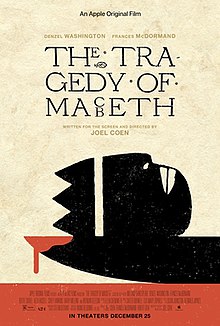
When Adaptations Neuter the Witches of Macbeth

.

I have been thinking about Macbeth lately and even revisited a partial screenplay where I adapted the play into a modern setting, preserving the text and playing with new meanings for old words.

One aspect of the play that is quite often cut down when adapted to the screen—either silver or electronic—is the scene where the witches are shown on the heath.

Apple TV

Now, the witches aren’t given much in the way of character, not even names, but they are given history and motivations that vanish when the scene is cut down.

When they “meet again” upon the heath, they bring each other up to date on what they have been doing in each other’s absence.

One has been slaughtering pigs, robbing some farm of food, or income, or both. For a farm, to lose a swineherd can be fatally disastrous.

Another witch recounts being denied chestnuts, and the trio conspire to ensure that the woman who denied the witch the desired nut suffers as his ship is blown about on the seas, lost and wrecked.

These witches are engaged in evil. They are cruel, malicious beings that delight in the terror and disaster they create for poor, pitiful humans. These are the beings that waylay Macbeth on the heath and fill his mind with prophecy of kingship.

When these aspects are removed from the adaptation, the weird sisters become nothing more than gumball prophecy machines, devoid of agency or intent. We are never left to question: Why? Why did they stop Macbeth? Why give him that foreknowledge of his future?

I think this is an artifact of our modern age. We are perfectly willing to let the witches come in and tell the character the future, but we want the tragedy to be that his ambition is his downfall, not the possibility that the tragedy is that Macbeth is trapped by fates beyond his understanding or control.

Share

That’s Not A Battleship…

So, Trump, in his boundless narcissism, has decided that the United States Navy needs battleships again, and that these should be known as ‘Trump Class’ battleships serving as the centerpiece of his golden fleet initiative.

Of course, like with nearly every single thing that comes from this man, they are not what he promises and are vaporware, produced to stroke the ego of a vain and insecure toddler.

The proposed ships are not battleships in any conventional sense of the word. Ships are rated by their displacement—that amount of water that is displaced by the vessel as it sits there floating in the ocean. The USS New Jersey fully loaded with crew, supplies and munitions displaced 61,000 tons. A destroyer, small fast and agile ships might displace as much as 9,900 tons, this proposed ‘Trump-Class Battleship,’ if it ever came into existence, is slated to displace about 35,000 tons, about half the size of an actual battleship.

The first ship to be commissioned in this proposal would be the USS Defiant, making the truth of the matter even more clear as the first ship commissioned is the lead ship and the vessel from which the class name is derived. These vaporware vessels would be Defiant Class ships, but hey we know that Trump would just love to slap his name on it before it glides down the slipway into the water. Not that it ever will, or if by happenstance it does, it will be far beyond the current presidential term and in all likelihood this president’s life expectancy.

What these deranged fantasies expose is that Trump, a dim-witted and ignorant man, is fixated on navies that haven’t actually mattered in over a century.

The last major war where battleships dominated the seas was World War I. By the next world war, the battleships lost their throne as monarchs of the seas to the aircraft carrier. Beyond delivering massive shore bombardment, battleships serve little purpose beyond being massive and terribly expensive targets.

I do wonder if we are watching the next major evolution in naval warfare as the Russian invasion of Ukraine plays out. The Black Sea fleet has been humbled and not by new sleek warships but by cheap uncrewed drones. Is perhaps the next dominant warship not something with guns that can throw shells the size of cars 20 or more miles or floating cities filled with the latest and most expensive jet fighters and pilots, but rather small fast agile vessels that can unleash hell in the manner of hundreds if not thousands of cheap hard to detect and hard to hit drones?

Either way, the man-baby that sits in the defiled Oval Office is too stupid and too vain to see it.

Share

Hogfather, Outrageous Fortune, and the Unexpected Connection

.

This past couple of days my sweetie-wife and I watched the Sky One production of Hogfather, an adaptation of the novel by Terry Pratchett, as part of our holiday traditions. The other holiday movie we often watch at this time of year is Rare Exports from Finland.
After Susan, Death’s granddaughter, has rescued the Hogfather—a Santa Claus analog—from the beings that wanted to destroy him and through that action destroy humanity’s capacity for imagination, she is told by her grandfather Death that humans need to practice believing in the little lies, like the Hogfather, to be ready for the big lies like Justice and Mercy. The theme, stated quite plainly as television is wont to do, is that without imagining such things as justice, how can they be real?
This year this ending and theme struck me quite differently. I had finished my horror novel Outrageous Fortune just a few weeks earlier and its themes were still fresh in my head. Part of the novel’s philosophical grounding is that the universe is utterly indifferent to human existence. It would be wrong to describe the universe as cold, as that implies at least some consideration. It is indifferent, not capable of having any consideration of human behavior and by extension no possibility of punishment or reward. There is existence and only existence as far as the universe is concerned.
Morality, the novel puts forward, is purely a personal perception, but it is also a trap because once it is perceived and recognized, then that knowledge is imprinted permanently on the perceiver’s mind. To recognize that an action is ‘immoral’ within the perceiver’s subjective understanding means it will remain immoral to that person. Whether you do or do not perform that action, the morality of your action is yours to carry as part of your identity regardless of the universe’s indifference. One does not ‘create’ justice; one recognizes it in oneself, or one is ignorant of it.
Pratchett’s work stipulates that belief creates an objective morality, but mine postulates that it never exists objectively but only subjectively, which is the only way we really experience life anyway.

Share

A New Motion Picture From the Creator of ‘Chernobyl’

.

Craig Mazin, the writer, producer, and show runner of the hit shows Chernobyl and The Last Of Us who has proven his ability to shock, horrify, and unsettle even the most steadfast of viewers with stories of humans caught in circumstances that test them to the limits of their endurance, often with dreadful deaths along the way.

The podcast Scriptnotes is hosted by John August and Craig Mazin and is  heaven for scriptwriting and things interesting to scriptwriters. It actually covers much more than that. I have set aside any dreams of scriptwriting but still I am devoted to the podcast as a weekly dose of sanity in my ears.

For years Craig has mentioned obliquely a script he and a producer have been working on, a challenging one to crack its story and its voice. This week the man who gave us the technological terror of Soviet Nuclear design and the uncanny horror of fungal possession released the first look at his newest project.

Here is the trailer.

youtube placeholder image

Share

Dedra & Syril: The Empire Mismatched Power Couple

.

Antagonists and Villains are tricky characters to craft. Make them too simple in their motivations and action and they become cartoonish targets, forgettable and easily swept aside by the protagonists. Develop them too well and they become so sympathetic as to displace the actual protagonists as read and audience identification grows. A careful balance between evil goals and representing their full humanity is an ideal that is so rarely achieved.
But achieved it was with Andor’s Syril Karn and Dedra Meero, agents of Star Wars’ dread Galactic Empire, lethal opponents to the protagonists, but fully realized and capable human beings trapped by circumstance and their environments.

Syril Karn (Kyle Soller) begins the series as midgrade police officer working for corporate

Lucasfilm/Disney Studios

security, desperate to prove himself and with a fierce passion for law and order. Syril gives no indication that he has ever given any thought to the politics of the empire. Syril has a much more grounded view of life: there are rules and they are the only thing that keeps the chaos at bay. Rules must be enforced and rule breakers must be dragged into the light and subjected to the legal system for correction. His rigid view of the law and justice sets him on a course for tragedy when he cannot accept his superior’s plan to sweep the murder of two fellow corporate cops under the rug. Refusing to participate in a cover-up that would allow a lawbreaker, a murderer, to escape justice, Syril ignites a series of events that lead to riots, the Empire displacing the corporate security, and his collision with Dedra Meero.

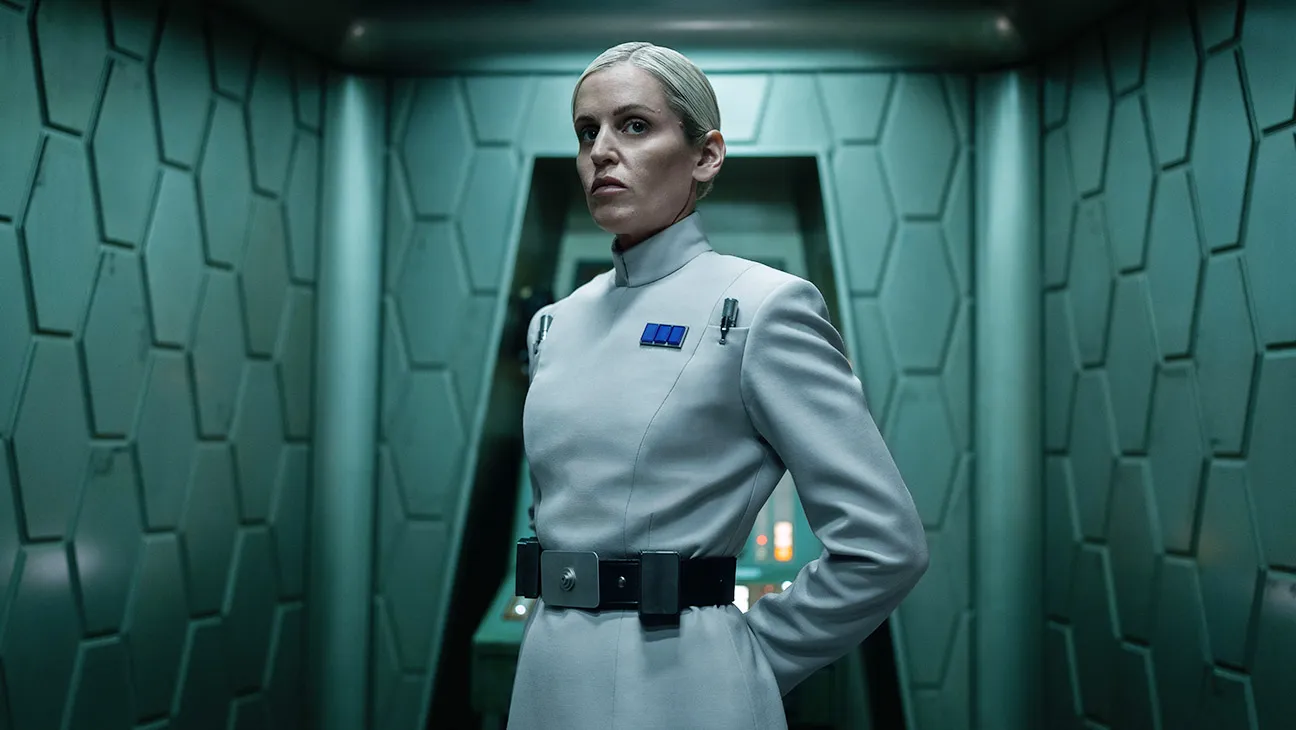
Dedra Meero (Denise Gough), a sector chief for the feared Imperial Security Bureau, ISB, has an

Lucasfilm/Disney Studios

equally rigid but more political worldview than Syril. Taken from her criminal parent and raised in an Imperial ‘KinderBloc,’ Dedra is a true believer in the Empire. For her, it is not law that brings order to the galaxy but power and the Empire’s power must be unquestioned or there will be chaos. Laws and rules are, for Dedra, permeable, but only insofar as rule breaking advances and protects the Empire’s power to provide stability, peace, and security. Frustrated by a bureaucracy which keeps sector heads and Imperial departments quarreling and warring for resources, Dedra violates rules and protocols pursuing a growing rebellion that others either cannot or will not see. Cold, competent, ruthless, and intelligent, Dedra Meero represents the Empire’s best bet for killing the Rebel Alliance before it even forms beyond the odd terrorist attack or heist.

By the second season this pair have formed both a romantic and professional union. We aren’t shown the courtship, but with the series time jumps we are presented with the couple living together in the imperial capital. When Dedra puts Syril’s overbearing mother in her place, establishing the firm boundaries required to protect her partner, it is clear that Dedra truly cares for Syril. Later Dedra pulls Syril into an intelligence operation that when he learns its true scope and purpose rattles his steadfast resolve, providing their relationship’s tragic conclusion.
Syril isn’t an evil man, he’s a man with solid understandable belief in law and order, but who by temperament doesn’t look at the hand that wields the law for its own self-interested purposes. Dedra, unbothered by both genocide and torture, is evil. She engages in torture and terrorism, putting aside what qualms remain within her withered conscience to advance a system whose true nature is revealed with the annihilation of the Ghor. Her desire for order at any price finds that even genocide is not too high a price to pay. This devotion to power brings the eventual conflict which shatters Dedra’s relationship with Syril and his rigid moral code.
Andor presents the audience with Imperials that are true characters, that are people with complex inner lives and for whom the Empire is not a setting but an environment that shaped them and that they shape. This is writing at its best.

Share