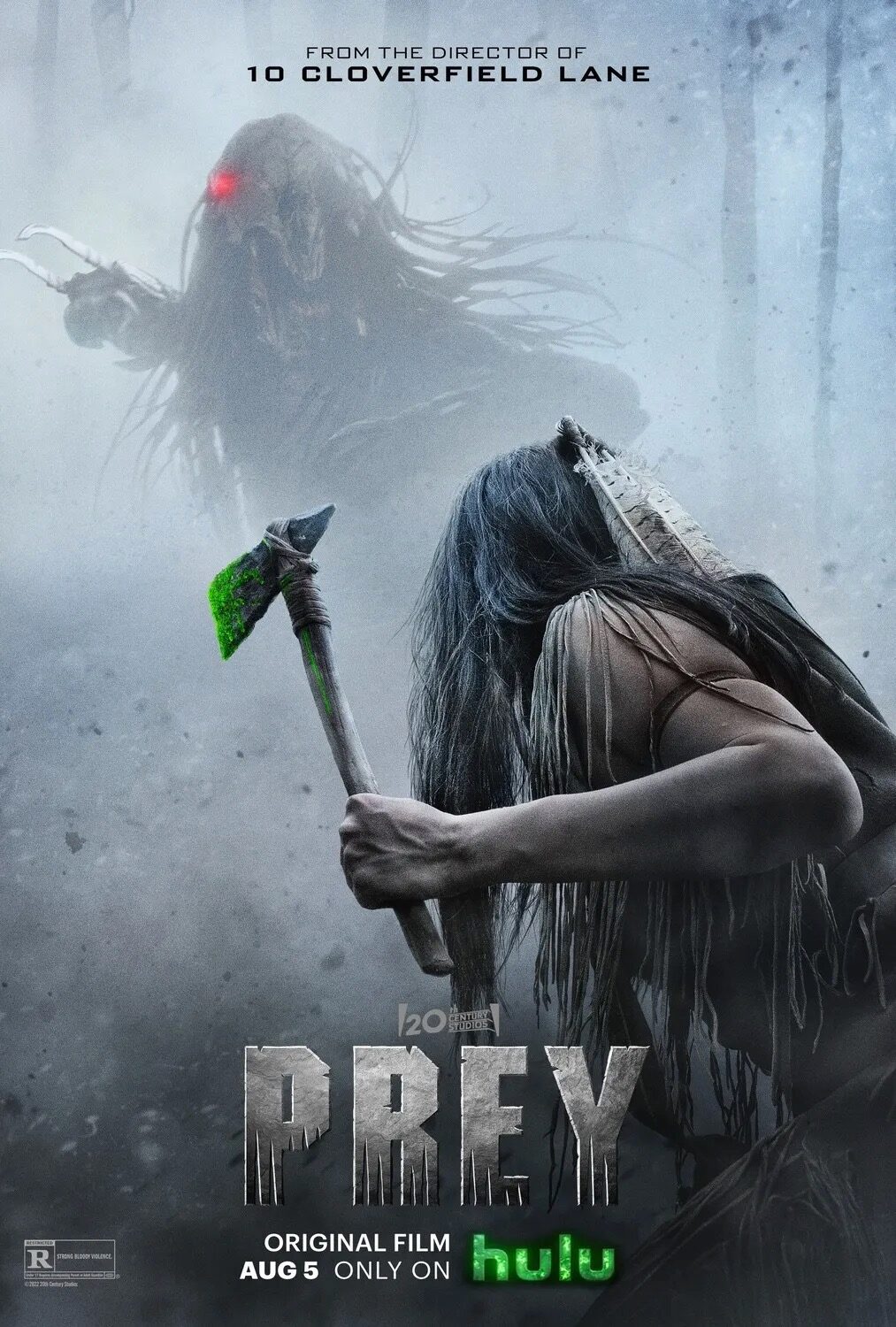
Movie Review: PREY

1987 saw the release of Predator itself inspired by the 1980 wholly lackluster low-budget movie Without Warning, both films used the premise of an alien hunter come to Earth for the sport of hunting humans. Unlike the 1980 movie Predator exploded at the box office quickly becoming a massive success spawning 4 direct follow-on film and melding it with the studio’s other Sf/horror franchise Alien.

Prey, the latest franchise entry, is set in North America during the early 18th century as a band of Comanche deal with a predator-hunter come to Earth. The film’s central character, Naru, (Amber Midthunder) a young woman skilled in healing arts but with a burning desire to a tribal hunter, finds herself struggling to survive the alien’s stalking while navigating the difficult waters of both her tribal politics and the further encroaching of the Europeans into the continent.

There are many who are praising Prey as not only a great sequel but superior to the original 1987 film. This is overly enthusiastic. Granted compared to the lackluster Predator 2, The Predator (2018), or any of the Alien v Predator entries Prey stands out as solid, enjoyable filmmaking. Only it and 20103s Predators took the central premise and did anything more than simply copy the form with cut-and-paste caricatures. That said I think none of the subsequent movies surprise the surprise, tension, and thematic depths of the original film. Predator’s commentary of the emptiness of bravado, and as Lucifer in Sandman might say, the traps of tools, is something that rings true today 35 years later. Prey like all the other films in the Predator franchise has its moments that shatter disbelief. However, it does not layer these issues repeatedly and thus audiences can recover their acceptance of the story as it unfolds. The incongruity that has stayed with me is that any herbal concoction that lowers your body’s temperature to background is simply lethal. No mammal gets to survive that experience.

That is not to say that Prey is a bad film, it is not. Prey boasts interesting characters, who act and react with authenticity. Something that is far too often lacking in popular genre media. (Yes, I am looking at you X.) The tribal characters are engaging, realized human beings with the writers avoid both the cliche of the ‘noble savage’ wise in all things, and the ‘brutal savage’ untamed and untamable. Little can be said for the French fur trappers that who make a brief appearance in the film as all of their dialog is un-subtitled and your humble reviewer speaks no French. Jeff Cutter’s cinematography capture the scale, scope, and beauty of Canada doubling as the American wilderness reminiscent of the fantastic vista often found in John Ford’s best westerns. Director Dan Trachtenberg, previously best known for 10 Cloverfield Lane a tight, confined thriller with a fantastic performance by John Goodman, delivers on the action and tension inherent in a Predatormovie. Naru’s escape and refuge in a beaver lodge is a particularly powerful if short sequence that displays both the character’s quick intelligence and Trachtenberg’s confident directorial skills.

The visual effects are competent and largely invisible. (That pun fully intended.) With CGI creatures and beast flawlessly integrated into the picture. The grizzly is particularly well executed. Prey unfortunately has no theatrical release, and it is possible the VFX would not survive on massive screens but on my 55″ 4K television is worked perfectly.

Prey is well worth watching and is currently streaming on Hulu.

Share

The Chain that Broke My Novel

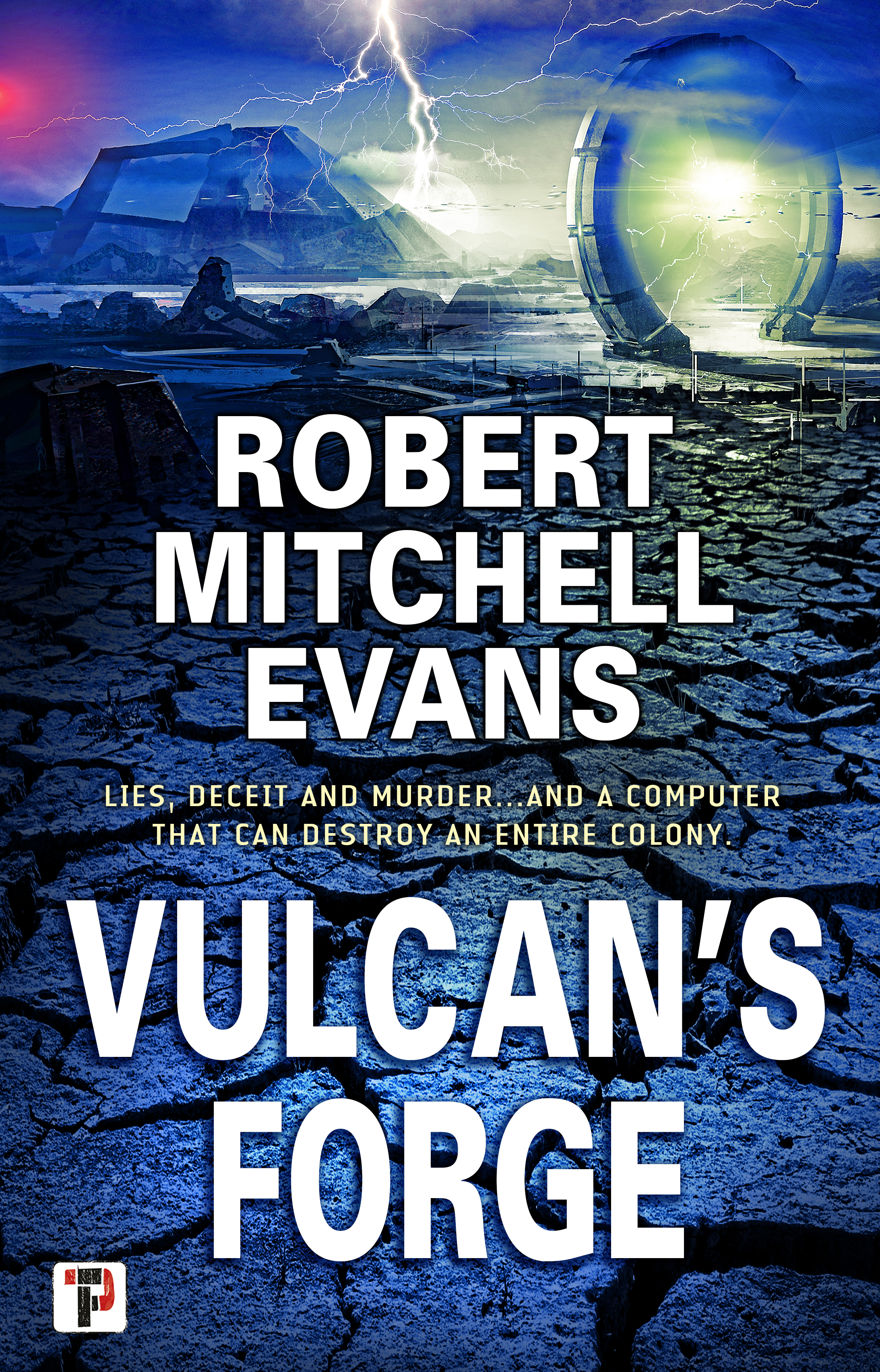
Late March 2020 saw the release of my traditionally published novel Vulcan’s Forge that played with Artificial Intelligence, the fetishization of 50’s Americana, the relationship between the

Flame Tree Publishing

individual and their larger culture, crime, Film Noir, and loads of movie references. It was a novel that I had written solely for myself and yest was purchased by the first editor I presented it to.

Late March 2020 is also the time the world shuttered, going into a prolonged lock-down as a pandemic, the likes of which had not been seen in a century, swept the globe, disrupting every aspect of life and killing far too many people. (Including a friend I had known for nearly 40 years.)

Needless to say, that was a very bad time to release a debut novel. As if a global pandemic was not enough to throw at my arrival as a novelist the fates had more hurdles to place. The publishing house was transition between physical distributors, snagging and disrupting sales to bookstores and they had just ended the contract with the studio that produced their audio versions, leaving Vulcan’s Forge without an audiobook not only as their format continued to grow but as that very format became more readily accepted during the pandemic.

Within eight weeks bookstore had worked out virtual launch events and people had begun to adjust to a new way of living during shut down, but the damage had been done and Vulcan’s Forgenever recovered from its debut.

Such is life. There are always factors in life far beyond your control or even influence. I don’t waste time crying over what has happened and cannot be changed. Life moves in one direction, forward, and that is the focus of your attention with the past providing lessons to improve your choice of paths into that future.

Now, I have not mentioned the most important link in the calamitous chain that broke my novel and the lesson I and others can learn from it.

Vulcan’s Forge sat on my agent’s desk for a year, unread and unrepresented.

When I discovered that my agent had lied to me and withheld critical information about his position at the agency, I contacted his boss and that is when he dropped me as a client. But for months I had been harboring doubts and considering dropping him. And that is the lesson, not all agents are good for you. In fact, they can hurt you in ways you cannot foresee. That is not to say you should never have an agent, but you must always remember that they work for you. If they are a poor employee, fire them and find another.

It can feel scary, nay terrifying, most of us search for years, enduring rejection after rejection searching for that representation but do not let that blind you to the truth. If they are not helping you then they are hurting you. There is no neutral position.

Vulcan’s Forge is history, though you can still order copies, but my future novels are not. I have a murder mystery/sf Novel under serious consideration at a major SF publisher, I am finishing up a military SF novel now and will then move onto crime and corruption on Mars. There is only one direction to life. Forward.

A gentle reminder that I have my own SF novel available from any bookseller. Vulcan’s Forge is about the final human colony, one that attempt to live by the social standard of 1950s America and the sole surviving outpost following Earth’s destruction. Jason Kessler doesn’t fit into the repressive 50s social constraints, and he desire for a more libertine lifestyle leads him into conspiracies and crime.

Share

My Writing Method

Some general nattering about how I approach writing.

As I have said in other posts, I am a plotter. I cannot start writing a story until I know how it ends. To me ending are where it all comes together and produces the satisfaction for the journey. For short stories I can begin just knowing where I start and where I end the few thousand word between the two I can discover. However, for novels I have to outline, sometimes just six or seven thousand words and sometimes nearly twenty-thousand words laying out character, world, story, and plot.

When I write I must write from start to finish. I cannot, as some other writers do, leap ahead, and write scenes near the end before I have gotten there in the manuscript. This may seem strange since as I have planned out the story and plot, I already know what the scenes do and why, but the truth of the matter is I can’t feel the scenes ahead of time.

Those hours and hours writing the sequences before a scene are an emotional journey not only for the fictional characters but for me as a writer. (And hopefully, for the readers as well.) I must experience the emotional journey to understand and feel the emotions in a scene I am writing. I may know that this is the scene where the scales fall from the hero’s eyes and they see the betrayal, but I can’t feel the devastation, the despair unless I have walked in their shoes and lived their trust. Other writers can leap into those souls more easily than I can. That is neither good nor bad. It is their process, and this is mine.

Share

The Racist Titration of the GOP

On a recent podcast I heard conservative commentator Mona Charen state that she was shocked at how quickly the GOP became Trump’s GOP. The host, Charlie Sykes, repeated his long-presented view that the racist authoritarian streak in the GOP had been a ‘recessive gene’ that has now become dominate but this is a terrible analogy for what has happened, absolving all those ‘good’ conservatives for their action and inaction that created the current condition. A better analogy is found in chemistry class: Titration.

In titration one liquid is slowly, drop by drop, added to another. The base liquid is clear and colorless and at first e3ach drop appears to do nothing. The swirl the mixture but it remains clear, colorless. Then after a number of drop colors appears but fades quickly away in the swirling returning to the clear colorless form. But at some point, a single drop transforms the mixture and now the flask is filled with a colored fluid that had just moments before been colorless. It has changed and seeming from a single drop but of course it was a process that had been carried out over time.

This is what has happened to the GOP. Listen to ‘Never Trumpers’ and after a short time someone will remind you that in the old days, they threw out the crazy Birchers, that the party used to enforce rationality. But that was in the early 60s by the late 60s Nixon played his Southern Strategy, inviting in the racists whom the Democrats had enraged with the Civil Right legislation of the great society. The drops of racism began to be added to the GOP, but it wasn’t much, and it didn’t really change the nature of the party. Then there was Nixon’s War on Drugs and that was quite deliberately not enforced equally across racial lines. More Drops into the mixture. Welfare Queens, Crack babies, and more and more drops added to the mixture, flashes of racist color but with enough swirling you could make them go away. Crime Bills and torture for brown people were more drops added to the liquid, along with ballot initiatives against ‘illegal immigrants’ that really targeted more brown people. Throughout this process the left ceased to be political opponents and were the enemy of the nation.

Trump didn’t ‘change the GOP,’ he was the final drops the completed its titration into a neo-fascist, racist, caricature of the party that had thrown out the Bircher only to crawl back into bed with them.

Share

The Muse Has Returned to Olympus

Yesterday the word spread officially that singer, actor, and activist Olivia Newton-John has died. With a performing and philanthropic career that spanned five decades ONJ left an indelible mark on popular culture by far not the least of which was her role as Sandy in the feature film production of the musical Grease.

I cannot remember the first album I purchased back in the 70s, but it was almost certainly either Barry Manilow’s Greatest Hits or Olivia Newton-John’s Greatest Hits. As a fan of easy listening, great vocals, and romantic songs, her music has been with me since adolescence. It was not easy being a teenage male in the 1970s and preferring love songs and pop when the rest of the world seemed consumed with rock and hair the coming of the hair bands.

Those who know me know that my favorite film was one in which she starred, Xanadu. Now, Xanadu is in fact a terrible movie. Starting production to participate in the brief roller-disco craze of the late 70s it suffered constant and extensive rewrites throughout filming and lacking in strong central narrative or character growth the film bombed at the box office while igniting

Universal Pictures

the musical charts with its soundtrack of Electric Light Orchestra and ONJ songs. The feature found additional life as a cult movie and eventually an Ironic stage musical. Underneath the trashed production, inconsistent plot, and truly ineffable ending the film touched hearts due to it sincere adoration of dreams and dreamers wrapped up in its theme that ‘Dreams don’t die. Not by themselves, we kill them.’ Like Tinkerbell, the dream survives as long as you believe. Olivia has passed, her dream and ours remain.

Share

Sunday Night Noir: Hell Drivers

Joe ‘Tom’ Yeatly (Stanley Baker), a drifter who has learned of an open position as a driver delivering loads of gravel due, after passing an interview from the company manager (William Hartnell) and a test run to verify that he is reckless enough for the demanding pace, is hired as the driver for truck 13. Tom, a loner who isolated from the rest of roughneck drivers, quickly
becomes friends with the other outcast Gino Rossi (Herbert Lom) and Italian POW who remained in the UK after the war and Lucy (Peggy Cummins) becoming entangled in a romantic triangle as Lucy’s fascination with Tom grows. In addition to the dangerous pace required by the manager, to meet their trip quotas the all the drivers speed and endanger themselves and other cars on the road, Tom must also contend with the bullying and cruel driver foreman ‘Red’ Redman (Patrick McGoohan.) Protecting the secret of why he is a drifter and without a recent employment record, Tom has to navigate the treacherous waters of a love triangle and the distrust and hostility of his fellow drivers.

All the elements of a decent-to-good noir are present in Hell Drivers and yet the actual assembly leaves much to be desired. Most of the character motivations are simply too rudimentary to inspire much engagement. The truckers are crude lot, drinking and squabbling without anything to define them as characters and not caricatures. I commented to my sweetie-wife as we watched that all of the men could be used as example of ‘toxic’ masculinity. Without any actual depth to the characters, it is less a story more just a plot. It is late in the film’s running time that we see what is motivating Tom’s need for money and had that been hinted at earlier as a mystery it could have provided a hook upon which to hang the audience’s interest.

Another element of the filmmaking that it difficult to suspend disbelief is the reliance on ‘undercranking’ the camera to simulate the speeding of the dump trucks. The motion was speeded up artificially it was impossible to accept that these trucks were cornering without rolling side-over-side.

That said, an additional bit of interest in Hell Drivers is the numerous future stars that appear in small roles. Beyond the actors already mentioned in my review this film also boasts, pre-Bond Sean Connery, Pre-Man from Uncle David MacCallum, and Jill Ireland. With a slightly tighter script this could have been a 1st class noir instead it is closer to a melodrama and at that it is merely serviceable.

The entire film can be found on YouTube.

Share

Series Review: Light & Magic

Disney+ unveiled a new documentary recently Light & Magic a series exploring the history of the groundbreaking special effects house Industrial Light & Magic (ILM.)

Founded because no studio effects department was capable of meeting Lucas’s vision for his upcoming space opera Star Wars, ILM quickly became the industry’s premier special effects

Disney Studios

company, producing the special and visual effects not only for Lucasfilm’s productions, Star Wars, Indian Jones, but also the company others turned to when they needed outstanding effects for their films.

While it is important to remember that this documentary series is produced by a studio closely tied to ILM and its products and therefore cannot be considered unbiased there is at least some dirty laundry and less that admirable moments shared in the show. The episode steps us through ILM’s life chronologically from its founding as a rag tag group of artists who dared not dream of real cinematic heights to the creation of the defining effects of our time, CGI.

Light & Magic streams on Disney+.

Share

Is The Dawn Beginning to Break in the East?

Yesterday, in Kansas a state that the former idiot won in 2020, after all the scandal, sadism, and incompetence of his presidency, by 14 points the voters went to the polls with an option of stripping abortion rights from the state’s constitution.

The evil Republicans had done everything in their power to advantage themselves in their quest to strip people of their rights. They had placed the ballot imitative on a primary schedule when turnout among Democrats would be low but high among their own base. They wrote the proposal in twisted, contorted language to obfuscate its meaning and effect. They even ran ads blatantly lying that the proposal would protect rights and choice.

And it availed them not.

By about 17 points, a spread greater than the Orange Man-baby’s victory in 2020, the citizens of Kansas rejected the lies, the deceit, and the cruelty of the Modern Republican Party defeating the proposal.

We are still in the clutches of the dreadful night of the insanity of the GOP. And that night is long and full of terrors but perhaps the very first, faint, glimmers of dawn’s light are breaking in the East with this victory. Perhaps the first stirrings of a great giant are rumbling from Kansas. Perhaps to paraphrase Gandalf ‘The Democrats are to going to wake up and realize that they are strong.’

Share

Movie Review: The Black Phone

From the Writer/Director team that brough us Sinister and Doctor Strange comes the cinematic adaptation of Joe Hill’s short story The Black Phone.

Set in a Denver suburb in 1978 The Black Phone focuses on a pair of siblings Finn (Mason Thames) and Gwen (Madeline McGraw), their abusive alcoholic father, (Jeremy Davies) and the child abductor/murder dubbed ‘The Grabber’ (Ethan Hawke.) Things turn dire for the brother

Universal Pictures

and sister when Finn is the next victim of the serial killer, trapped in a soundproofed basement while The Grabber taunts and terrifies the young boy. In the basement a disabled telephone, it landline wires severed, rings and voices of The Grabber’s pervious victims attempt to help Finn survive and escape his ordeal.

The Black Phone is the second horror film I have watched this year with a nostalgic view of the later 1970s, the other being Ti West’s A24 release X. While X felt like someone had been told about the 70s and reproduced the period from that secondhand dissemination The Black Phone is more authentically accurate without the jarring anachronisms, Adult as missing persons on milk container, 24-hour UHF stations, and the like, of X. This film is peppered with beloved detritus of the 70s, the TV show Emergency! and if you look closely issues of Starlog Magazine. The only real violation of the period is Finn’s miniature penlight Saturn V which was far too bright and lasted for too long for the incandescent flashlights of the era.

The performances are consistently good to outstanding. The children characters are both written and directed as realistic children avoiding the ‘overly adult’ manner often found in child protagonists. Thames and McGraw are particularly standout as actors, giving performances that make both ends. terrified and determined, of the actions credible.

Brett Jutliewicz’s cinematography is unsettling and naturalistic, capturing the gloom and cold of the killing basement while just slightly off from reality that supports the supernatural aspects of the story. C. Robert Cargill’s and Scott Derrickson’s script is tight with little wasted time, moving the story along with a clean pacing that carries the audience through the story. Not everything established is critical but everything critical is established in the film’s first act showing a proper deference to Chekov without smashing the elements over the audience’s head.

The Black Phone is a solid entry in the horror genre and well worth seeing either in theaters or at home.

Share

A Space Opera Advantage

There is no doubt in my in mind that FGU’s role playing game Space Opera has one of the worst edited rulebooks from a major game company. Typos, contradictory rules, vital rules dispersed in various sections, and the lack of any index at all produce a set of rules that without ‘search’ when using the PDFs would make running the game quite challenging.

That said I do adore the game, its bold attempt to sweep in rule for nearly every conceivable SF setting, and its sheer naked ambition.

Recently, in the campaign I have been running since May 2019, I have come to appreciate another advantage to Space Opera, the lack of an experience point system for character abilities.

In Dungeons and Dragons players begin the game as low-level adventurers, dealing limited damage, easily killed, and marginally skilled. With each adventure the Dungeon Master awards Experience Points to the characters that advance their skills and capabilities, no adventure, no experience points, no advancement.

Space Opera using skill learning. Characters devote themselves to study and practice to become better at their skills and advance in capabilities from piloting to the sciences. As long as the character can continue their studies they can continue to advance.

This is an advantage when the real world collides with the role-playing world. Is a player in a D&D game misses one or more adventures, their character fails to gain experience points alongside their compatriots, falling behind in skills and toughness that may be fundamentally unfair. Real world responsibilities should always outweigh play. It is a mark of adulthood.

With Space Opera the missing player’s character, while not investigating the slave clone trade can continue to study and practice the skills they have committed themselves to advancing. When the player returns to the table, they suffer no in game penalty for attending to pressing real world duties. As long as the gamemaster is keeping careful track of the time passed, for which I have spreadsheets that have proven invaluable, and when the player is eligible to advance their skills, the system is fair to all players.

Share