Category Archives: writing

Frameworks for Fiction

In my opinion there are two critical frameworks for constructing fiction in a western tradition, on deals with the plotting and the other with the story but ideally they are used in a complementary fashion.

The plot is a simple ‘If … Then’ construction focused on the character’s objective, the IF portion of the statement is the goal the character must achieve and the THEN is the consequence of failure of success.

A simple example”

IF I do not make it to work on time, THEN I will get fired.

Knowing just this must a writer could craft a story about the troubles for getting to work. If the obstacles in the characters are too easily overcome then the story will lack tension, while if the consequence of failure is too slight then story will feel pointless. IF I am late to work THEN I will not get any of the donuts is a conflict but scarcely one that people will invest much time or emotion into. The relationship between then objective and the cost of failure is the heart of tension and reader engagement. This framework applies to the larger story and to individual scenes and when you’re thinking about larger works like novels it is important to not backslide from serious consequences to lesser ones. If an individual scene has a slight consequence compared to others that have come before it then it is vitally important that a larger goal with a more serious consequence remain unresolved.

Story is about change and can be reduced to the concept ‘I was/believed X and now I am or believe Y.’

The essence of a powerful story is that the reader can identify with the character’s transformation. This works in the positive mold as character grow and become better person, or in the negative when characters are consumed by their baser nature. What is important that that the character is not the same at the end of their journey as they were at the start.

Share

Down to the Wire

As many of you know I enter regularly in the Writers of the Future Contest. Winning the contest has launched quite a few careers in the SF and Fantasy genres but for me the biggest prize isn’t the money, or the entry on my CV but rather the weeklong seminar that the winners attended that is led by one of my favorite writers, Tim Powers.

The contest is open to authors who do not have profession grade publication credits and after checking with the contest administrator I confirmed that I remain eligible until Flame Tree Press publishes my novel. Given that it is my plan to enter every quarter that I remain eligible.

And this quarter has turned into a bit of race.

Every short story I started this quarter has sputtered and died in the middle and with the deadline for entering this Sunday evening I truly thought I was going to have to skip this submission.

And then an idea came together as I as falling asleep last Sunday. It’s all there, a strong narrative, an SF idea, and a character with a terrible choice before them.

I am nearly done with the first draft and I think I can complete it today, which leaves just Saturday and Sunday for polish and edits.

It’s a race.

Share

Further Thoughts on Aladdin 2019

So my mind keeps circling this year’s release of Disney’s Live-Action version of Aladdin.It feels to me that the movie just didn’t quite work and as a writer I want to dissect the corpse and find out why. I may not have found the primary cause but I think at the very least I diagnosed a serious complication and contributing factor.

In the 1992 release the character of Jasmine, Aladdin’s love interest, is principally a human McGuffin. The set-up of the story is that Jasmine, by law, must marry before she turns sixteen, as the only offspring of the ruling Sultan, Jasmine becomes the route to power. Her husband will rule and Jafar, the scheming adviser/sorcerer, wants to marry her for that power while Aladdin, the good hearted ‘diamond in the rough’ wants to marry her for love and thus will wield that power more justly. Jasmine simply wants to choose for herself and not be ordered to marry someone she doesn’t love. Jafar and Aladdin have opposed goals, only one can achieve their desired end and as such the plot has conflict between its two poles of good and evil. Jasmine has no song in the 1992 version because there is very little she is trying to achieve and very little character beneath her surface motivations.

The 2019 release of the story has made critical changes to the plot. Jasmine is no longer forced to marry on any timeline, removing the ticking clock that helped drive the earlier version. Jafar, with somewhat deeper motivations, has plots to seize power without the requirements of a royal marriage, which removes the conflicting goal between him and Aladdin. The two characters are no long directly opposed ceasing to be well-defined protagonist and antagonist.

Complicating matter from a structural standpoint Jasmine has now been given her own goals and motivations and a song. She is presented as smart, capable, and with a burning desire to serve her people as a leader, but thwarted in this because of her sex. She wants the throne not for vain glory or to make the Kingdom a great power but because she wants what is best for the populace, placing her in direct conflict with Jafar. It terms of the plot Jasmine and Jafar are now our respective protagonist and antagonist.

This would be perfectly fine if  the script had been re-written with the dynamic had formed the spine of the story but the movie insists that Aladdin is the hero, he is the protagonist in a story in which his stakes are secondary when compared to other characters.

Look at the stakes for each character.

Jafar, failure means loss of position, imprisonment, or death because if you move against the Sultan and fail it will end badly.

Jasmine, failure means the people loss her leadership, her empathy, and she is consigned to a lifetime of watching an evil man ground the populace in the war plans.

Aladdin, failure means he continues his life of poverty. Aladdin’s stakes are improvement of his life or stasis; he stays where he is. No ticking clock, no disaster befalls him, not the sort of things the Jasmine and Jafar are facing.

To fix this they needed to either give Aladdin stakes that mattered as much as Jasmine’s or Jafar’s or they need to re-conceive the story with Jasmine as the lead, the protagonist, the hero.

Share

More Thoughts on Noir

Recently I have been re-reading my SF/Noir novel Vulcan’s Forge  in anticipation of editor’s notes as we proceed towards our early 2020 publication date and, along with watching classic noirson streaming while reading some of the classic works in their original forms, I have been thinking about the nature of the genre and what really makes up this beloved form.

In previous posts I have discussed how one of the principal driving factor of noiris to me is how characters are consumed by their appetites and I still hold that this is an essential elements in noir  fiction, be it film or literature, but I am now thinking there is an additional element, beyond the stylized ones, that feels central to the genre and that is the conflict between the character and their culture.

In noir  fiction characters are often immoral and that immorality is judged against the larger culture that character comes from.  Murder, theft, and unsanctioned sexual activity are the hallmarks of noir  movies and from the classic period running through the 1940s and 1950s acting on these desires places a person firmly beyond the boundaries of ‘polite society.’ Even when the heroes of noir fiction aren’t murderous insurance salesmen but rather the hard-bitten border-line alcoholic private detective they still transgress far beyond anything accept my society at large. Sam Spade before being entangled in a hunt for the ‘black bird’ and temptation of great wealth it represents is betraying both his partner and societies morals by his affair with Archer’s wife. Time and time again the main characters in noir  reject society’s conformity, sometimes they do so with an internal code such as Spade or Jeff Bailey in Out of the Past  or in other instances they simply violate society’s rules out of greed and lust such as Walter Neff in Double Indemnity.

All of this prompts the idea, that I am sure is far from original with myself, that a close reading of noir, either in a film or prose piece, can also been seen as a commentary on the society surrounding those characters. This is doubly so when the noiris combine with another genre such as fantasy or science fiction where the society is likely to be as fictional as the protagonists leveling an additional responsibility on the creator to be detailed and thoughtful about their narrative and what it says about human nature both at the individual and societal levels.

Share

Nailing the Ending

For me endings are where the meaning and themes of the story come together into a synergistic whole. The point if the story, be it a film or prose, usually lies in how that tale concludes and this places an especially important weight on getting your endings correct.

Here I am not talking about how the plot resolves, but rather the character beat that wraps up the transformation, for good or for ill, that was the protagonist’s journey.

In 1987’s Robocop  the film originally ended with one final news break segment that let the audience know that Murphy’s partner, Lewis, not only survived the film but had not been transform into a cyborg as Murphy had but once the filmmakers watched the final confrontation and it’s final line ‘Murphy’ they knew that beat ended the movie, there was no story after he reclaimed his humanity.

2008’s Iron Man  went through a similar edit. The script ended with Tony Stark coming home and having his meeting with Nick Fury and the hint of further adventures to come with ‘the Avengers’ imitative. However just as with Robocop  the director found that his story had ended with the line ‘I am Iron Man.’ Unlike Robocop  Iron Mancarried the weight of teasing the wider Marvel Cinematic Universe and the Nick Fury scene could not be discarded and the Marvel Post Credit Sequence tradition was born. Marvel did not invent this, before Iron Mancame along these were called buttons and the occasional film make tossed them in a treat for audiences that sat through the entire end credit sequence. (Pirates of the Caribbean: Curse of the Black Pearlhad on with the monkey Jack grabbing a curse coin.)

I know that when I was editing my novel that comes out next year I discovered that I had done a similar thing. From the start I had a particular line that I wanted to end the book on and yet as I edited I discovered my story ended half a page ahead of my beautiful sentence. I killed my darling and the book ends where it needs to, or at least how it looks to me.

It is reported that Avengers: Endgame has no post credit sequence because the movie acts as the thematic end for the current cycle of the MCU films. I will see Endgame  this Sunday morning, the traditional times that my sweetie-wife and I go together to the movies, and I hope hoping that not only do they give me a satisfying ending to the Infinity War saga but also to the unique 22 film experiment that is the birth of the MCU.

Share

Poison or Protect: or Doing Sex Scenes Correctly

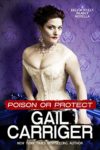
As I have said before my blog is not a book review site. Because of the rather small community of editors and writers I do think it is a conflict of interest to pretend to be objective concerning an industry that I participate in. That means when I discuss a book it is because I liked it and I thought it delivered well on some aspect and such is the case with Poison or Protect a romantic novella set in the Parasol Protectorate setting by Gail Carriger. (Full disclosure Gail has been a friend for many years but that is not why I am here to praise her work with this piece.)

Poison or Protect  concerns a mountain of a man Gavin, a retired military man, a Scot, whose has been dispatched to protect a politician from a potential assassination who suddenly finds himself overwhelmingly attracted to Preshea a woman who has left such a trail of dead husbands in her wake that she has been dubbed ‘The Mourning Star’ and who may be the very assassin. Preshea has been sent to the country house by other political powers with additional agendas and finds herself off balanced by the impressive Scotsman. This is a lighthearted roman with serious emotional undertones and more than one Hard R rated sex scene. The humor fires on all cylinders with engaging and memorable characters but I want to focus on the sex scenes.

I am one of those writers that tends to close the discreetly on my character’s sexual adventures but that is not from prudishness but rather my philosophy about writing in general. A scene should do one or more things, further plot, reveal character, establish mood or perform world-building, and ideally a scene does several of these things at once and most sex scenes are usually just that, the characters having their fun. What Gail performs admirably in this novella is that not only do the sex scenes reveal essential character elements for both Gavin and Preshea, the exact nature of the sex, the advances and retreats all give us a much fuller understanding of the characters than any other scene could have hoped to achieve. Not only does her sex scenes reveal character it is very difficult to imagine a more elegant way to reveal these very aspect, making Gail’s sex scenes critical elements that are unable to be excised from the text without destroying the fabric of the tale. The sex scenes are not ‘fan service’ but rather the emotional heart of the story and a perfect example of how to craft character illuminative sequences.

Share

A Dreaded Task

This weekend I will be undertaking a difficult and unpleasant task related to my recent victory in selling a novel. No, I am not talking about responding to an editorial direction, reviewing copy edits, or even languishing in the doldrums of the ‘what do I write now?’ blues but rather it is time to take and select — an authorial photograph.

Like many people I am nearly always unhappy with any photo of myself. I have never learned the model’s skill of an easy and natural smile and yet I am also unable to produce on demand the solemn and serious looking of deeply thoughtful person. With the assistance of my sweetie-wife we’re going to use my DSLR, which I got just recently and I am thoroughly enjoying, and see if we can produce, at least to me, a least objectionable photograph.

Share

The Day has Come

Sorry for the couple of days missed at this blog but things have been a little hectic. Good hectic as I am about to tell you but hectic all the same.

So after sitting on the news while I wait for all the details to be finalized and all the signatures collected I can now announce that I sold my SF/Noir novel ‘Vulcan’s Forge’ to Flame Tree Press and it is currently slotted for publication May 2020.

This has been quite a road and there have been a number of lessons learned as I traveled it. I won’t go into too many details as I think some of them will be better served in dedicated posting but here are a couple of highlights of lessons learned.

One: write what you love. I did not write ‘Vulcan’s Forge’ with any sort of an eye to the market, rather it was my own desire to see a blending of science-fiction with noir that spoke to my sensibilities. There are plenty of fine SF stories that blend with the noir traditions but the vast majority of them do so through the lens of the private detective and I wanted something that came at it from more a James M. Caine perspective where ordinary people get in over their heads in the sordid criminal life. When I outlined and wrote the novel my plans were to self publish it because it was more for myself than anyone else.

Two: Never self reject. I mentioned my plans were for self-publication but I still examined the publishing market and Flame Tree who publishes both crime and SF novels seemed to be the kind of house that might publish my cynical noir. If I had not submitted the book and self published it I would have never discovered that there are others who share this taste that I explored.  Always submit the material.

I am thrilled to be working with Flame Tree Press and I am over the moon excited about bringing ‘Vulcan’s Forge’ to market next year.

Share

Sexual Assault in Dramatic Narratives

After watching No Blade of Grass I started thinking more about sexual violence in media because this film has a nearly perfect example of a gratuitous rape which serves no purpose in the narrative and I can use that to discuss why sexual violence is so often something that should be removed from a piece.

In the story John Custance, his wife Ann and daughter Mary are waylaid by evil men who knock out John, abduct Ann and Mary and rape them. John and the other in their band of survivors find the men, interrupt the assault, and kill them, Anne killing one herself. Then the band moves on, back on their quest for the safety of the potato far.

A scene in a narrative piece needs to fulfill a function the most common function for a scene include; Advancing the Plot, Revealing Character, Motivating Characters, and World Building/Exposition. It is not only possible but also preferable that a scene performs more than a single function but it should serve at least one of those goals. So let’s look at this sequence and see what functions it may fit into.

1) Advancing the Plot. This attack and its resolution in no way advances the plot. The characters quest remains the same after the incident as before and the attack doesn’t change their approach to their goals. There is no alteration to their methods that later effect their progress. The plot is utterly unaffected.

2) Revealing Character. The Point of View character for this film is John Custance and other characters, particularly given the movie’s brief running time, are scarcely explored at all. The assault reveals nothing new or hidden from the viewers. No unexpected reaction, no dark history revelation.

3) Motivating Characters. This is an old action movie cliché, the hero’s significant other is assaulted by the bad guy or his henchmen and the hero is finally propelled into action and the third act of the movie. It is sexual assault and major trauma reduced to a motivational excuse. In No Blade of Grass  the attack doesn’t even service that purpose. It takes place about the middle of the second act and the attackers end up dead adding no revenge element to the story. It should also be noted that the assault, while it produces some changes in the Ann and Mary, these changes are give only as surface treatment and are principally shown in how they affect their respective romantic partners.

4) World Building and Exposition. I think it is fairly likely that the filmmakers thought that the inclusion of this scene dramatized the cruel and violent world born of this disaster but that is a quite naive viewpoint. Rape is a daily reality. Stranger rape and gang rapes are a reality, one that women are quite aware of. If this is meant as world building then it sadly fails to understand how our world already works.

Major trauma should only be deployed for major story elements. Such real life terrors should never be used as a motivational gimmick to get a hero moving. If you need to rape someone to give the hero motivation, then make it the hero who is assaulted and leave side characters for side quests and lesser elements.

Share