Category Archives: noir

Review: Mildred Pierce (1945)

The Criterion Channel has a collection of Joan Crawford films and I decided to give Mildred Pierce, adapted from a James M. Cain novel, a spin.

Crawford plays Pierce, a role which won her an Oscar, a middle-class woman who’s forced to survive and flourish after her husband leaves her stranding her with two daughters to raise, one, Veda, with expensive tastes and a growing sense of snobbery. Navigating lecherous men, back-stabbing business deals, heartbreak, and the growing gulf between herself and Veda’s increasing obsession with money and status Mildred also find friendship, loyalty and a strong sense of self as she carves out success founding a small chain of restaurants.
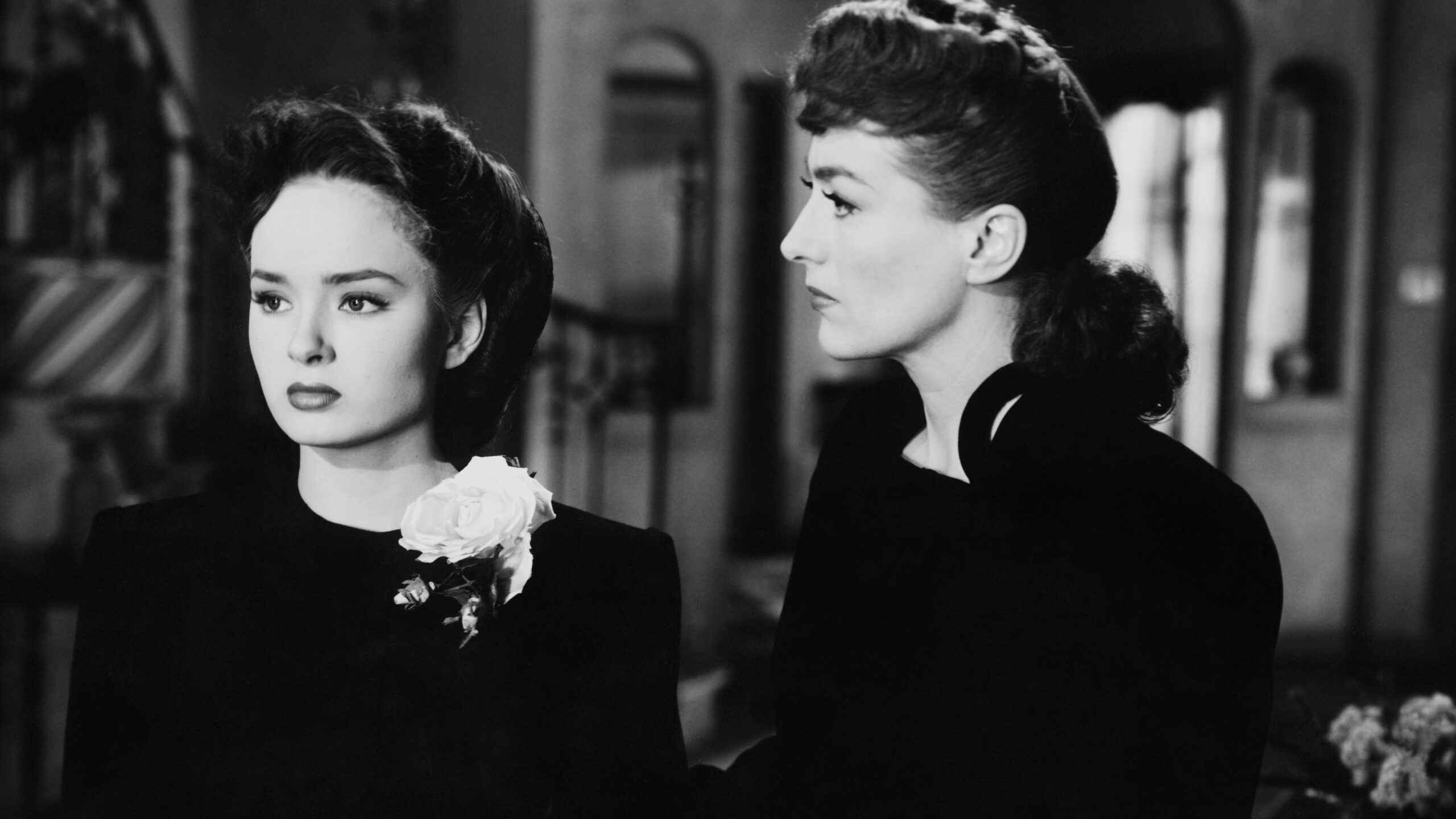
Unlike the novel the film centers around a murder investigation hen Mildred’s second husband is shot dead at his beach house, providing a flashback framing device for the film’s script. This adaptation also eliminated several sub-plots from Cain’s novel due to the restrictive production code enforce on all Hollywood productions at the time.

Crawford delivers a compelling and powerful performance. I was pleasantly surprised to find Eve Arden, whom I had primarily known for her much later career work in the 70s, here as Mildred’s sharp toothed friend. Arden displays a talent for delivering a cutting the remark that would serve her well throughout her career.

Directed by Michal Curtiz the film is competently produced and never lacks for pacing or a strong sense of style despite being hampered with an overly melodramatic scrip and more than a few dry performances in addition to the, even for the period, overly racist caricature of Mildred’s servant girl Lottie, played by Gone with the Wind’s Butterfly McQueen.

While the tacked-on murder plot adds a criminal element Mildred Pierceunlike some of Cain’s other works can only be considered noir adjacent and not noir itself.

HBO has produced a limited series adaptation of the novel which hewed much closer to the original story and not shying away from elements of infidelity and incest.

Share

Quick Hits July 17, 2020

Burn the GOP to the Ground


Pence would have been far from perfect but leaving corrupt incompetent Trump in has made the pandemic far worse and that is entirely at the feet of the spineless Republican politicians.


 The Towering Inferno Still Holds Up.


I’ve been watching this on HBO (I have the DVD, but HBO is in High Def.) and thoroughly enjoying a style of filmmaker that has fallen out of favor. Loads with stars and taking the time to tell stories. Though you gotta wonder about a team of firemen walking around with plastic explosives and detonators.


New Story Ideas beginning to bubble in my brain


This damned crisis, both global and personal, has been sapping my creativity but an idea for another Sf/noir is starting to take form in my head. It would be on a generation ship where sharp distinct classes have formed between crew and colonists and the murder that shatters the secrecy at the heart of the noir.

Share

Columbia Noir: Human Desire

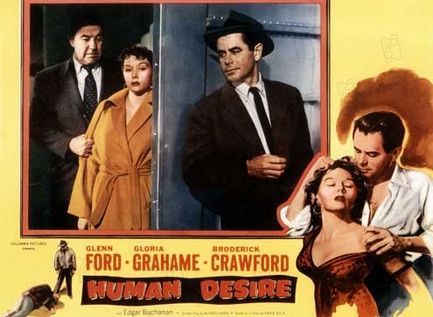
This weekend I continued my exploration of the Criterion Channel’s collection Columbia Noir with Human Desire.

Human Desire is the story of Jeff Warren (Glenn Ford), recently returned home from the Korean War and now resuming his job as a locomotive engineer. In his absence the Assistant Yard Supervisor Buckley, (Broderick Crawford) has married a much younger woman Vicki, (Gloria Grahame.) Before long there is jealousy, robbery, and murder the staples of American Noir. This is very much like the descriptionprovided by the Criterion Channel and it is in my opinion

dŽsirs humains
human desire
1954
rŽal : Fritz Lang
Broderick Crawford
Gloria Grahame
Glen Ford
Collection Christophel

quite misleading and capture where I think the film took its initial and consequential misstep. The entire movie is told from Jeff’s point of view treating the unfolding events as principally his story and it really isn’t his at all. The story should have been written and presented from Vicki’s point of view. When Buckley, a brute and intellectually challenged man, is fired from his position it falls to Vicki to win him his job back but in doing so triggers his violent jealousy launch a series of events that will entangle Buckley, Vicki, and Jeff in robbery and murder as she desperately tries to survive.

Despite its erroneous point of view Human Desire is a film worth watching. Glenn Ford plays the sort of role that he is best known for the fundamentally decent man though in keep with noir’s traditions he has a difficult time resisting temptation. Broderick Crawford as Buckley convincingly gives us both a man who is dangerous and unpredictable but also deeply flawed and trapped by his own self-doubted that is amplified by his alcoholism, but the real star of this film is the luminous Gloria Grahame. Grahame’s realistic portrayal of a woman desperate to escape her circumstances using the means and methods at her disposal without sliding across into evil is a wonder to behold.  Grahame appeared in many great noirs and died too young at 57 but her star continues to shine bright through her performances such as this one. Direct by Fritz Lang is a competent film though a number of plot threads were either never completed or are used simply as audience misdirection. Particular attention in the story is paid to a distinctive watch and yet that element never closes back to a resolution.

Overall, I enjoyed watching Human Desire but I have no desire to add it permanently to my library.

Share

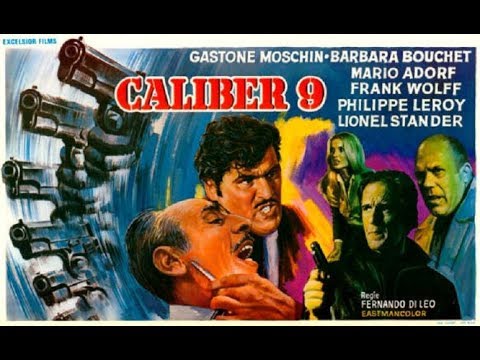
Italian Genre Cinema, Home Edition: Caliber 9

The COVID-19 crisis among other things stopped could the Film Geeks San Diego’s year-long presentation of Italian Genre Films that my sweetie-wife and I were enjoying so much. So, while we wait for the crisis to pass, we have been scrounging streaming services for gems of Italian Genre movie from the 70s and earlier. Last night we watched Caliber 9 1972.

I would classify Caliber 9 as an Italian neo-noir. It stars Gastone Moschin as Ugo Piazza a small time mobbed up crook just released from three years in prison. Unfortunately for Ugo both the police and the local crime boss, Mikado, believe that Ugo took part in the theft of 300 hundred thousand American dollars from the mob and that he has the money stashed away. Even Ugo’s girlfriend Nelly, played by Barbara Bouchet, thinks he stole the cash. When Mikado puts a particularly brute thug Rocco on point for finding out where Ugo has hidden the loot, thing begin to spiral out of control leading to murder and Ugo’s quest for revenge.

While the quality of these 70s era Italian exploitative movie can vary a great deal I thoroughly enjoyed Caliber 9. This film has a gritty, realism to it that helped sell the story to betrayal, greed, and fractured loyalties. It is not surprising that there is a re-make currently in post-production slated for a release this year, but between the trouble with foreign producers finding American distribution and the pandemic who knows if we’ll get a chance to see that in theaters at all. It’s a nice tip of the hat to the original that Barbara Bouchet will be appearing in the remake.

Caliber 9 is currently streaming on Amazon as one of the movies available to Prime Members.

Share

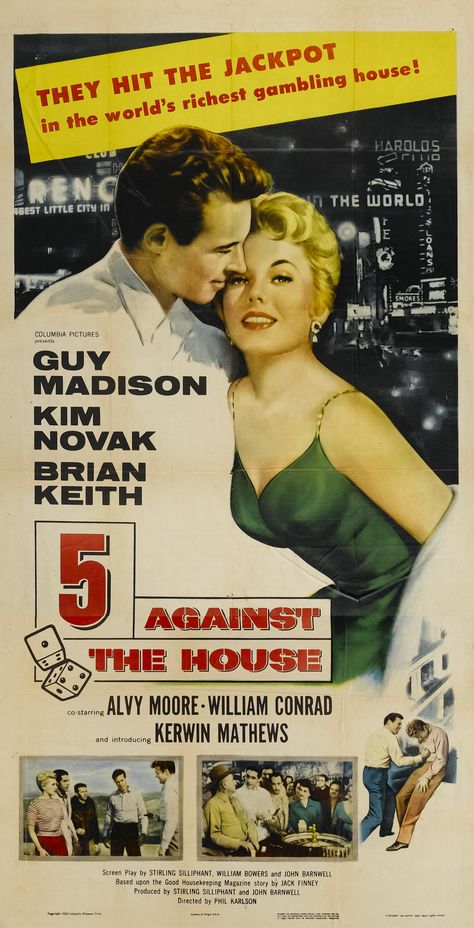
Noir Review: 5 Against the House

Continuing my expedition into Columbia Noir hosted on the Criterion Channeland early Kim Novak performances Sunday night I streamed the 1955 noir 5 Against the House.

Directed by Phil Karlson from a screenplay by Stirling Silliphant and John Barnwell based on a novel of the same name by Jack Finney who is better known for penning the novel The Invasion of the Body Snatchers. 5 Against the House is about a collection of college students that decide to rob a Reno Casino as a prank with intentions to return the money. Naturally the plan goes from prank to plot when one of the students seizes on the idea that this sudden influx of cash will end his troubles.

While the characters attend Midwestern College, they are older than the usual student body because they are Korean War Veterans going to school on the G.I. Bill, particularly Al, played by Guy Madison, whose life was saved in combat by ‘Brick’, played by Brian Keith. Brick suffers from what is now known as PTSD and struggles both academically and socially due to his difficulty integrating back into civilian life and leaving the horrors of the battlefield behind. His instability coupled with a tendency towards violence drive much of the films tension for the second half.

My trouble with this movie is that while there is taunt tension in the second half the first is devoid of any serious conflict and none that concerns all of our major characters. Al wants to marry his girl Kaye, played by Kim Novak, but she’s uncertain about their love and skittish to commit while the others in the friendly clique engage in freshman hazing and comic banter that is well written but serves no function in advancing the plot, making this 83 minute feature feel much longer. The actors rang from adequate to quite engaging with the obvious star power of Novak and Keith driving much of this movie’s appeal.

Share

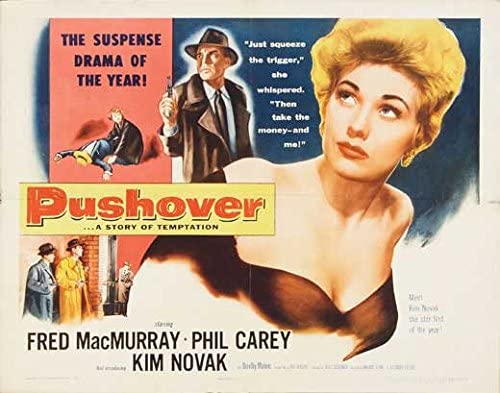
Columbia Noir: Pushover

Continuing my exploration of the Criterion Channel’s hosting of a number of noirs from Columbia studios I watched Pushover from 1954. The movie stars Fred McMurray, a decade after his turn as Walter Neff in Double Indemnity, E.G. Marshall, Phil Carey, and introducing Kim Novak. Directed by Richard Quine and with a screenplay by Roy Huggins based upon two different stories. This is not the only time two source materials have been combined into a single screenplay though the best-known example of that process is probably The Towering Infernowhich was adapted from the novels The Glass Inferno and The Tower, this movie is a serviceable noir, better that Drive a Crooked Road but not quite on target.

McMurray plays police detective Paul Sheridan, who along with his partner Rick (Carey) is staking out Lona (Novak) the girlfriend of a man wanted for bank robbery and murder. Paul’s boss stresses that after Lona leads them to their suspect, he is to be taken alive so that he can disclose where hundreds of thousands stolen from the bank has been hidden. Paul become at first infatuated and then emotionally entangled with Lona and eventually hatches a scheme to, using his duty as an excuse, kill her boyfriend, and then take off with her and the stolen loot. Getting to this point in the film takes about half of the 88-minute running time and felt like a tire re-tread of Double Indemnity. Once Paul’s less than brilliant plan goes astray complication upon complication pile on his haphazard improvisations with escape becoming less and less likely.

During the set-up of this movie I was scarcely engaged with this cruder version of Wilder’s far superior film but once Paul’s plan derailed I became more invested. The nature of the plan’s failure was nicely established but without blaring klaxons announcing that establishment and I found it very credible that a person once they crossed the line discovers that were never the nice and good person that they had imagined themselves to have been. Still that didn’t justify the tedious and well-trod first half and aside from Novak most of the cast seemed to be sleepwalking through the establishment. Perhaps what makes Pushover unique as a noir is that Novak’s character is not a femme fatale and generates considerable sympathy because she is not the murderous schemer.


Share

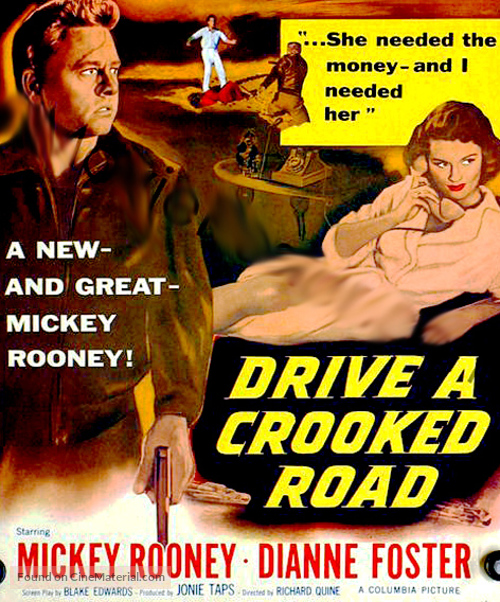
Classic Noir: Drive a Crooked Road

Part of the Columbia Noir series running on the Criterion Channel Drive a Crooked Road stars Mickey Rooney in a dramatic lead along with Kevin McCarthy a couple of years before his encounter with Pod People in Invasion of the Body Snatchers and Diane Foster in the role of the obligatory Femme Fatale.

Rooney plays Eddie Shannon a mechanic and a driver in local car races. After coming in second in a race Steven Norris (McCarthy) and his partner in crime Harold (Jack Kelly) single out Eddie as someone without a family or a girlfriend, perfect for their scheme. Playing upon Eddie’s social awkwardness and self-consciousnesses over his prominently scared face Barbara (Foster) seduces the naïve Eddie emotionally manipulating him so that he will be willing to assist the gang in a daring bank robbery that requires his impressive driving and mechanical skills.

With a brief running time of just 83 minutes Drive a Crooked Road doesn’t have the room to fully explore either that characters or the situation but rather races from plot element to plot element ticking off the elements of a story without ever fully engaging the audience. Directed by Richard Quine from a script by Blake Edwards and Quine this movie presents a serviceable premise that fails to deliver. An overreliance on under cranking the camera, lowering the frame rate artificially acceleration the action on screen, along with an intrusive musical score that doesn’t know when to back off and allow the actors to carry a scene Drive a Crooked Road ends up feeling cheap despite boasting an impressive and skilled cast. While the story is a classic noir set-up and pay off, he did it for the money, he did it for the girl and he didn’t get either the money or the girl, this film spins its wheels without ever reaching a destination.

Share

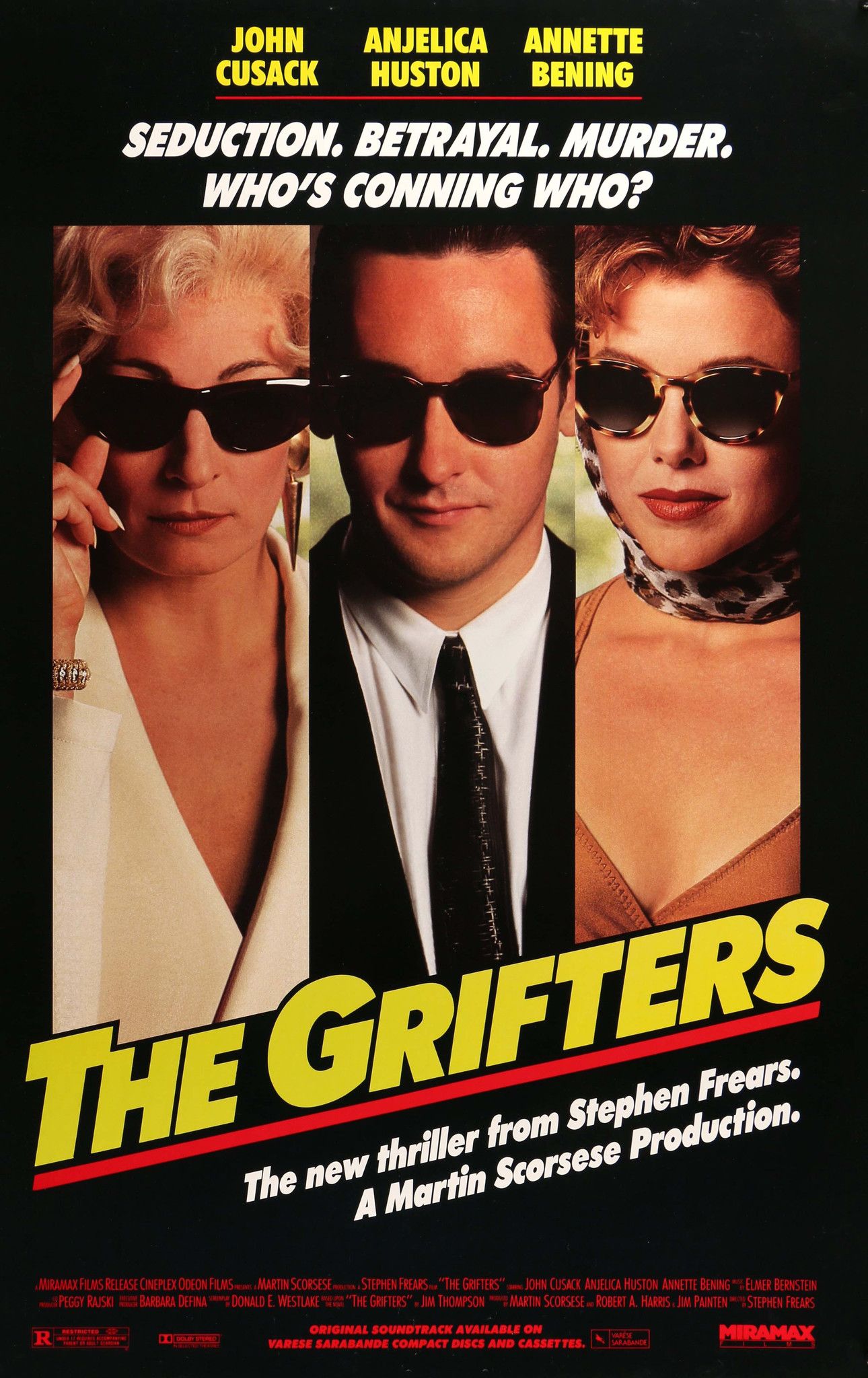
Streaming Review: The Grifters

I remember wanting to see the neo-noir back in 1991 when it played at a local art house theater. Somehow, I never made it to the theater and missed the movie entirely.

The Grifters, adapted from the novel of the same name, stars John Cusack, Anjelica Huston, and Annette Bening as con artists, i.e. grifters, Roy, Lilly, and Myra respectively . Roy is Lilly’s son but because she was so young when he was born he was passed off as her younger brother for most of his life. Lilly works for a major Maryland mobster, Bobo, traveling to racetracks and placing large bets to reduce the odds for longshot horses and is estranged from Roy. Roy is a short con artist, playing trick on marks that pay off quickly with elaborate set-up allowing him to avoid most form of legal entrapment and enforcement. Myra is a long con artist looking for a new partner and is involved with Roy though at the start of the story neither are aware that they are both grifters. Grievously injured by a mark, Roy lands in the hospital bringing all three of the character together and dynamic of the triangle are established. Lilly wants her son out of the racket and to go ‘straight,’ Myra wants to displace Lilly as a major influence in Roy’s life, and Roy struggles to find a way to satisfy both women while maintaining his independence. Stakes quickly rise and soon it becomes a matter of life and death over Roy’s stash of cash and his relationship with Lilly.

Directed by Stephen Frears and produced by Martin Scorsese The Grifters is a bleak, cynical look at humanity and the self-destructive nature of greed and the need to dominate. I enjoyed the film thought I found the ending less than fully satisfying. While the story and plot are both resolved I tend to prefer for a story to force a character to make a choice, a hard, difficult choice, rather than having an impulsive action produce unintended consequences that resolve the conflicts. This is not the same as a deus ex machina where an unestablished power or character magically removes the troubles but rather in this case a realistic and predictable outcome comes from a moment’s anger rather than a character making the decision to produce that final outcome.

Still, I am glad I watched the film before it finished its run on The Criterion Channel at the end of the month.


Share

Noir Review: The Sniper

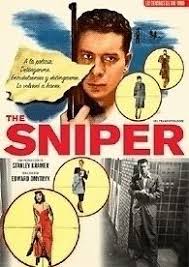
Recently a friend and I watched The Sniper as part of The Criterion Channel’s March programing of Columbia Noir. This movie, released in 1952, is shockingly relevant today and presents a story and complexity about its central character well ahead of its time.

Directed by Edward Dmytryk, who also gave us one of my favorite films The Caine Mutiny, and written by Harry Brown, The Sniper is focused on Edward Miller a troubled young man recently released from prison. Miller struggles against a deep-seated hatred of women and after a couple of attempts to get help fail and he is romantically rejected Miller loses control and begins a murderous spree as a sniper killing dark haired women. The police led by Lieutenant Frank Kafka and his partner Joe Ferris are nearly helpless to catch Miller. Stuck in a mindset that looks for motive their focus on peeping toms and men with a history of sexual assault their investigation gets nowhere until the department’s psychologist Dr. Kent, redirects their attention by use of what would eventually become psychological profiling. In a final inversion of classic film tropes, the ending doesn’t rely upon exciting gunplay but instead leaves the viewer with a haunting image of a man in pain.

When we decided to watch The Sniper with its subject matter of random murder we expected a film that leaned heavily towards the exploitive but instead we were treated to a thoughtful, though occasionally didactic, and serious treatment of the problems American society has, then and now, in dealing with psychological trauma and the use of a prison system in lieu of hospitals. Aside from one scene where the plot is brought to a full stop to allow for speechmaking by the filmmakers The Sniper does an excellent job of presenting its themes within the context of a compelling narrative. This one is well worth seeking out and watching.


Share

Sunday Night Movie: Murder by Contract

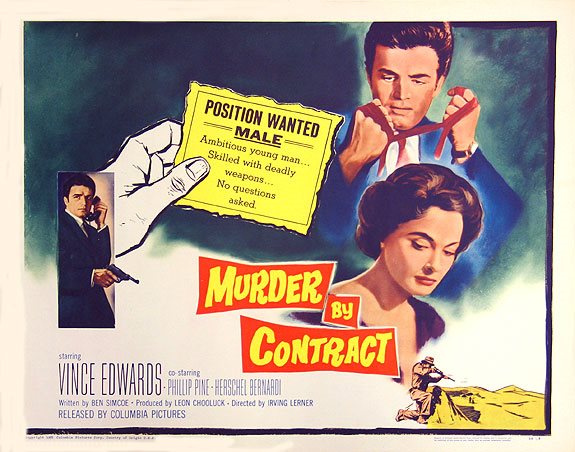
Apparently, the Criterion Channel recently dropped a bunch of noir films into their streaming service. Yesterday as I browsed the ‘recently added’ queue I stumbled across noir after noir and the titles were unknown to me. Under the limitations of a time and temperament I selected Murder by Contract as the one to watch Sunday night.

Hailing from 1958 Murder by Contract is a low budget quickly produced film noir centered on Claude and man with large dreams and no empathy. Claude leaves the respectable life of an upright citizen and becomes an assassin for the mob in order to secure the funds for his dream home. Curious for a character of this type and profession Claude rejects firearms for most of his contracts and quickly establishes himself as a killer of unusual competence. The mob sends Claude out west to Los Angeles where he meets up with two local hoods, George and Marc, for the most challenging assignment of his cruel career where nothing goes as anyone planned.

Though the word is never used in the film Claude is presented as a sociopath. He professes to have taught himself to have no feeling but it is more likely that this is a justification for the character than an actual achievement. His intellect and cool demeanor carry him through most of his assignments unperturbed but as this final contract goes awry the illusion of his self-control crumbles.

Shot in seven days Murder by Contract presents the material in a spare and unadorned style. Aside from Vince Edwards as Claude who would later go on to portray Doctor Ben Casey from 1961 thru 1966, the aspect of casting that leapt out to me was that four future Star Trek (the original series) guest actors also appeared in the crime drama, Phillip Pine, who played the genocidal Colonel Green in the episode The Savage Curtain, is the hoodlum Marc, Kathie Brown plays a secretary who moonlights as an escort and she appeared in the episode Wink of an Eye as Deela one of Kirk’s alien romantic conquests, Joseph Mell who plays Harry also was in the pilot for Star Trek as a trader from Earth who sparks Pike’s interest in the Orion slave woman, and finally David Roberts as a Hall of records clerk but got a promotion to doctor for the episode The Empath.

While lacking the depth of characterization found in classic noir such as Double Indemnity and with a jazz inspired soundtrack that bordered on irritating, Murder by Contract still proves to be an interesting entry in the sub-genre from the end of its classical period.

Share