Category Archives: noir

Spider Noir

.

Spider-Man: Into the Spider-verse introduced to the silver screen a number of Spider-Man variants with its central protagonist being the young Miles Morales but one of the favorites to emerge from the strange, animated team up was Spider-Man Noir, a 40s styled, film noir, detective enhanced with spider-like abilities, and voiced with manic perfection by internet favorite Nicolas Cage.

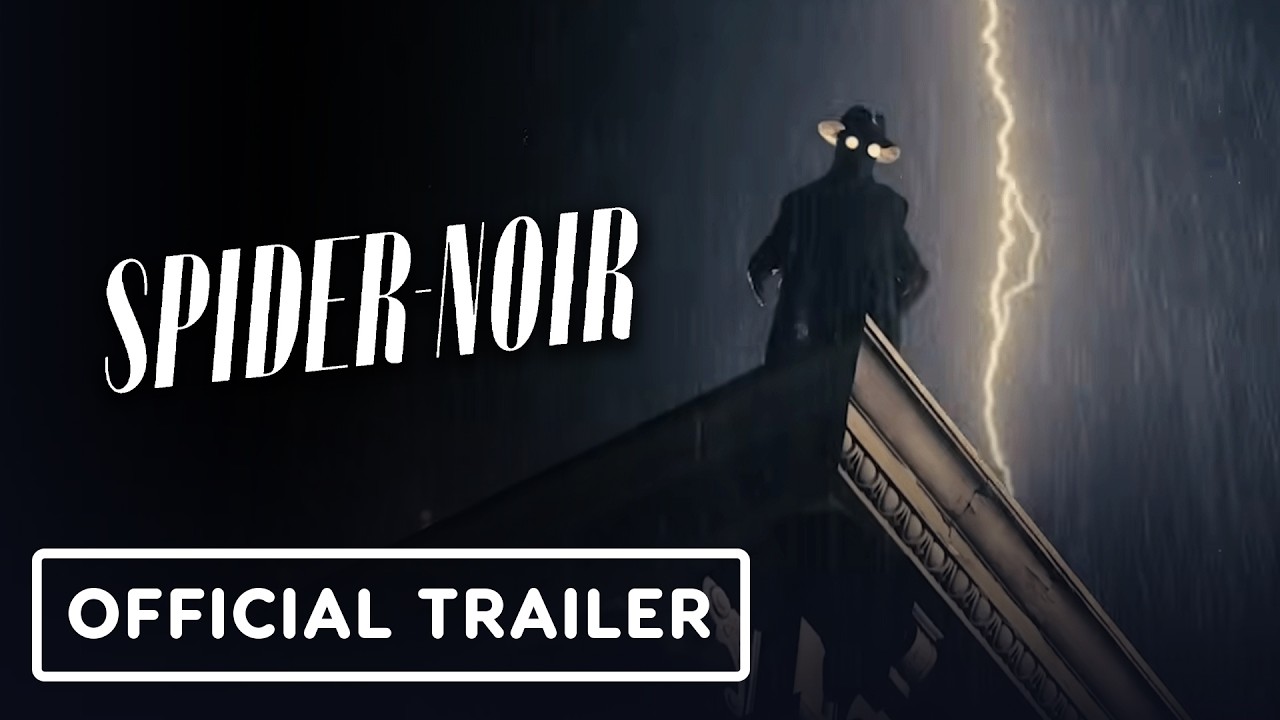
Last night I stumbled across the trailer for a new television series premiering on Amazon Prime in May 2026, Spider Noir, a live action continuation of the adventures of Spider-Man Noir, starring Nicolas Cage.

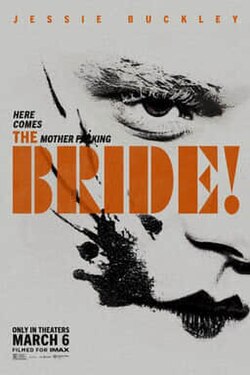
Much as my love of Warner Brothers’ gangsters movies and classic Universal monsters is making it impossible for me to sidestep The Bride! this mash-up of film noir tropes with the over-the-top manic style of Cage makes Spider Noir equally irresistible.

Just as the trailer was reaching its end, I thought to myself, it is a bloody shame that the series is not in glorious black-and-white. One of the more amusing aspects of the Spider-Man Noir character in the animated film was his puzzlement over things with color as he continued to be rendered in a stark greyscale. Then the trailer’s image suddenly shifted to black-and-white accompanied by text indicating the program could be watched in either format.

Man, I hope they pull that off well.

A few films in the last decade have released black-and-white versions to home video going for that vintage film noir aesthetic, three notable ones were Logan, Mad Max: Fury Road, and Nightmare Alley. I have seen all of these movies, which are each exceptional examples of the cinematic arts, but honestly only one of them really worked in Black-And-White.

Both Logan and Mad Max: Fury Road looked simply like the film’s color data had been deleted, the greyscale nature of the image had none of the life or vibrancy of a shot composed and production designed for Black-and-White cinematography. del Toro’s remake of the film noir classic Nightmare Alley on the other hand, looked better in its Black-and-White version than it did in the full color rendering. I do not know this for a fact, but I would bet dollars to donuts that del Toro guided every aspect of production design and photography with a monochrome sensibility in mind, but, aware that the studio would balk at releasing it solely in that format. Nightmare Alley, though dragged down by a bit of casting, in both color and in Black-and-White looks fantastic, just better in the monochrome that evokes both the pre-war period of the story and the associations with classic cinema.

Monochrome cinematography is not just shooting with B&W film, or digitally removing the color data, it is understanding that color itself registers differently when photographed in Black-and-White. It is knowing that blood looks too pale and something dark brown is more ‘realistic’ than photographing a crimson liquid or knowing that colors that may garishly clash when seen in their full hues can be very complimentary in greyscale. There lies the real challenge of making a production for both color and Black-and-White, resolving those conflicts between the different requirements.

Did the production team of Spider Noir design from the ground up for both color images and Black-and-White? I do not know but man, oh, man I really hope that they did.

.

youtube placeholder image

Share

The ‘Dead Men Don’t Wear Plaid’ Project

.

When I went to the theater with my friend Ray in 1982 to see Dead Men Don’t Wear Plaid, it was not because I was a deep fan of detective movies or film noir. Steve Martin and Carl Reiner were enough of a selling point to motivate me to see this comedy, and it’s something I never regretted.

Dead Men Don’t Wear Plaid is both a satire and a salute to the detective and film noir films of the 1940s and 1950s, with Steve Martin as Rigby Reardon hired by Juliet Forrest (Rachel Ward) to investigate the mysterious death of her father, a famous scientist. Rigby’s investigation brings him into contact with numerous shady and dangerous characters before leading him to a cadre of Nazis in South America bent on continuing the war with America.

What makes this film special is that it’s a collage project with most of the shady and dangerous characters that Martin interacts with as Rigby carefully edited scenes from classic movies of the period. By careful use of over-the-shoulder shots, sets and costumes crafted to duplicate those seen in the archival footage, and sometimes the use of doubles photographed without their faces visible, the illusion that Martin is actually in these scenes is delivered with a degree of sophistication that’s impressive.

A few years after seeing and thoroughly enjoying this movie in my Introduction to Cinematography course I was exposed to some of the more important films that Dead Men Don’t Wear Plaid used in its collages and my fascination with film noir began.

Last month I got the idea it might be fun to make it a challenge to watch every one of the 19 classic movies that this film borrowed clips from. By my own count, I’ve seen eight, leaving eleven yet to be experienced. I made a list, organized it by IMDB ratings, and decided to start from the lowest rated and work my way to the highest, skipping none—making this a mix of films new to me and old favorites.

  1. Double Indemnity (1944) – 8.3
    2. White Heat (1949) – 8.1
    3. Suspicion (1941) – 8.1
    4. The Killers (1946) – 8.0
    5. The Lost Weekend (1945) – 8.0
    6. In a Lonely Place (1950) – 8.0
    7. Notorious (1946) – 7.9
    8. The Big Sleep (1946) – 7.8
    9. Sorry, Wrong Number (1948) – 7.7
    10. Dark Passage (1947) – 7.6
    11. The Glass Key (1942) – 7.6
    12. The Postman Always Rings Twice (1946) – 7.6
    13. I Walk Alone (1947) – 7.4
    14. This Gun for Hire (1942) – 7.3
    15. Humoresque (1946) – 7.3
    16. Deception (1946) – 7.2
    17. Johnny Eager (1941) – 7.1
    18. Keeper of the Flame (1942) – 6.9
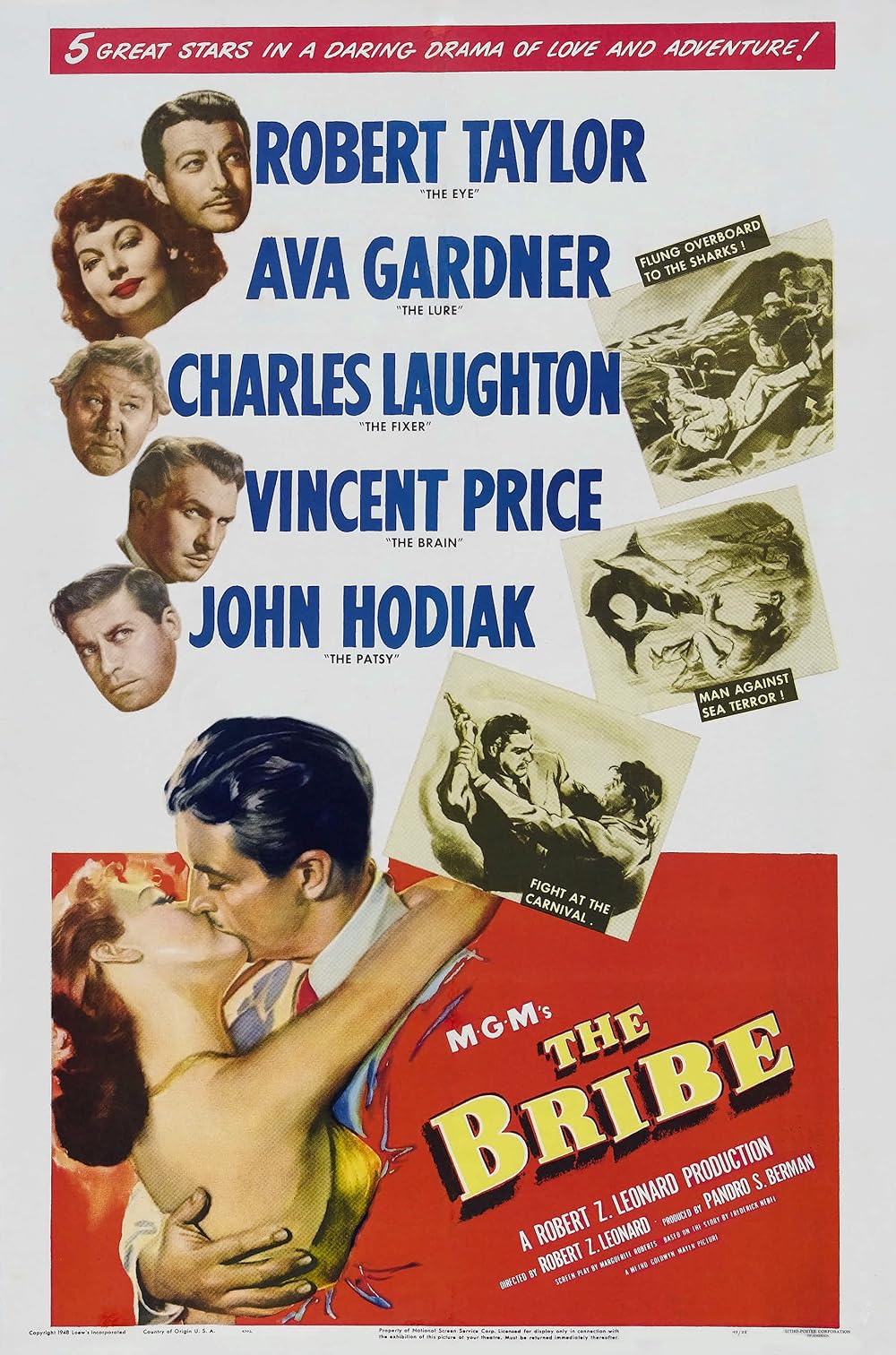
    19. The Bribe (1949) – 6.8

My project ran into immediate trouble.

The Bribe, which fascinated me most from the clips utilized by Reiner and Martin, was not streaming anywhere, nor was it available even as a video-on-demand (VOD) rental. There had been a single release on DVD 16 years ago in 2010 and long out of print.

I didn’t want to abandon this project—it seemed fun to me—but I also hated the idea of skipping some of the films that violated the very essence of the endeavor. Surrender seemed to be the only option until I remembered one tiny little fact: the San Diego Library System has DVDs.

A quick search of the catalog revealed that they had two copies of The Bribe on disc, and so soon, my friends, I will begin the climb up that list as my 2026 cinematic venture.

Share

Movie Review: Three Strangers (1946)

.

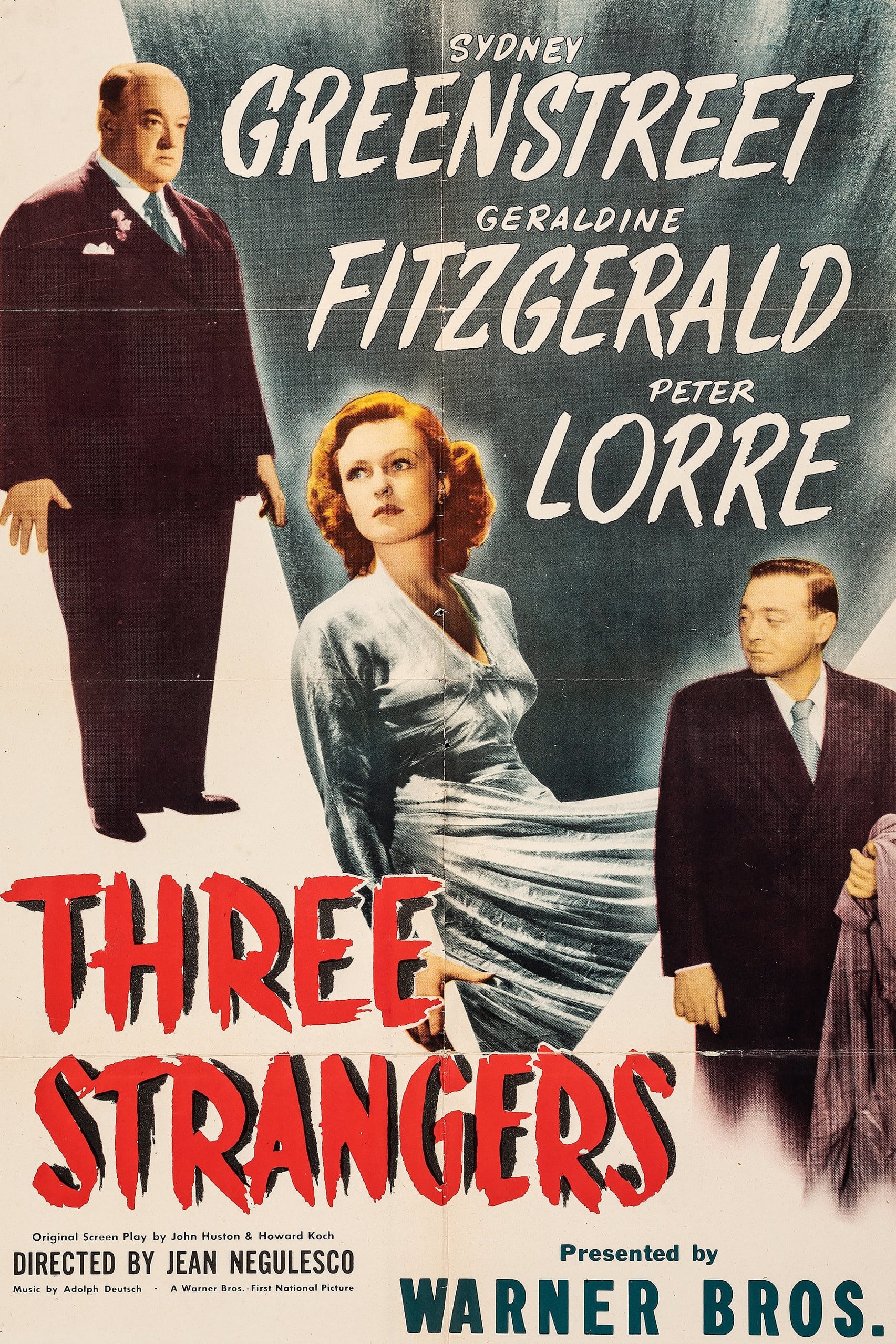
Counted among Warner Brothers’ film noir catalog, Three Strangers shares a thematic aspect with The Night Has a Thousand Eyes in that it is a noir with a strong atmosphere of the supernatural about it.

Warner Brothers Studios

A mysterious woman wordlessly lures a man to her apartment in London. Once inside another man, obviously intoxicated, rises from the sofa. The woman explains that she also invited this gentleman, again without knowing anything about him, even his name. She speedily explains that at least for the moment, they must not reveal their names or anything about themselves to each other. In her apartment she has a statue of the Chinese goddess Kwan Yin and at midnight as the new year begins, it is said that the goddess will open her eyes and grant a wish to three strangers, provided that they wish for the same thing. They agree to wish for money via a lottery ticket for the national horse race. They sign the ticket, making it a contract amongst themselves, using a blotter to obscure their names as they sign so no one sees another’s name.

They wait for midnight, gazing at the candle-lit statuette. The hour is struck, and a wind extinguishes the flame, plunging the room into darkness. By the time the candle is relit, the hour has passed. Then Crystal Shackleford (Geraldine Fitzgerald), who can now safely reveal her name, insists that she saw the statuette’s eyes open, as the myth insisted. The first man, Jerome Arbutny (Sydney Greenstreet) insists he saw no such thing, with the third person, Johnny West (Peter Lorre) taking no serious part in the debate if the eye opened or not. The three go their separate ways, Arbutny cynical that anything serious has transpired, West willing to believe but more interested in more drink to fuel his alcoholism, and Shackleford devout in her faith that this idol will bring about fortune for them all.

The rest of the film follows the three through their troubled lives. Arbutny has embezzled funds from a trust he manages for an eccentric widowed peer, the discovery of which will ruin him financially and reputationally. West, in a drunken stupor, was shanghaied into being a lookout for a burglary that went badly and ended with the murder of a police officer. Shackleford instigated the entire affair in hope of winning back her husband who, after unspecified marital difficulties, has taken an extended business trip to Canada. Each person’s life spirals more and more out of control. Arbutny finds no source of funds to cover his theft and his client is now suspicious. West ends up taking the fall for the murder one of his compatriots committed, and Shackleford’s husband returns, demanding a divorce so he may marry his new love. When the lottery ticket turns out to have drawn not only the name of a horse in the race but one favored to win, the film turns to its final act without ever addressing if it had been mere chance or supernatural forces at work as the characters suffer the consequences of their choices.

Three Strangers is an fascionating sort of film noir. Produced in 1946, it is early in that genre’s formation, so the dipping into the supernatural is not an attempt to revitalize a form but one that rose organically when John Huston conceived the story. It is a film I have heard of for quite some time and this week finally got around to watching. In terms of film noir, there are better movies that I will revisit much more often than this one, but it is also interesting enough to warrant watching and with a collection of characters that are entertaining with all their faults; Icy the woman who loves West despite his drinking, Gabby their accomplice in the robbery who is a brute but one with a code and the clerks working in Arbunty’s office all give the film charm and depth. . I really like how the supernatural—not only Kwan Yin but the spirits of the dead visiting their loved ones—is handled so deftly that it can be mere coincidence or actual evidence that there is much more to the world than what we can see, hear, and touch. Three Strangers is a gritty crime noir that suggests perhaps the world is not as material as it appears.

Share

Nordic Noir Review: Freezing Embrace (Hautalehto)

.

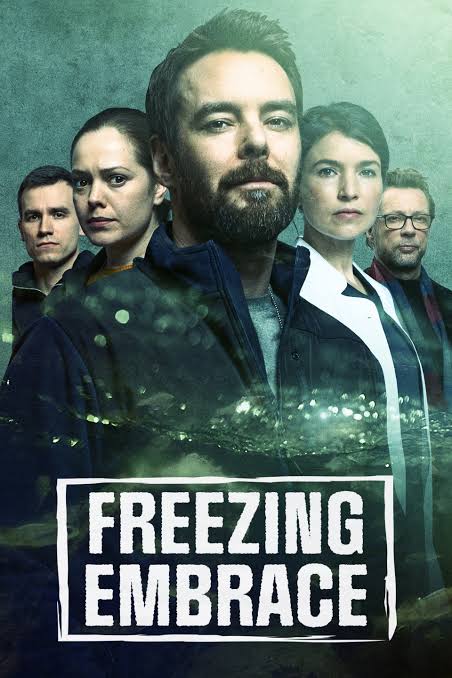
Having finished Arctic Circle and Reindeer Mafia my sweetie-wife and I turned to a series new to us on the streaming service MHz Choice, Freezing Embrace (Hautalehto in Finland).

Solar Films

Adapted from a novel by Christian Ronnbacka, Freezing Embrace follows Chief Inspecter Annti Hautalehto (Mikko Leppilampi) as he deals with a number of issues, the finalized divorce from his wife, his police chief’s potential slide into alcoholism, his best friend’s potentially unstable son joining the police force while a serial killer who targets and murders young men by drowning them in the icy river. As bodies pile up, the evidence more and more begins pointing to his best friend’s son, a skilled diver, as the murderer.

While I found Freezing Embrace less engaging than either of the other two series I mentioned at the start of the post, and despite in many ways it being a by-the-numbers drama of serving on a police force, the disrupted personal life, the troublesome superiors, the seemingly willful blindness of the national forces, the characters and performance kept the show from feeling routine. I was particularly impressed by Leppilampi in the series. He had been a supporting player in Arctic Circlewith a very different character and quickly with this series I wholly accepted Antti as a distinct person with nothing that overlapped with the character from the other show.

I did find it amusing that when the entire mystery has been resolved and everything about the murderer’s motivation laid bare that the plot for this season was, in fact, a serious, dramatic rendition of the plot of the original Friday the 13th.

Share

ESL or Bad Acting?

.

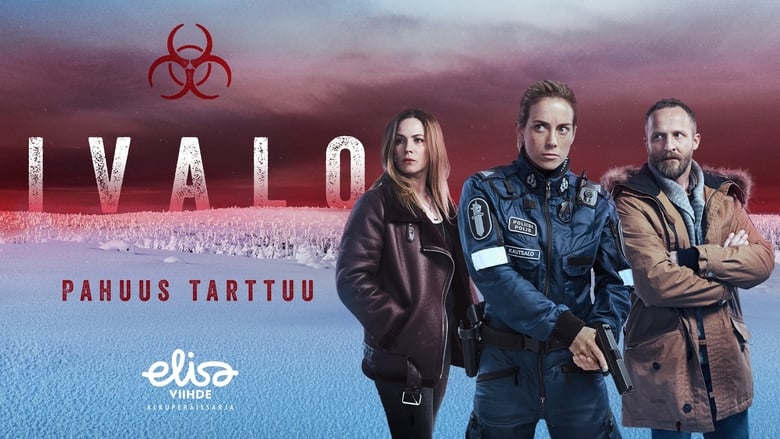
My sweetie-wife introduced me to the joys of Nordic Noir, films and programs from the Scandinavian nations dealing with murder and investigations. One of our favorite shows is Arctic Circle, following the career of a police officer, Nina Kautsalo (Lina Kuustonen) in the far north of Finland as over the season she climbs from a patrol officer, through detective, to Chief of Police for the small town of Ivalo.

The current season we are watching, season 3, deals with a billionaire’s self-driving automobile being tested in the harsh Lapland winter, corporate espionage and murder, along with Nina’s continuing familial dramas. A key character in the corporate evildoers’ plot is Walter Blakeney, an American ex-special forces man who has done security work across Europe and has a quiet, heated temper.

There is not a lot of dimension to Walter’s character for any actor to play. We learn nothing about his life outside of his security work and the fact that he’s perfectly willing to do anything to achieve success. He does curse quite a lot when angry, and that has been the most jarring moment of his performance. Cursing, particularly when it’s a string of curses, is a lot like singing. There is a beat and a rhythm to it. It is pure emotion spilling out of a character unguarded and unconstrained.

But not for Walter.

His always came out with a closed, stilted cadence lacking a naturalistic flow or meter. I wondered if the actor was perhaps not a native English speaker and as such found the fast flow of angry cursing difficult to perform. It’s more common in British television to find Brits putting on an accent and trying, to varying degrees, to pass as American, and certainly this could have been the case here. It wasn’t. The actor was born and raised in America, moving to Finland in 2000. He just can’t pull off naturalistic cursing.

What a shame.

Share

Movie Review: The 4th Man

.

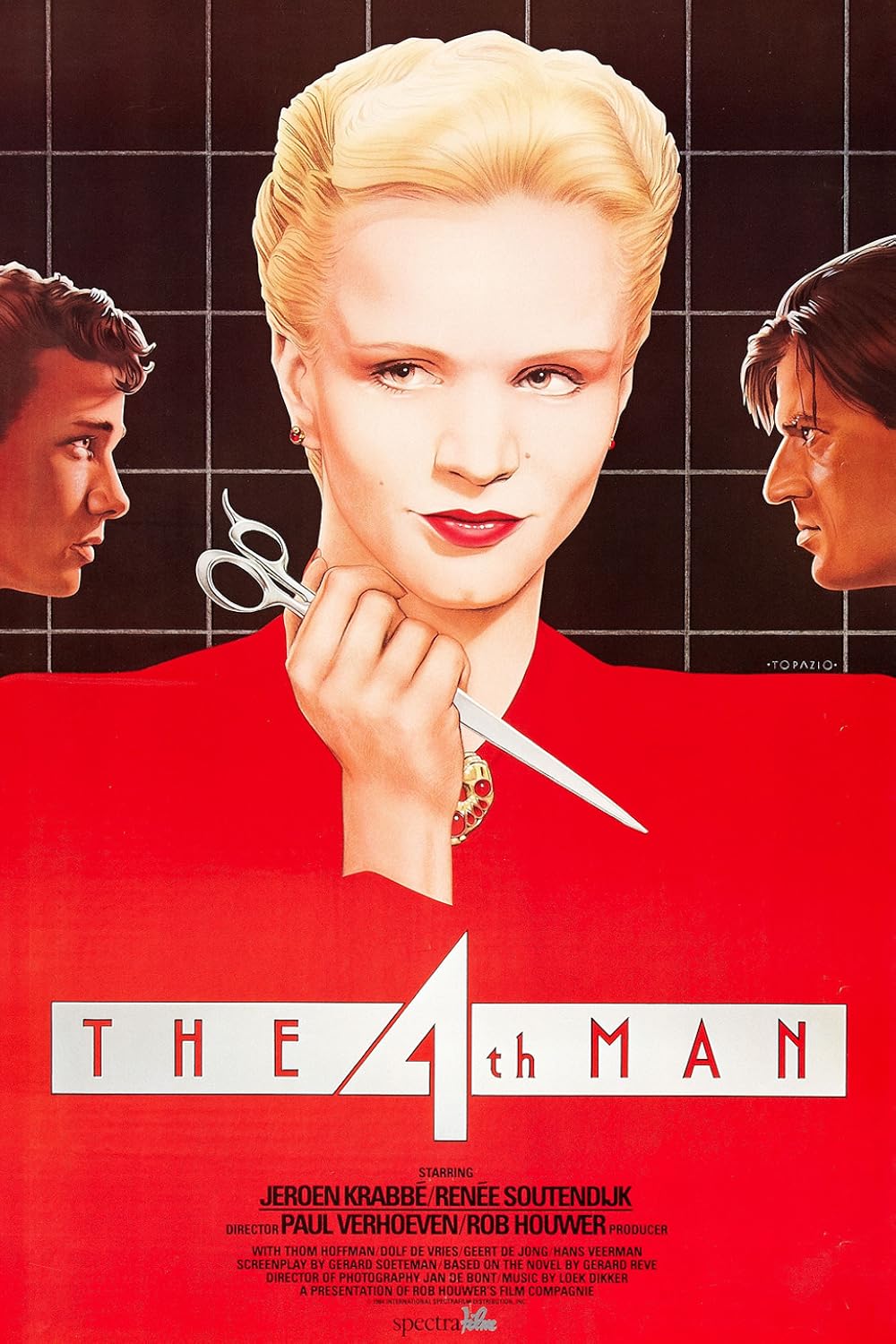
While researching films that played, particularly in the art houses of San Diego, during the summer of 1984 for my work in progress, I came across a newspaper ad for Paul Verhoeven’s The 4th Man and became quite intrigued.

Searching all the online streamers yielded the result that no one had the film available, nor was it available for a Video on Demand rental or purchase. The fact that the movie seemed impossible to watch only enhanced my curiosity about it. Eventually I found a copy in the public domain section of the Internet Archive and after much toil and trouble got the subtitles working as the film is in Dutch. So, this past weekend my sweetie-wife and I watched The 4th Man.

Verenigde Nederlandsche Filmcompagnie

The story centers on Gerard Reve, a bisexual novelist and clearly on the path to severe alcoholism. After fantasizing about murdering his roommate and lover, Gerard takes a train to another city to give a lecture to a local literary society. Along the way he becomes fascinated by a strikingly handsome man he briefly sees in the carriage of a passing train and is also haunted by strange delusions or visions of a seemingly threatening woman.

After the lecture and experiencing seeming confirmation of his frightening visions, Gerard accepts an invitation from the society’s treasurer, Christine, to stay the night at her home and business. The pair become lovers, but Gerard continues to have disturbing dreams and visions, some of which present Christine as a murderous woman killing off her former lovers. When her current lover Herman returns from his business trip, Gerard is shocked to see it was the same handsome man that had fascinated him at the train station. Now with his sexual desire for both Christine and Herman burning strongly, Gerard’s visions or delusions also intensify and he must discover if they are truth and if he or Herman is destined to become the 4th man murdered by Christine.

Given the similarities in theme—a potentially murderous woman, bisexuality, and explicit sexual scenes—The 4th Manis often compared to another Verhoeven film, Basic Instinct, with the director himself calling The 4th Man a spiritual prequel.

The 4th Man is a stylish erotic thriller that is uninterested in providing the audience with any solid answers to the questions it raises. Gerard’s visions might be prophetic flashes of both future and past or they may be delusions of an alcohol-soaked brain. Christine may be a spider luring men into her parlor and their deaths or she may be a woman tragically unlucky who has suffered the loss of several lovers. It is for the viewer to determine which is the more likely scenario. While watching this film I turned to my sweetie-wife and commented that “David Lynch probably loved this movie.” My feelings were only intensified by the lush, lovely, and captivating cinematography of Jan de Bont. There is absolutely no doubt that The 4th Man is a masterpiece of photography, even with its limited budget.

I have no idea if the movie will make it to the pages of my work in progress—elements of it fit perfectly with my cast of characters—but whether or not it makes an appearance, it was worth the viewing.

Share

Movie Review: Honey Don’t

.

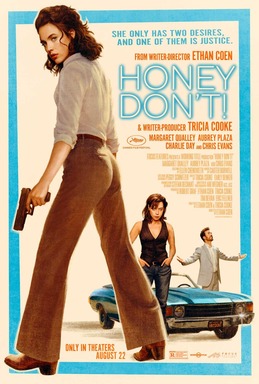
The second in Ethan Coen and Tricia Cooke’s planned trilogy of ‘lesbian B-Movies’ Honey Don’t is the story of Honey O’Donahue (Margaret Qualley) a private detective in sun-blasted Bakersfield California.

Focus Features

When a prospective client dies in a single car traffic accident, Honey begins investigating which brings her into the orbit of police evidence officer MG Falcone (Aubrey Plaza) and the pair begin a heated and powerful relationship, bonding over the shared trauma of terrible fathers. The investigation brings to Honey’s attention a Christian church of questionable morality led by the charismatic and corrupt preacher Drew Devlin (Chris Evans.) Things become more complicated when Honey’s niece, Corinne, (Talia Ryder) fails to return home after her closing shift at a local fast-food joint.

At a breezy 89 minutes Honey Don’t is a fast and easy watch but perhaps the film is a bit too breezy. In the resolution of the mystery and when revelations come to light Honey connects dots that I have no recollection of ever being presented to the audience. Now, this is not a terrible thing in a black comedy neo-noir, this is not the Agatha Christie movies of revealing the killer in a murder mystery with clues withheld from the reader, but it would have been nice to have had the same set of dots that Honey possessed.

That weakness noted, and this film has not been gathering great reviews, I enjoyed Honey Don’t with much of it dark and grisly humor working quite well for me. This movie is fairly explicit in the sex scenes, both the heterosexual encounters and the lesbian ones, so be aware of that when you watch it. Given that this is directed and co-written by half of the Coen Brothers team it has the collection of odd and offbeat characters one can expect from Ethan Coen but much more sexually explicit than the team tended to produce together.

This is not a film for everyone, its various plot threads do not eventually all resolve into a single narrative but rather appear more like ‘slice of life’ where life is criminal, corrupt and darkly comic. I do not consider it a waste of my time to have seen Honey Don’t in a theater but for many this may work perfectly well as a home experience.

Share

Movie Review: Siberian Lady Macbeth

.

A Polish film from 1962, Siberian Lady Macbeth is an adaptation of the 1865 novel Lady Macbeth of the Mtsensk District, which has been adapted into an opera and films since 1962.

Kino Video

Katarina is an unhappy wife living on a large estate with many serfs, ruled by an overbearing “master” Boris, to whose son she is married. Childless and joyless, with her husband away dealing with some far-flung emergency, Katarina begins an affair with a recently hired serf, Sergei. Katarina and Sergei conspire and murder Boris when he returns so Sergei may become the “master” of the estate. Their idyllic future is threatened by the arrival of distant relatives with a claim on the estate. Burdened by guilt and with suspicion against the couple growing, their relationship frays, leading to the story’s inevitable tragic conclusion.


Siberian Lady Macbeth is not an adaptation of the classic play but rather takes its title from the central conceit of a woman manipulating the men around her into murder. The story is presented more as a film noir, with characters driven by their base desires and greed into inescapable situations. While this film was produced in Poland, it in many ways adheres to America’s Production Code, both in the depiction of onscreen sexuality and violence and the compelled moralistic ending.

The copy streaming on Kanopy is not restored and displays many scratches and blemishes due to its age but is still quite watchable.

Overall, I am glad to have seen this film, but I can’t say that it ranks very highly among my favorite noirs nor my favored adaptations of Macbeth. There are several shots, particularly of the windswept and foggy estate that serves as the story’s central location, that were reminiscent of 1957’s Throne of Blood, my favorite non-Macbeth adaptation of the tragedy.

Share

Series Review: Mobland

.

On April 1st I reviewed the first episode of the Paramount+ television series Mobland. Last night my sweetie-wife and I completed the first season, and I can now talk about it as a whole.

Paramount+

In the show two crime organizations, the Harrigans, an Irish family and the Stevensons, an East-London family are on the brink of war over control of the fentanyl trade in London. Conrad and Maeve Harrigan (Pierce Brosnan and Helen Mirren) are the elder parents that rule their family

with ruthlessness and manipulation. We see less of Richie Stevenson (Geoff Bell) as the Harrigans are the focus of the series, mainly through the eyes of their primary fixer and enforcer Harry de Souza (Tom Hardy). The Stevensons and the Harrigans inevitably go to war, the principal focus of the season, with only one family slated for survival.


The series presents a bewildering collection of characters associated with Harry, his family, and the Harrigans, often with their own subplots and schemes that interact with the war that breaks out between the criminal gangs. In my opinion there are too many of these side characters and stories, some of which I still cannot accurately describe in plot or in importance.

That said, I enjoyed Mobland and was quite pleased that the conflict between the Harrigans and the Stevensons concluded at the end of season one. Enough plot threads lay unresolved that the series can continue while still presenting a complete tale in its first season. The acting was generally brilliant, and I am sure Brosnan thoroughly enjoyed playing a right bastard of a character.

All ten episodes of the first season are now streaming on Paramount+.

Share

Movie Review: Night has a Thousand Eyes (1948)

.

John Triton (Edward G. Robinson) a stage mentalist working with his fiancé and best friend instead of the manipulated performance begins having spontaneous and accurate psychic visions. After several come to pass precisely as he envisioned, Triton flees, leaving his fiancé and friend without an explanation, hoping his absence will avert her death that he foresaw.

Paramount PIctures

Isolating himself from humanity and surviving by making mail-order tricks, Triton desperately avoids contact with people, unwilling to foresee more tragedy. However, when circumstances bring him into the orbit of his former fiancé’s daughter (Gail Russell) and his visions again spell doom, Triton struggles to prevent the future that now seems predestined.

Night Has a Thousand Eyes is usually categorized as a film noir, but the paranormal aspects make this a difficult movie to place definitively into any single genre. Where noir is often propelled by human weaknesses such as lust or greed, Eyes finds its motivation in Triton’s deep desire to not be the herald of disaster. The seemingly doomed nature of his vision, presenting what appears to be a hard, unalterable future, gives this film a touch of horror. Triton is a tragic character and, like all really good tragic characters, he is very sympathetic. He never sought the power that came to define his life. He never understood it and wanted nothing more than to be rid of it. Fate commandeered his life leaving him as helpless as a leaf blown by a wind. Robinson gives a fine nuanced performance, and he is the heart of this film. had he been unable to exude the required pathos none of it would have worked.

When I began watching Night has a Thousand Eyes, even though it is not a terribly long movie, I expected to watch only a portion before going to bed, but instead it sucked me in, and I completed the movie in a single sitting. It is well worth the watch.

Night has a Thousand Eyes is currently streaming on the Criterion Channel.

Share