.
“No Matter Where You Go, there you are”. Dr. B. Banzai PhD, MD, MFA
I had intended to see the new horror film Backrooms on its opening weekend but a cluster of migraines kept me at home and it wasn’t until this past weekend that I managed to get out to the theater to catch this latest horror sensation.
A24
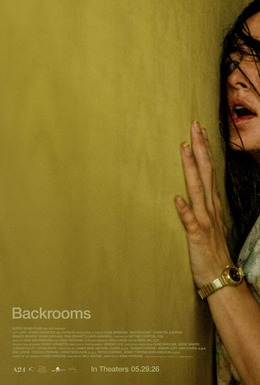
Backrooms, the brainchild of Kane Parsons and born of his internet posted short subjects, centers on Clark (Chiwetel Ejiofor) a man for whom life has not turned out at all the way he had hoped or wanted. Turned out of his home by divorce and living in his discount furniture store Clark listlessly seeks help from a therapist, Mary Kline (Renate Reinsve) but clearly struggles to make progress. Late one evening Clark discovers a portal in the sub-floor of his store that leads to an uninhabited and seemingly endless series of rooms and corridors laid out by some sort of inaccessible dream logic. Exploring the labyrinth Clark discovers terrors that echo his own distraught mental heath but remain beyond comprehension.
Liminal Horror entered the lexicon quite recently in 2019 with images of abandoned malls and disused spaces appearing on internet chatrooms and message boards. By 2022 Parsons began uploading short subjects of CGI crafted liminal horror to his YouTube account, developing a talent and fandom that eventually led to the feature film Backrooms with its attendant success and recognition. As a subgenre of horror liminal is the most mood defined. Where supernatural horror ranges from ghosts to demons, to witchcraft, and slashers are very specifically about a series of gruesome and on-screen ‘kills’ and zombies, either undead or virally induced, are about the implacable masses, liminal horror has no clearly defined monster at its core but consists almost entirely of atmosphere. In its purest form it would be possible to craft something that is recognizably liminal horror from a single still image. Backrooms, in its expanded feature film form, is more than liminal horror but rests, in my opinion, on a subgenre of horror just over a century old, cosmic horror.
Cosmic horror, perhaps best illustrated by the writings of H.P. Lovecraft, is the subgenre that while often reduced to tentacled monstrosities is at its center about the relationship between humanity and reality, but that reality as presented in the piece is far stranger and utterly incomprehensible to the puny human mind rendering it terrifying. It is not that there are simply great areas that lie unknown to humanity, but that reality itself is unknowable and our pitiful understanding of it is utterly in error. The horrific nature of the universe cannot be explained because it cannot be understood at all.
The strange, nightmarish world that Clark discovers in the sub-levels of his furniture store is never explained, with hints at the film’s conclusion that this is not the only occurrence. While the space, its shape, and its nature is twisted by the psyches that invade it, those psyches do not create nor do they dictate it, merely influence the bizarre and unpredictable events and forms it takes. The Backrooms are not constructed of timber and drywall; their nature is beyond human understanding and realizing just how far beyond our meager intellect it lies is the true nature of its horror.
I both rejoice in the tremendous success Backrooms is finding at the box office and fear it as well. There will be terrible pressure for a sequel, for a continuation of the story and if that comes to pass then each iteration will rob a little more of the mystery, will seek to explain a little more the terror until nothing at all is left to experience.
I opened this review with a quote from a classic cult film of the 80s because the Backrooms are the dark interpretation of that saying, no matter where you go you take yourself with you, and that includes the demons that haunt our every footstep and the loops of destructive behaviors we are unable to unlearn.
