.
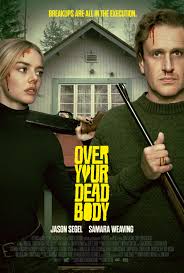
Last week I published a list of the summer movies I anticipated going out to the theaters to enjoy and here is my review of the first film on that list, the black comedy, Over Your Dead Body.
Independent Film Compan
Married couple Lisa (Samara Weaving) and Dan (Jason Segel) Burton have retreated to their isolated wooded cabin for the weekend, ignorant of the fact that each has plotted to murder the other as a solution to their marital troubles. Wholly inept as would-be killers their plans are exposed to one another but before either party can fulfill their rather simple and highly unlikely to succeed plots, the couple is confronted by a trio of strangers, Pete (Timothy Olyphant), Allegra (Juliette Lewis), and Todd (Andre Eriksen), that present a far more credible, if not equally comedic, threat to them both, resulting in the film climaxing with over-the-top, farcical, Sam Raimi-like gore.
Over Your Dead Body, adapted from the Norwegian film, I Onde Dager, (Streaming on Netflix with the English language title The Trip) works as broad comedy with a strong sense of the absurd. All of the actors involved play their characters well, walking that fine line between believable, credible persons and exaggerated caricatures, never straying so far on either side as to damage the entirety of the story or the project. The director and the screenwriters, Jorma Taccone and Nick Kocher & Brian McElhaney respectively, played an expert level of set-up and payoff through the film, with several moments that are first presented seem minor color details later revealed to be clever and subtle foreshadowing.
Perhaps the most elegant and deft piece of screenwriting centers around the possibility of a sexual assault that threatens one of the characters. (It is not the character that you would expect that is threatened, providing an inversion of the trope, sliding away from the terrible titillation that often accompanies such sequences in lesser movies.) Once this element arose, I became seriously concerned about the rest of the film. It looked as if the writers had maneuvered themselves into a nasty, ugly little corner. If they took the scene to its conclusion the tone of the movie would irreparably rupture never to return to its comedic color and yet once begun it looked as if there was no way but to play the scene out as it threatened. Their solution displayed the genius of the scribes and saved the movie. I salute such brave and inventive writing.
The film’s final act escalated into cartoonish, wildly impossible, and, for my tastes, hilarious gory violence. I suspect for some it may be a bridge too far which shatters their suspension of disbelief but for those who had correctly calibrated their engagement and understand the movie’s attitude, it should play perfectly.
Over Your Dead Body is a movie that is best seen in a theater, with few distractions and preferably an engaged and laughing audience.
