Monthly Archives: December 2025

When Mixing Genres Use Care: Arctic Circle Season 4

.

My sweetie-wife and I have now completed all the available seasons of the Finnish police procedural series Arctic Circle (Ivalo in Finland). The protagonist Nina in Season Three became the chief of the Ivalo police force and became entangled with a tech billionaire, his self-driving car company, and murders surrounding the launch of his newest product. That was a decent season and did not come off as a direct critique of any particular real-world billionaire with a self-driving car company.

Sadly, Season 4 proved more disappointing.
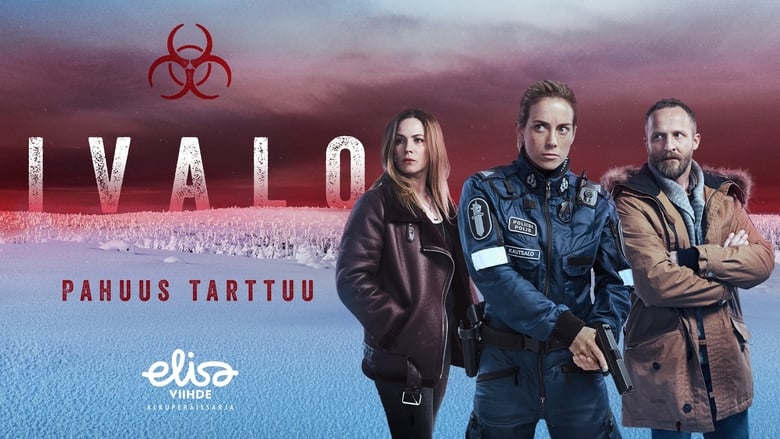
A comet is passing close to Earth, and a collection of international astronomers and scientists is gathering in Ivalo to study the object, but an American terrorist has also slipped past the watchful eyes of the FBI and escaped to the Lapland community. When the staff of a nursing home murders nearly all the residents, Nina discovers that a cult of Christian fanatics are in her town and they have a grand scheme based upon their twisted understanding of their splinter church’s teachings.

Now, just that would be a perfectly fine season-long arc. Nina has both professional and personal challenges—her formerly drug-abusing sister now a deeply committed Christian convert—and juggling being a professional and a new mother. But the series went off the rails when it introduced elements of the supernatural and made the religious beliefs reflect reality.

Characters get mysterious voices in their heads that actually are vital clues to solving the crimes. The comet, which we have been told visited the Earth about 2,000 years earlier and was the actual “Star of Bethlehem,” hangs in the sky and actually leads the police to the perps.

No, no, no.

Now, I have no issues with Christianity being real in the right sort of story. You can’t have The Exorcist without it. (As the sequels kind of prove.) The worldbuilding has to match the genre and style of story that is being told. True Detective successfully blends elements but also generally refrains from providing explicit answers.

Arctic Circle spent three seasons presenting grounded drama without any hints or suggestions of preternatural aspects to its worldbuilding. Trying to add them this late in an established setting is doomed to failure. You just can’t hand-wave Christ and Holy Signs into the story with literal, if subtle, divine intervention as a deus ex machina in the final episode. When you do that, you break the reality of the worldbuilding.


Share

The HBO Series About SpaceX has RUD’d on the Pad.

.

For those who haven’t been following—and that includes me—HBO had been in development on a dramatized limited series depicting Elon Musk and the founding and eventual success of his rocket company, SpaceX. Earlier this week, news broke that the series won’t happen and the rights to the biography from which some of the source material was drawn have reverted to the author. The series has suffered an RUD. (The ironic term SpaceX developed for when a rocket explodes instead of flying: Rapid Unplanned Disassembly.)

This news has disappointed many of SpaceX’s devoted fans, but I’m not sure such a series, at this time, would likely have been all that great. Don’t get me wrong—I think what SpaceX has achieved and demonstrated, the flight and recovery of orbital-capable boosters, is probably the most important development in aerospace since the jet engine. It’s the dramatized series itself that I doubt. I have a few reasons why I suspect it would have been difficult to pull off a truly great show.

1) We do not have enough historical distance.

Elon Musk, SpaceX, and the challenging rockets being developed are happening right now. They are not history; they are very current events. To tell such a story well, I think it’s important that enough time passes for the passions, partisanships, and preconceptions of those deeply involved to either fade or mellow.

2) Musk is still a very politically active agent.

Musk may or may not be the richest man in the world—stock fluctuations apparently change that title quite quickly—and he is reportedly thin-skinned. It would be quite difficult to make an honest dramatization of him and his nature at this time. No man is a saint, nor is any man entirely a devil; the best stories deal with people who are visibly a mix of the two. Whether Musk himself turned an unfriendly spotlight on the show if made to “look bad,” or whether those still angry over his DOGE activities thrashed the program for presenting him in too positive a light while entangled in today’s political passions, it’s doubtful any studio would have let the story unfold without heavy interference.

3) Whose Story Is It?

A story is about character and the changes and transformations characters evolve through over the course of their crisis. The most likely character for that treatment in a SpaceX story would have been Elon Musk himself, but that lands us even more solidly in the troubles of point 2. If your plot is compelling enough, you can dial back on character growth, but that requires a very clear, dramatic plot. Apollo 13’s Jim Lovell doesn’t really change over the course of the crisis, but the plot is blindingly clear: get home alive—simple and overwhelmingly dramatic. “Can we get a rocket to fly and land?” is not as dramatic, no matter the technical and engineering challenges. Without a central dramatic challenge, you need a strong character arc, so I ask again: whose story is it?

In the end, I think the “died in development” outcome for this proposed show is probably, at this time, the right outcome.

Share

Final Revisions and Themes Are in Sight

.

My gay, 80s, cinephile ghostly horror novel is now rounding the corner and racing down the stretch as I work on the final revisions hurtling towards the climax.

This has been a very interesting voyage on the writing ship. My first novel written without a guiding outline, my first period novel — albeit a period I lived in and in locations I knew quite well — and a novel that is sounding more and more literary as I grapple with the themes that organically emerged from the crisis and the characters.

The poor thing has had an identity crisis as I struggled to find a suitable title for my creation, but unlike Victor Frakenstein, I did eventually give it a name, Outrageous Fortune. Now, Shakespeare was not in my head when I started writing the text. Very little was in my head aside from certain aspects and things I wanted to play with as a writer, ghosts and a cursed motion picture film on dangerous nitrate stock, but when one of the characters announced that she was unwilling to suffer ‘the slings and arrows of outrageous fortune’ I knew I had stumbled across the title.

Thematically, my gay horror novel has delved into an existential question about morality in a cold and indifferent universe. If reality has no intrinsic morality — show me the particle that carries the ‘good’ or ‘justice’ between elements of matter — then the only morality that exists is the morality we conjure by our actions and our thoughts. But if we perceive a moral quality to our actions then that becomes something we cannot un-perceive and it is the knowledge of the meaning we have prescribed upon an indifferent universe that binds us.

Outrageous Fortune is quite unique among the novels I have written, the most thematically complex and with the most explicit sex scene of my writing history, only time will tell if I can find a market for it.

Share

Movie Review: Wake Up Dead Man

..

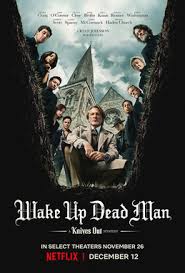
Wake Up Dead Man, the third Knives Out mystery, opened to a limited theatrical release on Thanksgiving, the day my sweetie-wife and I saw it, and will be available on Netflix, the service that produced the project, on December 12th.

Netflix

Daniel Craig once again stars as Benoit Blanc, a private detective noted for solving perplexing and intricate cases of murder. Blanc has been drawn to a small New York town where the local Catholic priest, Jefferson Wicks (Josh Brolin), was murdered, with suspicion falling on the parish’s junior priest, Jud Duplenticy (Josh O’Connor), whose troubled past—which includes a short, fiery temper and killing a man during a boxing match.

As is standard for murder mysteries of this sort, there is a large cast of characters all with seeming motive to murder Wicks, despite at one time being devoted to him. Being a Knives Out mystery, the case is stacked with notable names all thoroughly enjoying themselves.

I enjoyed the movie, felt it clipped along at a decent pace, but my sweetie-wife felt there were moments in the middle where it slowed too far and that it could have been cut. The story does present a number of reversals where you believe a solution has been presented and then that answer is demolished. Perhaps one of those false resolutions could have been removed without damaging the film, but if so, this is a very minor fault in the production.

It is a shame that Netflix won the bidding war 5 years ago after Knives Out surpassed $300 million at the box office and thus required that the sequels be primarily streaming affairs with brief—too brief—runs in actual theaters. Wake Up Dead Man, unlike Glass Onion, is much more of a traditional murder mystery and doesn’t engage in a restart of the story halfway through the run time like Onion did. (Do not get me wrong, I loved Glass Onion, but I don’t feel it’s really all that much of a mystery as it is Johnson having fun playing with the tropes of a sequel.)

If you get the chance to see Wake Up Dead Man in the theater, take it; otherwise, it will make a fine evening’s viewing at home on Netflix starting December 12.

Share

After Action Report: Loscon 51

.

After working at the day job with my schedule shifted from its routine 9-6 to an early morning 7-4 my sweetie-wife and I made the drive from San Diego to Los Angeles for Loscon 51, the 51st Los Angeles Area Science Fiction Convention.

Now, Loscon starts the morning of ‘Black Friday’ but as I will never have the seniority to win the bidding to have that Friday off from work I am resigned to the fact that I can never make programming any earlier than 8pm on the con’s opening night.

Saturday was a different story. Not only were we there for the full set of panels and presentations but I had the privilege and pleasure of participating as a panelist on a pair of them.

1:00 PM I took part in a discussion of apocalyptic fiction, its uses to transmit to coming generations warnings of the dire threats that they would face. We also addressed the tangle that if we, the previous generations had left the world in such bad shape why should anyone paid head to our warnings?

4:00 pm was a much more lighthearted discussion as we tackled the voyage of the McGuffin. We discussed many famous cinematic McGuffins, the difference for McGuffins that are active in the plot and required by the characters for its resolution and passive ones that don’t do anything in the story but are the treasure/item that is sought by the characters.

Saturday evening, after the sweetie-wife and I played out customary games of Dominion online, I visited the open room parties for a while, taking part in conversations, snacking on junk food and soda, and having a wonderful time. After the parties I found a quiet corner and worked on the revision for my novel.

Sunday, I participated in three panels, Developing a Creative Habit, AI & Science Fiction, and I closed out the convention with a discussion of Spiritually in Science Fiction and fantasy.

Directly after the final panel, It was time to climb into the auto and drive home to San Diego. All in all it was a glorious weekend.

Share