There has been a rather lengthy hiatus in this series as I dove into edits of my novel and composing a new short story, but I have returned to the topic, coming around to perhaps the most important decade in SF cinema except for the 1950’s.
First up I’ll discuss the moon-sized shadow eclipsing all SF films of the 70’s and later;
Star Wars (1977)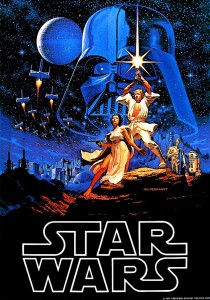
I think it is difficult for people who came of age later to appreciate just how monumental Star Wars was in the history of cinema. It is part of the triumvirate that created the block-buster phenomena that Hollywood continues to chase to this very day. (The other two films being JAWS and THE GODFATHER.) Science-Fiction simply had never been as big as Star Wars before and that sort of success casts a might long shadow.
Looking at SF films of the 70’s everything before Star Wars gets lost in the uproar of that space fantasy and everything after it is compared to it. While Hollywood had been moving in fits and starts towards adult science-fiction in the 1970’s with film such as The Omega Man, The Andromeda Strain, and Logan’s Run, the arrival of Lucas’ baby shunted all that aside for a generation as the studios chased after the next massive box-officer adventure.
However the influence of this movie reaches far beyond the pale imitations hurried into production and the senseless pursuit of massive runs, how we watch , hear, and make films changes because of George Lucas.
Today’s theaters packed with digital projectors, multi-channel sounds systems, and comfortable seating owe a great deal of their evolution to Lucas’ and his foresight and insistence on exhibition as well as film production. Behind the scenes, Lucas’ advanced the technology of film making more in the twenty years post Star Wars that in all the years following the introduction of synch-sound, Digital effects, digital processing, non-linear editing, these are tools that make todays production look vastly different to films short and edited traditionally. When you shoot a home video on your camera phone and edit it on your home computer you are participating Lucas’ revolution, it’s that massive.
Selecting a second film for the 1970’s is a very tough thing. Any film produced and released before Star Wars pretty much had any lasting impact erased by the tidal wave that is Star Wars, any film made after Star Wars nearly always is following and in some case just bolding stealing, from Lucas’ massive hit. Personally I came down to two post Star Wars films for my second choice; Star Trek: The Motion Picture and Alien. Alien has been copied endlessly since it’s stellar release in 1979, but I think the broader impact it had was that in theatrical films it pretty much, singlehandedly, destroyed the professional explorer set-up. Before Alien interstellar travel was the domain of military and para-military experts, after Alien’s ‘truckers in space’ approach the professional explorer for all practical purposes vanished from feature films.
However I am going to go with
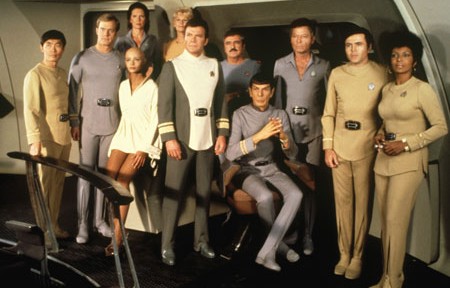
 Star Trek: the Motion Picture (1979)
After the success of Star Wars Paramount decided that the pilot that they had been planning for a new Star trek television series needed to be a feature film. The script wasn’t in great shape, and Roddenberry wasn’t an experience hand at feature film production. The $20 million dollar budget quickly vanished as the studio spent $40 million, the script was re-written as they filmed, and the production was troubled from the set to the special effects, but still the film was a hit, spawning a franchise of feature films that continue to this day, but I would argue that is not the lasting effect of Star trek: The Motion Picture.
The lasting effect came from the firing of Gene Roddenberry. Now out of the loop in the feature film department, he returned to his true love, television but this time with a Radical concept, a television show that would be sold directly to the stations, instead of a network, Star Trek: The Next Generation.
The success of the show paved the way for a flood of directly syndicated programming, most of it genre, laying the ground work for the fertile and rich television landscape we have to day in SF and fantasy. I don’t think we would have any of this with Star Trek: The Motion Picture.

 So after the racie war implications driving the plot of Conquest of the Planet of the Apes, 20th Century Fox, fearful that they had driven the kiddie away, took the next, and final, installment of franchise in a lighter and more optimistic direction. The screenwriter for the previous two sequel relinquished his duties, in part due to the dark nature of his proposed script and in part to ill health, while the husband wife team that penned the screenplay for The Omega Man came onto the scene.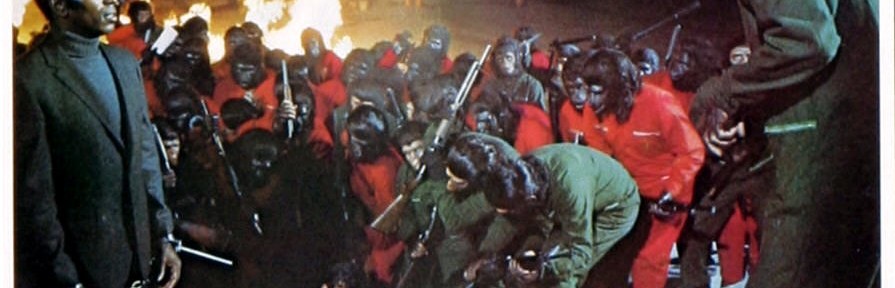
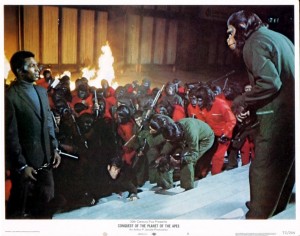 favorite film of the series, Conquest of the Planet of the Apes. While I love me Planet of the Apes and it is wonderful film, more often than any other in the franchise I will pull out the blu-ray of Conquest and sit back to watch it over and over. Once I did get it on Blu-ray I also stopped watching the theatrical cut and exclusively watch the unrated directors edition. When the film was released in 1972 they had hopes of getting a ‘G’ rating, but thee scene of revolution were so intense the studio feared they might get an ‘R’ and ordered the ending re-written and the footage edited to be considerably less graphic.
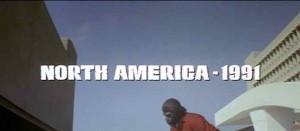 progressed from pets, replacing the cats and dogs that died in a global pandemic into a servant and slaves. Armando, the kind hearted circus owner last seen saving the time-traveling apes’ baby has returned to the city, bring the circus for a need tour, and along with it the now adult intelligent ape Caesar. (Whom was named Milo as a baby in the last film but hey retcon is nothing new.) thing go badly and before long Ceasar is a slave himself, alone and friendless, subject to the same brutal treatment as his ape brothers and sisters, including the producer’s wife in appearance number 3 in the ape movies. In the end Caesar lives up to his new name and leads a revolt overthrowing the fascist power structure in a brutal, bloody, and revenge filled night. The film ends with images of the city burning and nearly all of our principle human characters dead.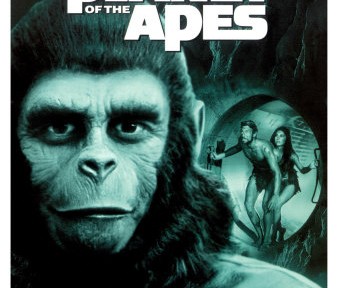
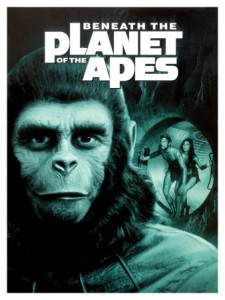 Beneath the Planet of the Apes is the hastily consider sequel to 1968’s smash box-office success Planet of the Apes. However due to financial troubles at 20th Century Fox and boardroom infighting the film suffered from a trouble production from the get-go. Heston, the star of the first film hated the very idea of any sequel and only reluctantly agreed to participate as a favor to Daryl Zanuck, but even this came at the price with Heston insisting that his character of Taylor — spoiler alert stop reading if you care, serious stop reading — be killed off in the story.
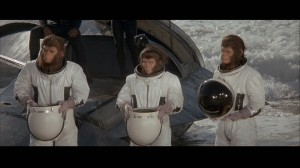 I can clearly remember seeing Escape from the Planet of the Apes at the Sunrise Theater in Fort Pierce Florida. That was 1971 so I would have been 10 years old, and I remember laughing a full belly laugh as the ‘unmasking’ scene at the film’s open. Escape faced the challenge of crafting a continuation of the story when in the pervious film not only did your principle characters get killed, but the entire freakin’ world was turned to ash as a gravely toned narrator informed the audience that the world was now dead.
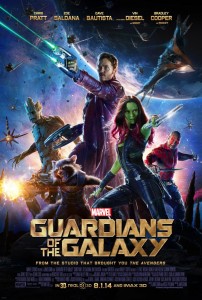 Guardians of the Galaxy (GotG) must count among the strangest concepts ever used to launch a major franchise. GotG concerns a collection of criminals and riff-raff that are thrown together with conflicting motives with the fate of the galaxy resting on their actions.
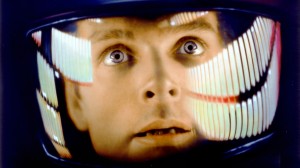 Stanley Kubrick’s brilliant and baffling masterpiece, 2001 is truly not only one of the most influential SF films of the 1960s, it is one of the most influential films of any genre of all time. It is groundbreaking in its style, scope, depth of concepts, technical mastery, and sheer artistry. Coming at the end of the decade, this movie raised the bar on what could be expected of a science-fiction film. Where Forbidden Planet brought in literature, 2001 demonstrated that SF, the genre of ideas in print fore decades and decades, could also be the genre of ideas on the silvered screen. Eschewing a traditional plot driven narrative, this film took us from the dawn of humanity through its eventual evolution beyond the cradle of Earth. It did this will a level of technical competence that forever changed what would be expected of a major SF film and set the stage for the dazzling spectacle in the next decade of Star Wars.
 film! Yes it is both of those things, a horror film, just as Frankenstein was a horror film, and it is not just a zombie movie it is the progenitor of all modern zombie movies. It is also, quite clearly, a science-fiction film. First off, co-writer and Direct George A. Romero has mentioned in interviews that the inspiration for this film was Richard Matheson’s novel, I am Legend, a story about a world overrun by scientifically explained vampires. In the film Night of the Living Dead, quite unlike Romero’s other zombie films, there is a clear explanation given for the rise of the dead and their transformation into murderous cannibals – radiation from the Venus probe. This radiation is what ‘activates’ the ghouls’ brains (the term zombie is never used in the movie and was grafted onto these revenants later) and it is what destroyed the brain destroys the ghouls. The cause and explanation is grounded in a scientific reason, though it is terrible science. So, like Dr. No, this is a movie that one rarely thinks of as SF, but clearly falls within those borders.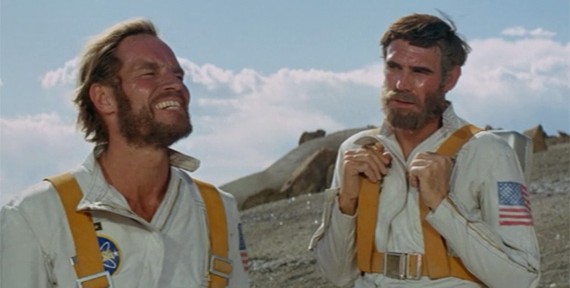
 Released in 1968 Planet of the Apes would certainly be on the short list for best SF movies of that or any decade, but I can tell you that it is not one of the two films I selected as most influential from the 1960s.