.
After watching Mike Flanagan’s limited series adaptation of the novel, I got the hankering to read Stephen King’s Carrie, a book I do not think I have re-read in four decades. Revisiting the text has been illuminating, both from a craft perspective and evaluating that no adaptation has captured the character of Carrie White that King created for his story.
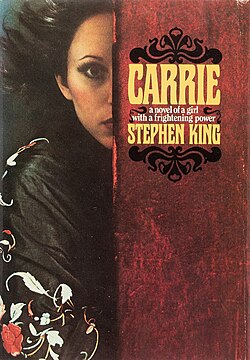
Doubleday
Carrie, King’s first published novel and one of his shortest at a breezy 61,000 words, hit the shelves in 1974, and I read it in 1978 as a hardback from my high school library. The story is quite straightforward: an ostracized teenage girl, after enduring a lifetime of abuse from both her peers and her hyper-religious mother, unleashes telekinetic hell on her high school and on her small town.
The novel’s blinding success has inspired two theatrical feature film adaptations, one made-for-TV feature film, a stage musical, and this year’s television series. I have seen Brian De Palma’s 1976 film, one of the very few horror films to get nominations for competitive Oscars, several times, the 2013 feature film version once, and, of course, the most recent adaptation; I have never seen the stage musical. With so many film versions floating around in my skull, I began to question just how much of the original text remained in my memory and how much of what I thought of as “Carrie” was from King’s work and how much came from elsewhere, and so I have started re-reading the novel.
I am pleased to find that much of what I remembered from the novel is accurate and on point. It is also interesting to see how much of the novel remains in both De Palma’s venerated film and Flanagan’s ambitious modern interpretation. There are bits of dialog and scenes that have been translated quite faithfully in both of those adaptations.
King’s approach to the material is quite interesting, as are some of the techniques that he employs in the text itself. The novel has a broken, non-linear structure with elements from fictional magazine pieces, government investigation reports, journalistic books, and even a memoir from a survivor of “Prom Night” occasionally interrupting the narrative, foreshadowing without explicitly revealing the exact nature of the terrible night that Carrie White goes to the Spring Ball. I find this technique quite similar to the one employed by Michael Crichton for his science-fiction thriller The Andromeda Strain (1969), which used footnotes to non-existent reports and investigations to create an atmosphere of grounded reality for its fantastical yarn.
Another non-standard practice King uses in Carrie is how he interrupts the narrative with a character’s unspoken thoughts. The convention I see most often to indicate this is placing the thought in its own paragraph, treating it like dialog, and italicizing the entire thought. King abandons the traditional method of dealing with interiority for something more jarring and more intrusive. The thought will often come not only right in the middle of the paragraph that is from the character’s point of view, but in the middle of a sentence, set off as a parenthetical lacking any form of capitalization. This bit of craft is very interesting, creating a sensation, at least for me, of what an intrusive thought feels like. Not something coolly and carefully considered, but an invasion that is jarringly out of place but undeniable.
While the story’s spine has been fairly faithfully adapted in the various versions I have watched, none of them actually capture the interior life of the novel’s central and title character, Carrie White. In each of them, Carrie has been presented in a sympathetic manner; they omit the darker, vengeful nature that her life has produced in the girl.
Anyone who has endured the torment of the U.S. public school system in middle school, or who understands that the thematic foundation of Buffy the Vampire Slayer is that high school is hell, can feel great sympathy for the tormented character of Carrie White. Certainly, the easiest interpretation, particularly for a visual medium, is to present Carrie as the person who was simply pushed too far and snapped, lashing out at everyone around her, in this case with nearly god-like psychic abilities.
But that is not entirely the Carrie White of the novel.
Yes, she was a girl tormented by her peers, enduring bullying that was entirely out of measure, and her mother’s fanaticism further made her life a hell on Earth, but Carrie was not without agency. She accepted Tommy Ross’ invitation to the ball because she carried her own crush on the young athlete but, armed with a lifetime’s experience with the other students, she accepted that the entire affair was a setup for yet another elaborate stunt to humiliate her. She did not go into that gymnasium blindly or unarmed. Having already discovered her fantastic abilities, Carrie White practiced, growing not only in skill but in sheer strength with her telekinetic power, fully prepared for ‘them.’
“Them” and “they” are terribly powerful pronouns. Generic and undefined, the pair are the favorites of conspiracists, transforming fellow human beings into something alien. Carrie White suffered at the hands of many of her fellow students, a torment that began in grade school and carried on right into high school, but it was far from a universal thing. Many of the students at the high school never spared a thought, good or ill, for the strange girl from the repressive household, but “they” allows for no such careful distinctions.
In the vengeful mind of Carrie White, everyone else at the school, and even the town of Chamberlain much of which she destroyed, was part of the hated “they,” and she went to the ball fully prepared, if this turned out to be yet another humiliation, to make them pay. This element is missing from the adaptations. We see nothing of the students who did no harm to Carrie White burning to death in the hellish inferno; the filmmakers transferred Carrie’s “they” from the character to the audience. It is the greatest divergence from the novel and the one that undercuts what I think King was saying to us: Carrie White had become a monster and thus “earned” her own tragic ending.
