.
Last night I completed my viewing of Mike Flanagan’s adaptation of Stephen King’s debut novel Carrie for Amazon Prime. Overall, I enjoyed the season and thought that Flanagan in many respects has elevated the novel’s story and plotting, but in the end, quite literally at the season’s close, it fell flat. I doubt that I will have much interest in the second season, and the manner in which Flanagan engineered a second season is much of the reason why this adaptation fails.
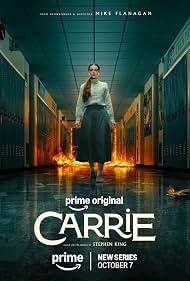
Amazon Studios
First, what I liked and what worked in Flanagan’s reinterpretation of King’s debut. Carrie, the novel, is a short book even by the standard of most novels, and by the standard of King’s later works it is practically a piece of flash fiction. When it was announced that there was going to be an eight-episode series adapted from the novel, I knew that much of what would end up on the screen would be invention not found in the source text. What remained to be seen was if this expanded material would enhance the story or be more like the trilogy of movies produced from The Hobbit, wandering so far afield as to lose connection to the story’s spine. I am happy to say that the expansion enriched the story and the focus remained on Carrie White as she navigated a world that was alien to her.
In the novel, Carrie has always attended public school along with her classmates, and this actually opens up an issue that I have no memory of King addressing. Since Carrie has attended physical education with her classmates into high school, even if Carrie’s mother, Margaret White, never discussed or explained menstruation to her, I find it beggars belief to accept that Carrie never witnessed it in any form among her peers. Flanagan’s choice to have Carrie homeschooled until her father’s death neatly avoids that fault in the backstory.
Flanagan also deepened and fleshed out the character of Margaret White, a vast improvement over King’s one-note crazed Christian caricature found in the novel. I have grown quite weary of King’s stock and stereotyped fundamentalist as an easy villain. While the Whites remained a deeply religious family and Margaret seriously socially conservative, Flanagan gave the character more understandable motivations and the sense of a person with contradictions and someone who struggled to find her own way in a world to which she was, in many ways, as alien as her daughter. As the story climbs the rungs of the ladder of escalation that ends with the “Black Prom,” Margaret is not simply a doomsayer and obstacle for Carrie but a voice that is sometimes one of reason as the school and the community hurtle towards disaster.
Continuing on the notes concerning characters and where Flanagan improved on the source text brings us to the story’s principal antagonist, Christine (Chris) Hargensen. It has been a number of decades since I read Carrie, so my memory may be a little faulty and colored more by the De Palma film than by the actual text, but, as I recall, King gave very little exploration of Chris’ character. Where the novel briefly touched on her father as lawyer who failed to save her from her exclusion from the prom, Flanagan crafts a more detailed home life and history of a father who is emotionally distant and a bully, behavior that Chris mirrors. I recall scenes where she and her boyfriend, Billy Nolan, plotted and carried out the hideous attack on Carrie but very little that explained, in any manner at all, why Chris was the way she was.
There is a fairly strong current over the last few decades, in film at least, of not only making the villains of a piece understandable but also a little bit right. Magneto’s experience as a European Jew who barely survived the Holocaust gives weight and authority to his argument that humanity and its racialized hatreds is the real villain of history. It is true that every villain is the hero of their own story, but that does not mean that every villain needs to have any sense of pursuing a worthy goal. With Chris Hargensen, Flanagan gives us enough of her life that we can understand without excusing her cruel and spiteful nature. She is a spoiled rich girl whose universe has always bent in her favor Now, as that world fractures and shatters and her entitlement goes unfulfilled. Instead of looking into herself and growing as a person, she lashes out, making others, particularly Carrie White, the recipients of her misplaced anger and frustration.
Another improvement is one I mentioned in passing earlier in this essay: the ladder of escalation. The novel opens with Carrie’s first menstruation and the cruel jeering she receives from her classmates, which leads almost immediately to Chris’ punishment and expulsion from the prom, which provokes the pig blood bath she and Billy carry out on poor Carrie. The reader is left to understand that there is a long history of Carrie being bullied and to accept this as justification for the rapidity with which the situation grew. Flanagan, having established that Carrie had never attended public school, crafted a series of incidents, each building upon the previous, that pushed the character of Chris further and further in her need to lash out and hurt someone for the shambles that her life had become.
Taking the story out of its mid-’70s setting and placing it into a contemporary environment with social media and school shootings and the vast web of conspiracy-addled subcultures proved one of the most challenging aspects of adapting the novel and one that Flanagan met quite handily. More than simply bringing cell phones and their cameras to the Black Prom, Flanagan integrated our current social issues and media into the story itself, making them essential rungs on that ladder of escalation that climbs to disaster.
With all these promising and praiseworthy elements, it makes the parts of the series that don’t work even more disappointing.
I found all of the teenage boys to be woefully underwritten.
Tommy Ross, Sue’s boyfriend, whom she convinces to take Carrie to the prom in her place, left no lasting impression in the novel, feeling more like a plot contrivance than a character, but he has even less to do in Flanagan’s adaptation. He spends six episodes either playing the devoted boyfriend or the sulking teenager when Sue, wrapped up in her own crisis, ignores him. It is only in episode seven that he takes any action of his own before briefly being cut down at the disastrous prom.
Billy Nolan, even more than Tommy Ross, is a device whose only function is to move the plot forward. My memory of Billy in the novel is of a sociopath who got sexual excitement from using his car to run down and kill dogs. In Flanagan’s version, he is a low-level drug dealer and not much more than that.
Moving beyond the thinly written teenage boys, I found it difficult to fully accept Flanagan’s opening up the world of Carrie to a constellation of enhanced and psychically empowered women beyond Carrie White. While King hinted at this when he closed the novel with a mother’s letter reporting that she watched her little girl move marbles without touching them, Flanagan introduces disciplined organizations of psychics, detecting each other psychic over vast distances, moving to recruit them. The series also introduces organizations that, seeing the psychics as an existential danger, hunt and murder them. Tonally, this moves the entire series from horror to nearly a superhero story. All this I might have been able to set aside had Flanagan not, with his radically altered ending, changed the very nature of Carrie.
Spoilers for the season finale follow.
Carrie at its core is a tragedy. The characters are trapped by their nature on a course that can only lead to their own destruction. The novel ends with Carrie White, racked with guilt at the death and destruction she has caused, bleeding out and dying. While some characters survived the hellish prom, there is no happy ending for anyone, and the end result of so much hatred and pettiness is fire and death.
Flanagan instead has Carrie White survive her night of retribution, saved by the psychic friends who have come to foil the hunter bent on Carrie’s murder and who spirit the young girl away for some undefined future.
This ending transforms a tragic conclusion into one that is disturbingly close to a victorious one. Let us be plainly clear here: in this story Carrie White murdered hundreds of people, the vast majority of whom not only had performed no act of cruelty towards her but in this very version had been in her corner, celebrating and honoring Carrie White. King was right in having her die at the end of the story: there is no redemption for her mass murder. Flanagan, setting up a season two, has in effect given a victory to what is for all practical purposes a school shooter. The ending as he crafted it is not one where a person who possesses both the ability and the temperament to murder on an unimaginable scale has frighteningly escaped but rather one where this person is given safety and support and is assured that she did nothing wrong. This ending inverts entirely the thematic nature of King’s novel. Perhaps Amazon/MGM pushed for something like this so they could have a franchise to profit from; perhaps Flanagan himself pitched this new take. Frankly, it doesn’t matter. The ending makes its case clear: it justifies murdering those who torment you, and collateral damage is of no consequence. That is a conclusion that drives me away from having any interest in the already announced second season.
