The PlayStation horror-themed video game Resident Evil spawned a film franchise that, from 2002 through 2021, comprised seven feature films and now, in 2026, the franchise is restarted with a new movie set in its own continuity.
Directed and co-written by Zach Cregger, Resident Evil (2026) reduced much of the lore and expectations from both the previous movies and the video game series itself, opting for a simplified structure and character set-up.
Sony Pictures
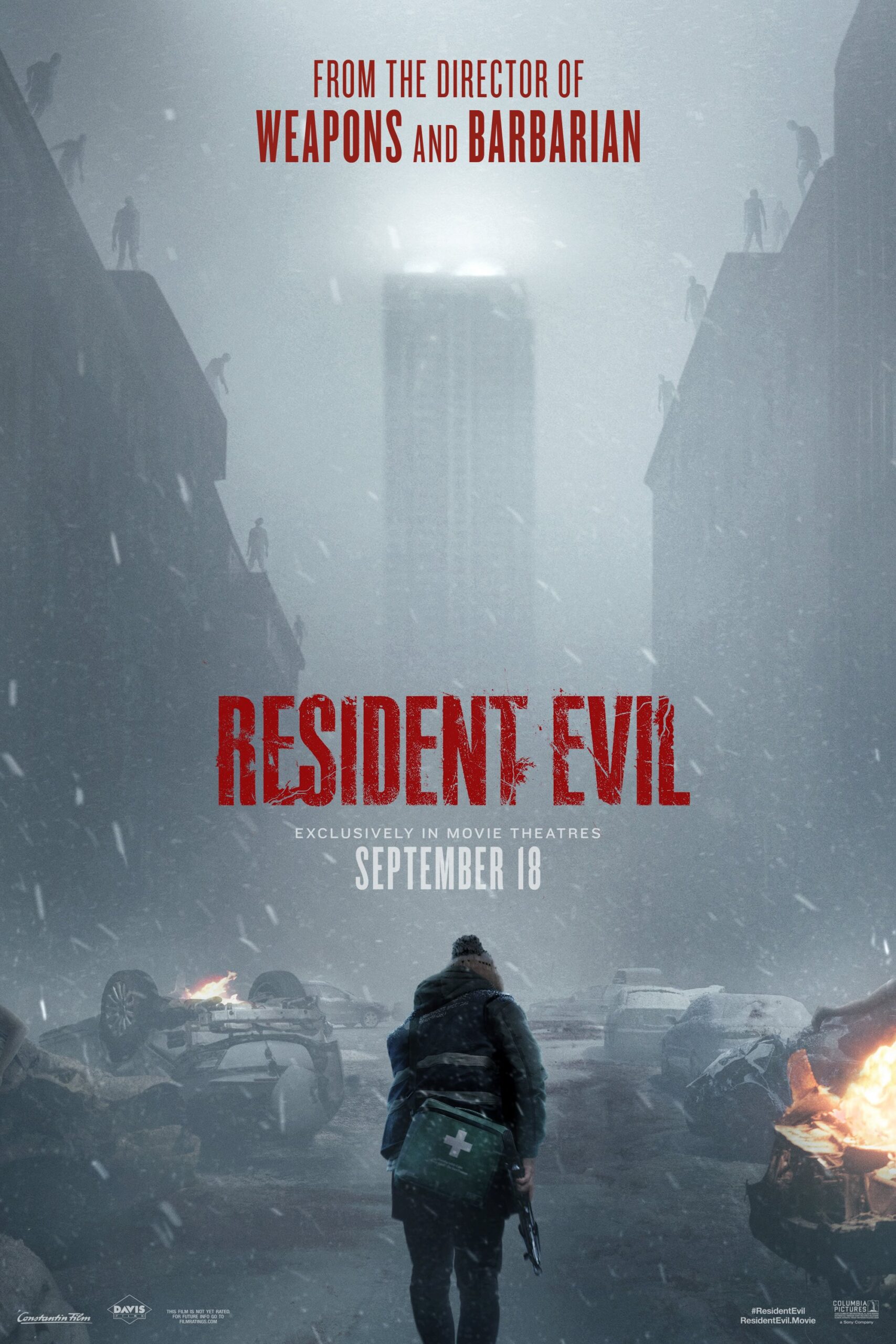
Bryan (Austin Abrams) is a medical courier floating through life, not quite ready to grow up and assume the responsibilities of adulthood and parenthood with his unseen significant other. He is offered an emergency high-speed run delivering a vital package to the general hospital in Raccoon City, and despite not having the required snow chains and other equipment for icy mountain roads, he accepts the contract.
It has been commented by others, quite correctly, that Resident Evil (2026) is structured like a video game. Bryan’s first encounters with the bizarre monsters between him and his goal are simple, easy to navigate, almost tutorial in nature, but each new set piece is more complex, requires greater danger to face and more skill to overcome, until his battles are with hordes of monsters.
Cregger and co-writer Shay Hatten, in addition to the video game feel of the structure and the body-horror of the people deformed by the loosed reagent, also infuse the script with plenty of humor derived from Bryan’s most understandable reactions. Perhaps the most uttered line in the film is Bryan whispering, “What the fuck?” The comedic and absurdist aspects of the script are enhanced by Abrams’ performance. He takes a character that is very, very thin on the page, with only the barest sketches of anything beyond the needs of the plot, and imbues it with a warmth that makes Bryan sympathetic and likable.
Cinematographer Dariusz Wolski and Cregger shot the film quite well, photographing at night in a manner that preserved that the darkness held terror just out of sight but without producing a screen so dim that the action became hard to follow. Cregger only occasionally slips into a loose point-of-view shot that echoes the screen of a first-person shooter video game but not so much that it becames a tiresome gimmick.
With Austin Abrams’ performance and the light touch of comedy throughout the movie, I was ready to judge that I had had a good time watching Resident Evil, but, alas, that is not something I can say in good conscience.
At the opening of David Lynch’s adaptation of Dune, Princess Irulan advises the audience, “A beginning is a very delicate time.” The same is quite true of endings. I would even argue that it is possible to recover from a bad beginning, as you have the rest of the story to course-correct, but a bad ending only leaves you with a sour note as your conclusion.
Resident Evil’s ending is bad.
A good ending unifies three elements: Character, Theme, and Tone, producing the conclusion that fits the story and satisfies the audience.
Had Steven Spielberg in Jaws filmed the novel’s ending, that movie would not have spawned the age of the blockbuster. In the book the shark, exhausted by the barrels, loses the strength to swim and, unable to push water across its gills, suffocates. That is a realistic ending but not one that would have been in step with the tone of the film. The exploding compressed air tank, however physics-defying it was, provided the audience with the heroic and victorious bang that they needed.
In Star Wars, had Biggs or Wedge scored the ‘kill shot’ on the Death Star, that would have been a terrible ending. The ending must flow from our principal character, their actions, and their decisions. It must be Luke, and he must trust to the Force for all three elements to come together.
These elements are required for the right ending even when the right ending is not a “happily ever after” one. With The Godfather, Michael by the end of the film has become what he did not want to be. He had told Kay, “That’s my family, Kay. It’s not me.” However, by his decisions, step by step, he has become that criminal Don, unifying in theme, tone, and character with that moment as the door closes, shutting Kay out of the office.
Resident Evil‘s ending fails on all three elements.
The movie has a very weak theme, if any is present at all, and so, being generous, we can disregard this element, but on the remaining two criteria this script’s ending is seriously flawed.
Tonally, it swerves from the comedic horror to a dark, dreary, and cynical take that is wholly unearned. The goodwill of the previous hour-plus of footage is discarded without preamble or consideration. The ending feels very much like a case of cynicism being mistaken for wisdom.
But perhaps the greater writing crime is that the finale, the last action set piece takes place without Bryan having any agency at all over its nature or its outcome. Bryan, as a character driving a story with his decisions and actions vanishes and instead is railroaded to a disappointing conclusion.
I was quite disappointed by the final act of Cregger’s Barbarian, and while the whole of Weaponsworks beautifully, it would seem with Resident Evil he again shows that where he needs to grow the most as a writer is crafting endings. He, so far, only lands that task one time in three.
