.
They Live (1988) was the 11th feature film from celebrated writer/director John Carpenter, and, in my contested opinion, halfway through the movie it becomes evident that Carpenter’s talent had fled, never to return. (Do NOT try to argue that In the Mouth of Madness is a great or even good film. A story where a shotgun-armed angry mob of men are chased off by mere dogs is stupid and expects its audience to be stupid.) I will be spoiling an already spoiled story.
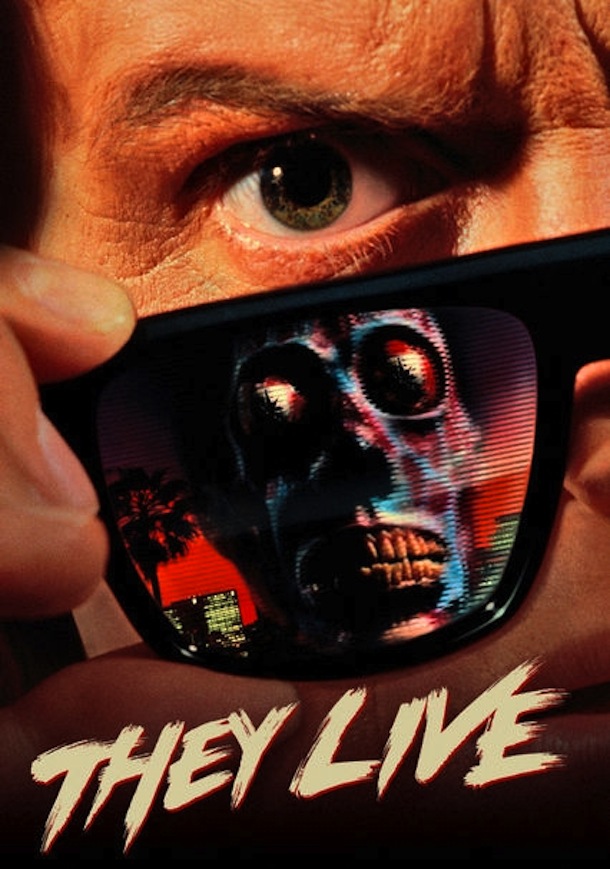
Universal Pictures
A conspiratorial mess, the story follows Nada (Roddy Piper), an unnamed and unhoused itinerant worker who has come to Los Angeles and is drawn into a vast alien plot to subjugate humanity and transform the planet to an environment more suitable to their lifeforms. Nada and another displaced worker, Frank (Keith David), join up with a resistance group and eventually destroy the single satellite transmitter that has hypnotized humanity in a walking sleep that has prevented anyone from perceiving the aliens or their subliminal manipulation.
The first half or so of They Live is actually quite good, subtle, with a growing unease that creates an uncanny valley as the audience remains as ignorant of the reality of the story as the protagonist. However, once the vast conspiracy is revealed, all semblance of intelligence flees the pages of the script, replaced with overly extended fight sequences and action movie tropes that, even by 1988, had become tired, worn out, and cliché. The descent into formula is further degraded by the ham-handed nature of Carpenter’s political preaching. Meant as a commentary on Conservatism as Reagan’s second term drew to a close, They Live delivers its message with all of the subtlety of a cocaine-addled bull elephant. Compounding this clumsy critique is a level of world building that cannot stand even a moment’s analysis and consideration.
The unnamed alien race has come to Earth to extract wealth and convert the planet’s climate to their own by way of industrial pollution. Okay, a metaphor for capitalism: it’s not particularly original, but it’s serviceable enough that Carpenter is not the only storyteller to have stumbled upon it. I will even accept the hand-waving over exactly how that wealth is being extracted, as, one, a film has no time to delve into interstellar economics and, two, we have no clue how such an economy would function anyway. The idea that aliens are covertly manipulating humanity is hardly original; too many people already accept it as a true thing, but it can be made to work.
But not in this movie.
The aliens have covered incomprehensible distances to come to Earth, but after that terrible expenditure of resources, what do they do? They become beat cops in Los Angeles. Oh, sure, they are presented at the very top of society and government, with one shot meant to imply that Reagan is one of them, but so, so many are walking about as working-class and lower-upper-class individuals. This is patently ridiculous. Yes, you might make the argument that this echoes humanity’s own action as European nations colonized much of the world, but colonization is not Carpenter’s metaphor. He is explicitly playing on the secret forces that really control society, using aliens as a metaphor for capitalism, but that idea doesn’t work if the secret masters of the economy are also the ones driving the patrol cars. This is the reason that, while he had aimed his satire at capitalism, the metaphor was handled so clumsily that Nazis took the aliens as a stand-in for Jews. Carpenter warred with them online about this reading, but he left that door open with his slipshod world building. Of course, if Carpenter had reserved his aliens for the ones pulling the strings from secret positions high above the common rabble, then he couldn’t have had his glorious scenes of Nada gunning down aliens in public, scenes that have become only more and more disquieting as America experiences an endless horrid parade of mass shooter events.
Even if you accept the concept that aliens have come across light-years to hold down street-level jobs, They Live is still a deeply flawed mess of a story.
Nada, shortly after learning the truth and going on his spree of murdering aliens that to everyone around him look as human as anyone else, takes a hostage, Holly (Meg Foster), to escape downtown Los Angeles. In her expensive hillside home, Holly puts Nada at ease and then, shattering a champagne bottle across his skull, ejects him from the structure and down the steep embankment.
Later, when Nada and Frank attend their first resistance meeting, Holly is there, presumably because she has had her eyes literally opened by the magic sunglasses left behind after Nada was thrown from her home. She is all doe-eyed and sympathetic to Nada, despite her only interaction with the man having been as his hostage at gunpoint.
The evil controlling forces show up, some deus ex machina shit goes down, transporting Nada and Frank to the local cable station that manages the vast interstellar conspiracy. They regroup with Holly, last seen at the resistance meeting in a bad section of town and now present without explanation, and hustle to the roof where the final plot coupon, the transmitter, waits. In the stairwell Holly wordlessly murders Frank, but on the roof she, with more doe eyes, pleads with Nada, while holding him at gunpoint, not to destroy the transmitter. Apparently, in addition to selling out humanity, she has a very specific kink about being kidnapped and held at gunpoint. Nada destroys the transmitter and dies, but exposes the entire global plot because aliens smart enough to not only traverse light-years but manage a decades-long cultural conspiracy are too stupid to avoid a single-point-of-failure system.
I cannot for the life of me understand why this film is held in such high regard. I found it trite, preachy, and stupid when I first saw it in ’88, and that opinion has only grown with the decades.
