.
Glen Powell, displacing Benedict Cumberbatch as the actor now found in everything around you, stars in the black satire as Beckett Redfellow, this bastard son of a disinherited daughter from a massively wealthy family.
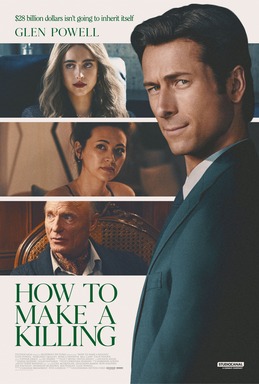
StudioCanal
As the patriarch of the family, Whitelaw Redfellow (Ed Harris) placed his vast 28-billion-dollar fortune into a trust to avoid estate taxes, the disinheritance of Beckett’s mother is no barrier to Beckett inheriting the fortune. What is a barrier is the 7 people ahead of him in the family tree. A chance encounter with his childhood crush, Julia (Margaret Qualley) ignites Beckett’s drive to eliminate the people standing between him and the vast fortune, a program made riskier and more fraught with Beckett’s affections torn between Julia and a new woman in his life, Ruth (Jessica Henwick.)
Adapted from the 1907 novel Israel Rank: The Autobiography of a Criminal by Roy Horniman, the source material that also inspired Kind Hearts and Coronets writer/director John Patton Ford updates the material to current times, making the satire of wealth and privilege sharp but without ever stopping the story to pull out a soapbox for a lecture. The movie unfolds as a flashback with Beckett recounting his life and crimes to a priest as a framing device that neatly provides a witty and wry narration. The failure of many voiceover narrations in movies is that they lack character, the distinctive voice and point of view that elevates them from mere exposition dumps to genuine vehicles of insight. Beckett’s narration provides enough warmth and vulnerability to make the character empathetic while never fully excusing his acts of murder for mere monetary gain. Powell’s deep reservoir of charm serves him and the film well, keeping the audience engaged and on his side, concerned for his fate as events spiral out of his control.
Jessica Henwick as Ruth isn’t given a lot to do here, but she does well with what is handed to her in the script. As the ‘pure’ love interest in contrast to Qualley’s ‘corrupt’ love interest Henwick breathes life into a character that is given little depth beyond voicing the counter-ideology that wealth is far from the real meaning of life and that value can be found in service. Henwick is also a performer who with only modest changes to hair and make-up transforms greatly. I failed to recognize her as Peg, one of my favorite characters in Glass Onion, a tribute to her underserved talent.
The more biting and dynamic female role is given to Qualley’s Julia. A woman who at first appearance seems to be quite likeable but as the story progresses reveals that she operates with little to no empathy for anyone, not even Beckett. I have become quite a fan of Qualley’s work having seen her now in three films, this one, Once Upon a Time In Hollywood, and Honey’s Don’t. (I skipped The Substance knowing that certain sequences, ones that have nothing to do with the central spectacle of the film, possessed a high probability of triggering a migraine.)
Few people arrived for the late Saturday evening screening that I attended which is a shame. How to Make a Killing is not going to make box office history nor change the course of film in the 21st century but it’s entertaining, well made, and with a point of view that many other supposed satires lack.
It should be seen.
