This past weekend was a celebration of cinema with two trips to the local multiplex and the last feature film to be watched on my 55″ LCD television before its replacement later this week, so, it is fitting to kick off the week with reviews.
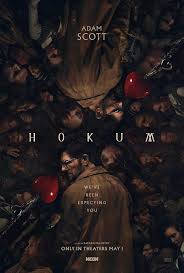
First up, the horror film Hokum.
Neon
The third feature film from writer/director Damian McCarthy Hokum is once again set in his native Ireland. Successful American author Ohm Bauman (Adam Scott) has traveled to the small and isolated Irish hotel where his parents had honeymooned and, after many years delay, to spread their ashes in the thick nearby wood. Bauman reacts to stories of hauntings and witches trapped in the sealed off honeymoon suite with the skepticism appropriate to not only an American of the 21st century but of a writer known for his dark, bleak novels of human futility. After uncharacteristically warming to a member of the hotel staff, Fiona, Bauman returns to the hotel as it is closing for the season to discover that she has gone missing, and Bauman begins investigating, a process that draws him into the supernatural dangers of the hotel and his own terrible history.
A common comment I heard about Hokum before seeing it was that in tone and intensity the film compares to Ari Aster’s Hereditary, a film that I very much enjoyed and found unsettling in the best possible manner. Now, having seen Hokum I disagree with that comparison. Hereditary was relentless in its narrative and focused with tremendous precision. I found this movie to be a little less focused, some of the plot turns struck me as fairly obvious, when Bauman spoke obliquely about his childhood trauma, I knew instantly what the third act would reveal, and Hokum’s plot meandered a bit, but not to any great detriment, just enough to make a comparison with Aster’s film misplaced.
The film I would compare this one to is 2020’s critically underseen and undervalued The Night House, written by Ben Collins and Luke Piotrowski and directed by David Bruckner. Both films spend considerable time in exquisitely shot darkened scenes with fantastic use of negative space and briefly seen and unsettling imagery. Where Hereditary finishes with imagery and a resolution that might be fitting to one of Bauman’s own novels, Hokum crafts a more traditional if not entirely settled ending for its tale that again fits as a comparison with The Night House.
A second element that Hokum shares with The Night House beyond its cinematography is that by the ending of the film events can be reasonably interpreted as either supernatural or a product of the protagonist’s own mental state with just enough ‘evidence’ to push most viewers into the supernatural conclusion.
Colm Hogan’s cinematography for Hokum is, pardon the pun, picture perfect. The deep shadows and blacks of both the night and the isolated area of the hotel are dark enough to conceal the threats from both Bauman and the audience and yet never so dark as to become frustrating to a moviegoer. McCarthy’s script, while suffering from a touch of predictability, is populated with enough realized characters as to make the plotting work even when that obvious reveal is telegraphed well in advance.
Hokum is enough of a slow burn, quite the opposite of a ‘slasher’ horror film, that it works best in the theatrical environment where someone watching the film will not be continually distracted by their electronic devices, the well-lit room, the kitchen beckoning them with snacks, and the ever-present noise of the outside world. This should be, and needs to be, seen in a darkened auditorium with others reacting to every moment of suspense and shock of a sudden appearance. If you are a fan of horror films, particularly of one that rewards patience, then waste no time in getting to your local theater and seeing Hokum.
