.
Dracula, written by Bram Stoker and published in 1897, is one of the most adapted pieces of fiction in the English canon rivaled, perhaps, only by Mary Shelley’s Frankenstein. The number of
SND
adaptations and the various media are almost beyond count. The famed vampire has been in London’s swinging 70s scenes, hunted the darkened streets and bayous of Louisiana, stalked victims aboard starships in deep space, and even blackmailed into hunting down criminals like a superhero (Dracula Returns, Robert Lory.) But after waves and truly out-there reimaginings filmmakers returned time and time again to the Stoker original novel, its 19th turning into the 20th century setting, and adapting once again that primal source material.
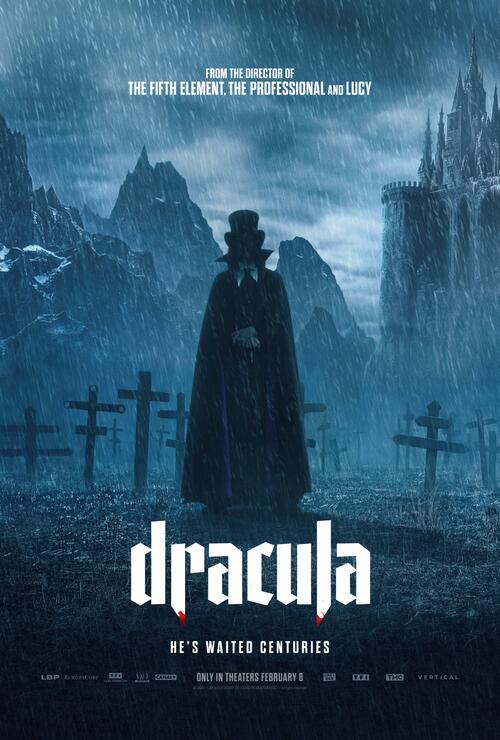
Filmmaker Luc Besson (The Fifth Element, The Professional, and Valerian and the City of a Thousand Planets, to cite a few) has released his own take on literature’s most famous vampire. Written, produced, and directed by Besson, Dracula, released in other markets as Dracula: A Love Story, is so loosely bound by the source material as to stretch to breaking the very definition of adaptation. (It causes me to remember that there was once a screen adaptation of a Shakespearean play with credit Additional Dialog by William Shakespeare.) People familiar with the novel Dracula will recognize a fragment of a scene here and there that echoes something of what Stoker penned, but nothing more than a faint and nearly imperceptible shadow of that original text. Gone is Doctor Abraham Van Helsing, replaced by Christoph Waltz (the principal reason I ventured to see this feature) as a priest, part of a Vatican-ordained order of vampire hunters. Following in the recent canon alterations (or desecrations depending upon your point of view) Dracula (Caleb Landry Jones) once again is portrayed as a man so tormented by the loss of his true love at the hands of his enemy that he has forsaken the Church and God, that he is cursed with the terrible affliction of vampirism, leaving him to haunt the centuries searching for the reincarnation of his lost love. Much of the film’s runtime, 2 hours and 9 minutes, is dedicated to Dracula’s backstory, following him through four centuries of searching and loss. Given that the film’s main action takes place after all of that backstory, this creates in the film a powerful sense that the movie is mostly exposition. This Dracula shares a thematic element with del Toro’s Frankenstein, a deep sympathy for the monster at the center of the tale. While it can be argued that Shelley imbued her text with such feelings for the creation, no such sentiment is in Stoker’s novel. This is the inevitable consequence once you introduce any hint of a tragic origin for the famed vampire. By the end of the film Besson abandons any considerations for the Count’s numerous and slaughtered victims, keeping his sympathy entirely for a vampire with whom Besson has crafted a nobility absent from the source material. This rendition, in addition to transplanting the story from England to Paris, contains mind-control perfumes, elaborate choreographed dances with scores of performers, and culminates with the Austro-Hungarian Empire assaulting Castle Dracula with troops and cannon.
On the plus side, Caleb Landry Jones turns in a performance that sold me, for the most part, on his portrayal as an Eastern European nobleman. To my untrained ear I detected no flaw in his accent and his bearing and delivery all contributed positively to the air of a man for whom power was a birthright. I do wish that hair and make-up had dyed his hair black, a blonde Transylvanian nobleman did stretch my credulity as much as the count being a master chemist whipping up mind-control perfumes.
Besson’s Dracula does strike me as the most thematically Christian rendition of the material. Most vampire movies and television programs will use the cross warding as a gimmick, a way for the characters to save themselves when confronted by a thing that vastly overpowers them, but here the story and its resolution actually turns on Christian theology.
And that made the final resolution unacceptable to me for what is yet another rendition of the ‘red shirt’ problem. In my final section I will spoil the ending of the film so you can bail out here, knowing that I cannot recommend this movie at theatrical prices, at best wait for it to come a streaming service you already subscribe to.
After the army and assorted characters have successfully assaulted and gained entrance to the castle, and after Dracula had slaughtered literally scores of men, Waltz’s priest confronts the vampire and implores him to renounce his heresy. For Dracula to accept God’s love and forgiveness, which Dracula does and then allows the priest to destroy him with a silver stake.
So, Dracula, a vile and evil creature who for hundreds of years has visited terror and death on the people of Europe, is in the end forgiven and granted absolution even as he stands in a hallway littered with the corpses of men he killed. These nameless characters died not to end a great evil, and in the end their sacrifices achieved nothing. It was not by their blood and lives that the Priest walked into the castle. They were mere spectacle, giving the conclusion some action.
It is Christian to believe that honest and true repentance will grant you God’s absolution, but it makes for a terrible movie ending and it is particularly rankling when once again we are being asked to accept a monster as subject of our sympathy and empathy.
