Tag Archives: Movies

The Two Most Influential Science-Fiction Films of the Silent Era

This will be the first in hopefully a lengthy series of essays as I yammer away about which two SF films of each period I consider to be the most influential. Naturally ‘influential’ is a quite subjective measurement and you are welcome to comment, argue and suggest films that you think had a greater impact than the ones I suggest.

I will start with the silent period, covering basic 1890-1930, but after that I intend to tackle the question decade by decade.
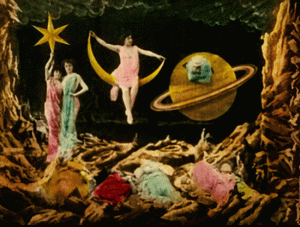
VOYAGE DANS LA LUNEA trip to the Moon (Le voyage dans la lune) – 1902 – George Melies

I consider this one of the most important SF films from the silent era because this is really the movie that kicked off SF as spectacle. The science was ludicrous and no one making did so under the illusion that this was a reality based adventure. This was about the wondrous and magical effect that the motion picture camera afforded the filmmakers. This is a short film, just 13 minutes long, but it cast a long shadow across the landscape of cinema. This film is the birth of special effect and special effect from this moment onward would remain at the heart and soul of SF cinema.
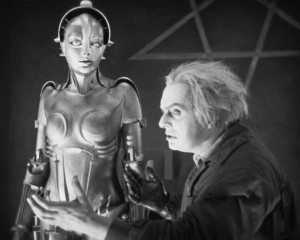
MetropolisMetropolis – 1927 – Fritz Lang

Director Fritz Lang is a towering figure in film. The visionary man behind such classics as ‘M’, the film that made Peter Lore an international star, Lang always had a deep and sincere love for Science-Fiction. (In fact it was Lang who convinced Robert A. Heinlein to start writing Young adult novels.) I would argue that Lang’s better SF movie was 1929’s Woman in the Moon (Frau in Mond.) Woman in the Moon is less didactic and pays a closer attention to scientific details while delivering a better story and adventure. (This film was also a favorite of Werner Von Braun who saw it as a teenager and right up through Apollo copied the paint schemes for rockets from this movie.) However, Woman in the Moon simply has not impacted to trajectory of SF films in the manner that Metropolis did.

Metropolis, a sprawling massive production set in a future city divided between the exploited poor and the extravagantly wealthy, set design and social models that were to be copied for decades, Ridley Scott’s Blade Runner look and feel can be trace directly back to Metropolis. The sprawling, towering city of the future was born here in this film.

The original print was lost for decades until 2010 gave us a restored version that is close to the original running time, but not quite. 1984 gave us a version where musical Giorgio Moroder revived the film with a soundtrack that included Queen’s Freddie Mercury, Adam Ant, Pat Benatar and many others.

Your thoughts?

 

Share

The things one remembers

I can clearly remember a disappointment of my young life. I was 11 or 12 when this occurred. As is quite normal for a boy of that age I adored monster movies. For me big rubber monsters smashing cities were the height of cinema. Usually I could only watch such fare on TV during the Creature Feature that played late night on Saturdays.

Ahh, that was a show that consumed many many of my hours. It literally was called ‘Creature Feature’ and, in my mind, I can still see the opening logo. So many classic and far far from classic films played during that late night and early morning hours.

However this particular summer I am remembering was not about an old black-and-white film playing on a local television station, but rather about a new release I desperately wanted to see,

Based on release dates this had to be 1972 or 1973 and Godzilla vs The Smog Monster had come to the local drive-in I burned to this movie. I had never seen a Godzilla movie in any other format than televised and the idea of seeing one on the huge screen at the drive filled me with an unquenchable desire.

I laid out hints to all the adults on the household, but to no avail. The weekends came and went and there was no surprise announcement that we were going to the drive-in, nothing but bitter disappointment

Now, I am not faulting my older brothers and sisters for their film choices. This was pretty much a kiddie Godzilla and it would have held little to no attraction to anyone with a discriminating taste. So the film played and moved on, leaving me behind, my desires unfulfilled.

Over the years I have seen many Godzilla movies, bastardized and cut-up American versions, subtitled original versions, movies that were Godzilla in name only, and even the most recent American adaptation, but somehow in all those years, and with that early bitter miss, I never watched Godzilla vs The Smog Monster.

Until recently.

HULU Plus has quite a library of films and I discovered, quite by accident, that via the Anime Network their collection included Godzilla vs The Smog Monster. Suddenly I remembered being that young boy and that movie I had so desperately wanted to see. Naturally I treated myself to the long long delayed satisfaction.

So two weeks ago over several night I watched the film in bit and bites as I relaxed after a long day working and writing. I can say that the younger me probably would have loved the monster fights, but many aspect of this, the most trippy of Godzilla movies, wouldn’t have played well to me.

You know how Pink Floyd’s ‘The Wall’ has those animated sequences? Well so does Godzilla vs The Smog Monster. It also has musical/dance numbers and Japanese hippies.

I’m glad I got to see it, and pay off that younger me who wanted it so badly, but man it was to date the strangest Godzilla film I’ve watched.

Share

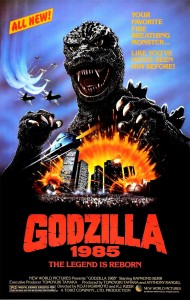
Sunday Night Movie: Godzilla 1985

So with the upcoming release of another American production of a Godzilla movie, I godzilla-1985-posterdecided to revisit the franchise for my Sunday night viewing pleasure. At first I was going to watch Godzilla: King of the Monsters, the Godzilla movie that most American would
mistakenly call the original film. It was in fact the Japanese film, severely cut down and with an American reporter, Steve Martin, (Played by Raymond Burr) stuck in with some ham-handed editing and thoroughly unmatched cinematography. Then It struck me that the right film in the franchise to watched was this one from 1985. Continue reading

Share

How Life Has Changed

I remember clearly a bit of frustration from my youth. I had read the Isaac Asimov novelization of the film “Fantastic Voyage” and I desperately wanted to see the movie. I have always been a fan of film and fantastic genre fiction particularly so. The problem was that this was the 1970s. There were no Blu-rays, DVDS, VHSs or Betamaxes around to sate one’s entertainment cravings.

The town I lived in did not have a revival theater, and all I could do was searched the listing on the weekly TV Guide and hope that some station like TBS , which aired a lot of films, would pay it.

I remember weeks of searching the guides, with no indication of an upcoming presentation, only my fondest hopes for one. It didn’t appear.

This weekend on a whim while scanned through the instant view option at Netflix I started watching Fantastic Voyage. Now I had seen it in the intervening years, so I was not watching to to satisfy that unscratched itch from decades past. It was just a way to pass the time and look at the filmmaking of years gone by.

However it did get me thinking about those months when I forlornly hoped against reality that it would appear in the listings.

We truly live in an age of Science-Fiction, so many treasures await our pleasures. We are approaching a film lover’s paradise.

Share

Saturday Night Movie: Lawrence of Arabia

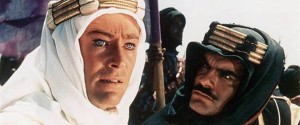
This is not a Sunday night movie feature because Saturday evening I had the very special opportunity to see the 1961 classic Lawrence of Arabia on properly projected on the big screen. In a post last week I lamented to death of San Diego last single screen theater, the Ken, an art house theater. The management planned a series of special presentations to hero_EB20010902REVIEWS08109020301ARsay good-bye to their patrons and Lawrence was Saturday’s. In a happy turn of events, the landlords and the business found common ground, apparently after the ground-swell of support from the community, and the Ken will not be closing, so these special presentations became a celebration rather than a wake.

Lawrence of Arabia is the dramatized film version of Col. T.E. Lawrence’s adventures in Arabia, helping the Arab revolt against the Turkish Empire during the first world war. The consequences of that war reverberates in our geopolitical problems today, but let’s set that aside and look at David Lean’s masterpiece of filmmaking.

Lawrence is a minor functionary in Cairo, with a deep love for the country and its people. He is paying attention to the Arab revolt long before the generals notice. Everything changes for Lawrence when at the behest of Britain’s Arab Bureau , he is dispatched on a 3 month mission to find Prince Feisal and appraise the state of the revolt.

Lawrence exceeds his mandate and becomes deeply entwined in the Arab revolt, harboring dreams of freedom for Arabia not only from the Turks, but all European powers.

While this film dates from 1962, the cynical nature of politics and the its corrupting nature would have made it a topic well suited to the dark period of filmmaking from the 1970’s.

The film boast a cast that is unrivaled, Alec Guinness as Prince Feisal, Omar Sharif as Ali, a trusted friend and loyal support of Feisal and Lawrence, Anthony Quinn in a wonderful performance as Auda Abu Tayi a brigand with a quite realistic approach to life, Claude Rains, Jack Hawkins, and Jose Ferrer also are notable in command performance from incredibly talented actors. Most notably is that this film has the credit Introducing Peter O’Toole As T.E. Lawrence.

If you have never seen this movie, it is one that really should be seen. Sadly the chance to see it properly, on a big screen is rare, and one I was very grateful to experience.

Share

Dreams at 24 Frames per Second

I came to San Diego, courtesy of the United States Navy, late in 1981. The west coast had kensington-ken-cinema-lbeen a choice of mine and I do not regret that, but when I arrived I knew no one in this town. First the first few months my only recreation were movies and one of my favorite places to visit, though the bus ride was tedious, was the revival house, the Ken Theater.
I have always loved films, and some of my earliest memories are of movies, so it was natural that I sough out the theaters of my new home town, the Ken however was unlike anything I had ever experienced of even heard of in my naively limited knowledge.

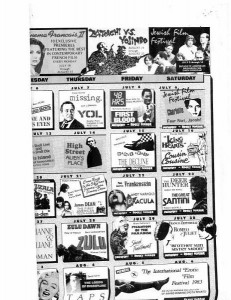
Check out this image from one of our local weekly papers, The San Diego Reader.

KenCult6_t620

That is the Ken Guide as it appeared when I first arrived at this city, double features that changed daily, except for when the theater would run a festival of some sort, which might block out a week or two. I did not get to th Ken as often as I would have like to during this period, but I made enough time to have forged some rosey cinematic memories.

The Maltese Falcon, M, Little Shop of Horrors (the original non-musical), The Seven Samurai, Creature from the Black Lagoon (in 3D!), this is a small sample of the wonderful film experiences I have had at the Ken. Truly classic films on the big screen.

The Ken is also where I met and made friendships during the mid 80’s as I attended the midnight showings of The Rocky Horror Picture Show. I have written in another essay the importance that period played if helping me come out of a very tight introverted shell, and I will not belabor the point again, but the Ken was there for me during that time. Many fond and funny memories were forged on that sidewalk as we waited for the film.

Home video killed the revival theater. When you could own or rent the movies, fewer people would take the time and trouble to see them as they should be seen. By the 90s The Ken turned from revivals to art house films and I remained a true fan of the theater. So many smaller and independent films that never played in mainstream house played here, Cube, Raise The Red Lantern, The Lost Skeleton of Cadavra are just three that I had the good fortune to see there. I missed the revival days, but the art house experience remained fulfilling.

All that is ending. The business owners and the landlord can not come to an agreement on a new lease and the announce has been made that the theater is closing down at month’s end. This was not part of my childhood, but this feels like childhood’s end. The last single screen theater in San Diego, a place that has shown movies for over 100 years, will so be no more.

The dreams will stop flickering, but my memories are eternal.

Share

The Non-Utility of the Bechdel Test

Hmm what’s this I see? A hornet’s nest? Let me get a stick surely nothing bad will come from probing it, right?

There has grown in popularity a test for sexist bias in film and other media known as The Bechdel Test. This test simple, composed of three elements, and if a film or piece of writing passes all three elements it is considered to have passed. Passing is good because that means your work is less sexist than the works that fail.

I think the Bechdel Test is far too blunt an instrument to be used in anything other than a light conversational manner.

Before I continue let me state without equivocation that I want strong well-realized characters of all genders, orientations, ethnicities, creeds, and all the other bewildering array of conditions that humans inhabit.  In now manner am I defending works where women are seriously presented in lazy, sexist stereotypes.

That said, sexism is far too broad a thing to be tested so simply.  The Bechdel test has three elements:

1)   The Film must have more than one named female character.

2)   The Female characters must talk to each other.

3)   Their conversation must not be about a man.

This has a witty simplicity and certainly there are scads of films where the female characters exist solely as wives/girlfriends with no other dimension to their character. However I contend that is the Test fails by producing both false positives – scoring a film as good when it’s depiction of women is sexist and stereotypical –and also false negatives – scoring a film as a failure when it’s females characters have real depth and characterization beyond a simple love interest – then the test has no real utility.

So here’s an example of a false positive: The Lost Skeleton of Cadavra.

Element 1

Named female characters 2 or 3, Betty Armstrong, Lattice, and it’s debatable if we should could Animala/Pammy. After all she’s not a real woman, but a construct of one from 4 Forrest animals.

Score – Passed

Element 2

Betty and Lattice have more than one conversation together.

Score – Passed

Element 3

The conversations are about shopping, cooking, their loves of dresses, and who cleans up in the kitchen. They do not in fact discuss their husbands.

Score – Passed

Now if you have seen this film you know that these two women are presented deliberately as bad stereotypes of wives. They have little self-direction, are subservient to their husbands, and in the words of the director/writer set back man/female relations half a century. While this film presented it as comedy and satire, any number of films earnestly presenting the same material would have passed the test, despite having horrid sexist tones throughout.

Now for the False Negative: Marvel’s: The Avengers

Element 1

Named female characters, 3. Natasha Romanoff, Pepper Potts, S.H.I.E.L.D. Agent Maria Hill.

Score – Passed

Element 2

None of these characters have a conversation with each other. All their conversations are with men.

Score – Failed.

Element 3

Since they did not have conversations, this too is a fail, but I suspect if they had engaged in conversation they would have still failed as it would have been likely that the subject of their discussion would have been the film’s antagonist, Loki, a man.

So Joss Whedon’s screenplay and film fails the Bechdel test. It must be sexist, right?

Of course this film has three very smart, capable women who hold their own against the male characters and prove repeatedly that there is far more to them than just a pretty face. Pepper maintains her own way in the headwind that is Tony Stark – not a minor feat, Hill has the spine to buck Nick Fury something even Coulson doesn’t do, and of course Romanoff is so talented she outwits Loki the god of trickery, winning valuable intelligence while the men uselessly debate torturing the captive deity.


The Bechdel tests is capable of both false positive and negatives, making it for me a tool not to be trusted. Ferreting out sexism in a piece of art can require a subtle eye, it is not achieved by a test less complex than Buzzfeed’s which Game of Thrones House are you?

Share

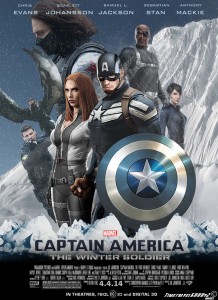
Movie Review Captain America: The Winter Soldier

This morning my sweetie-wife, a friend, and I went and caught an early show of Captain America: The Winter Soldier, the most recent addition to the ever growing franchise that is the Marvel Cinematic universe.

Starting with Iron Man, Marvel Studios has been building a shared universe setting for captain_america__the_winter_soldier_poster_by_timetravel6000v2-d6il80isome of their hero properties which culminated with the end of ‘phase one’ The Avengers. Last year saw the start of ‘phase two’ with Iron Man 3, and that phase continued with Thor: The Dark World and now Captain America: The Winter Soldier.
If you are one of those people who have seen all the cinematic universe films to date, then you will likely be pleased with this film. It builds nicely on the material established before hand and extends and reshapes the direction of the cinematic universe. If you have not seen the preceding movies, then this one may have a couple of section that feel overly expository, but you will still be up to speed on critical backstory.

Captain America: The Winter Solider continues the evolving story of Steve Rodgers, 5’4” 95lb 4-F war volunteer transformed into the world’s first super hero by the serum/process that made him a 6’3”, 210 lbs epitome of human ability, Displaced from his own culture and time by a prolonged ice-nap, and now having found a place in the world after the alien invasion of New York City, Steve is a member of S.H.I.E.L.D. specializing in hostage rescues and other heroic feats. A man with a simple worldview and believing that things can still be classified into right and wrong, he’s out of place amongst spies and assassins.

The film is a success in that it manages to be two sequels in a single story. It is a sequel to Captain America: The First Avenger, the elements of that movie are critical background to the plots and obstacles  Steve faces, both physical and emotional, while the story is also a worthy continuation of the alien invasion from The Avengers and the after-effects of that disaster on S.H.I.E.L.D. and the World Security Council. This balancing act of simultaneously serving two masters is admiralty well done, something the other films of phase two have not done as competently.

In addition to Cap, The Black Widow, and Nick Fury,  this film also introduces a number of new characters to the cinematic universe, including The Falcon, a high flying war veteran.

The movie moves quickly, the two hours and fifteen minutes speeding right on by as one set piece action scene leads into another. However there is enough plot and character to carry a real story, so in my opinion this film avoided the dread, “we fight, then we fight some more, and we end it with a bigger fight.’ There are a few fairly predictable turns to the plot, and I for one would like to see a little more originality in the idea of politicians both good and bad, but I suppose that will have to wait for my own material.

The films small faults and missteps are far from serious and I would recommend seeing this one in the theater, though nothing in the visual work screamed a need for 3D.

p.s.

I have no idea how the television show ‘Marvel’s Agents of S.H.I.E.L.D.’ is going to deal with the fall out of this chapter in the cinematic universe. It’s really big. I mean like blowing up Vulcan big.

Share

Movie Review: 300 II: Hellenic Boogaloo

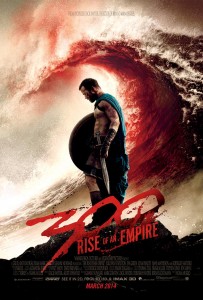
So this morning, after losing the requisite hour of sleep the time regulatory gods, my sweetie-wife and I went to the local cinema to take in a movie. My sweetie-wife wanted to see 300: Rise of an Empire, the sequel to 300, a highly stylized retelling of the Spartan stand against the Persian Empire at Thermopylae. Now if you have seen 300, based on 300-rise-of-an-empire-poster1Frank Miller’s graphic novel, then you know it wildly took liberties with the history and the culture of the Spartans.  300: The Rise of an Empire is true to the Hollywood tradition of a sequel being less intelligent and less well made of a film that the one it is following.
In this movie the physical are more at odds with reality, the characters as even more two-dimensional, and the story is much thinner. This is truly a film that should be shown to aspiring writing, both screenplay and prose, as an example of what not to do.

I had forgotten my watch at home so I am unable to tell you when the story starts, as the movie is front loaded with what looks to be at first a prologue, but turns out to be long tedious minutes of exposition. I am not taking about 3 or 5 minutes, I am talking about 10, 20 maybe more. When the story does start, it often stalls again for more exposition. At one point they literally give you a flashback to the opening of the movie as though you may have forgotten what happened a mere 60 minutes earlier.

This movie also is a prime example of everything that is wrong with digital effect as they are used today. While digital artists can create anything that can be visualized, that does not mean that everything that can be visualized should be created. In this film there are many shots of ships at sea, moving up and over large waves, throwing spray, and the characters aboard these vessels at standing stock still. Often these are not, or at least do not appear to be, digital doubles for the actors, but rather the actors standing in from of a green screen, lacking any realistic motion at all. In one battle the seas are so heavy that vast waves more than thirty feet high loom and present themselves as oceanic hills. Of course in reality ships if the era would be in serious danger of foundering during a storm like that, but in this movie they maneuver and attack with ease.

There is the now standard, falling damage doesn’t apply, digital stunt work, and the impossible animals. (Seriously the lend-lease with Mordor and Persia must still be in effect because the Persian war elephant or more like Oliphants, looming larger an than real land animal.)

My sweetie-wife noted that several times throughout the presentation I suppressed laughter. I assure it was not due to the filmmakers intent to impart humor. In fact this is a fairly humorless movie, and that studious effort to be meaningful and utterly failing is one of the many sources of mirth.

This movie is MST3K ready, right out of the box.


Share

Movie review Cockneys vs Zombies

No Sunday Night Movie this week, too tired to make it through any film and I watched part of Godzilla: Tokyo S.O.S.

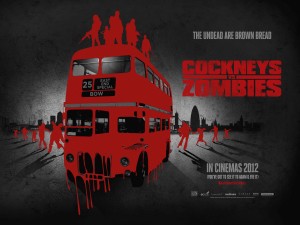
So instead I have a mini review for you of a film I watched view Netflix streaming Saturday afternoon with a couple of friends and my sweetie-wife; Cockneys vs Zombies.

You have to pity someone wanting to making a zombie film these days. The vein was never very thick and it has been throughly mined. We have seen Zombie at Night, at Dawn, in thecockneys-vs-zombies-poster Day, Nazi Zombies, fast zombies, indestructible zombies, Zombies on a boat, zombies on a plane, Zombies on an island, Zombies in Spain pretending it was the Uk, rom-com zombies, Romeo and Juliet zombies, Sex-slave zombies, and pet zombies, so it’s getting pretty  hard to find a new angle on the genre.

This film builds its humor on when the lower class, and stereotypical seen as criminal, London east-enders, Cockneys face the Zombie a apocalypse. The plot is barebones, a group of cockney youths are pulling a bank robbery to have the funds to keep their grand dad and his pals in the east-end when the pensioner home is demolished. Thanks to greedy and archeologically ignorant construction workers, the zombie plague is loosed on modern London, specifically the east-end. Both the youths and the pensioners fight the zombies, as the the crisis worsens.

Like Shawn of the Dead this si player for laughs, but more regional that rom-com. It is bloody and it is graphic as one should expect from a zombie film, but it is funny and touching, and has more than a touch of satire.

I recommend it.

Share