Tag Archives: Movies

Halloween Horror Movies part II

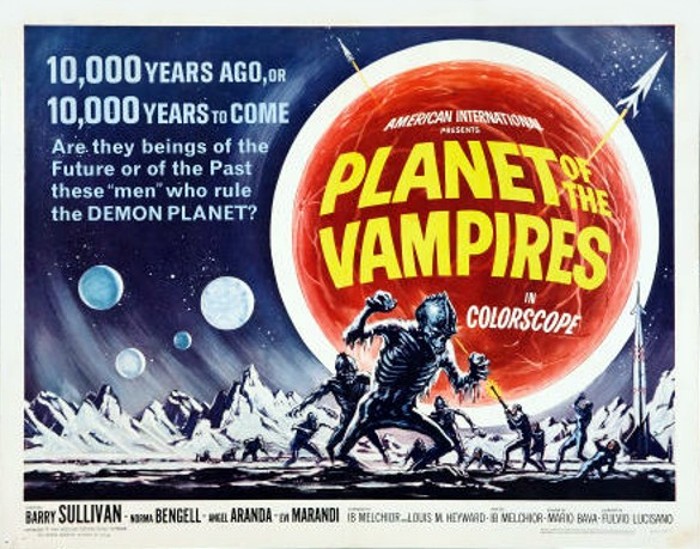
1_planet-of-the-vampires-half-sheet-1965I continued my horror film watching this week with 1965’s Planet of The Vampires. This film is based on an Italian SF short story ‘A Night of 21 Hours,’ but sadly I have never found a translation of that piece. This movie was an international production with American, Italian, and Portuguese actors. I have read that each actor delivered their lines in their native tongue. The dubbing is so-so and the script suffered from heavy exposition and discordant elements, particularly in the final ending scenes of the film.

That said what make this film something I have watched several times if the lovely look created by Italian master Mario Bava. Even hampered by a tiny budget, Bava pulls off a film that that is colorful, stylish, and with impressive in-camera effects.

It is also a subject of vast speculation that this movie heavily influenced Ridley Scott when he directed Alien. From the massive alien skeletons, the landing sequence, the shape of the ships, and the atmospheric tone of the alien world, a great number of stylistic similarities exist between the two movies. (both this movie and It! The Terror From Beyond Space seem like the direct parents to Alien.)

The plot of Planet of The Vampires is rather straight forward. Two starships have arrived at an alien world investigating mysterious signals that may mean intelligent life. Landing on the planet goes badly and the crews find themselves facing threat not to just to their own lives but their homes as well.

Not a great movie but for an genre cinema a must see.

 

Share

Halloween Horror Movies part I

Here’s a quick post about movies I have been watching this week as part of a celebration of the season.

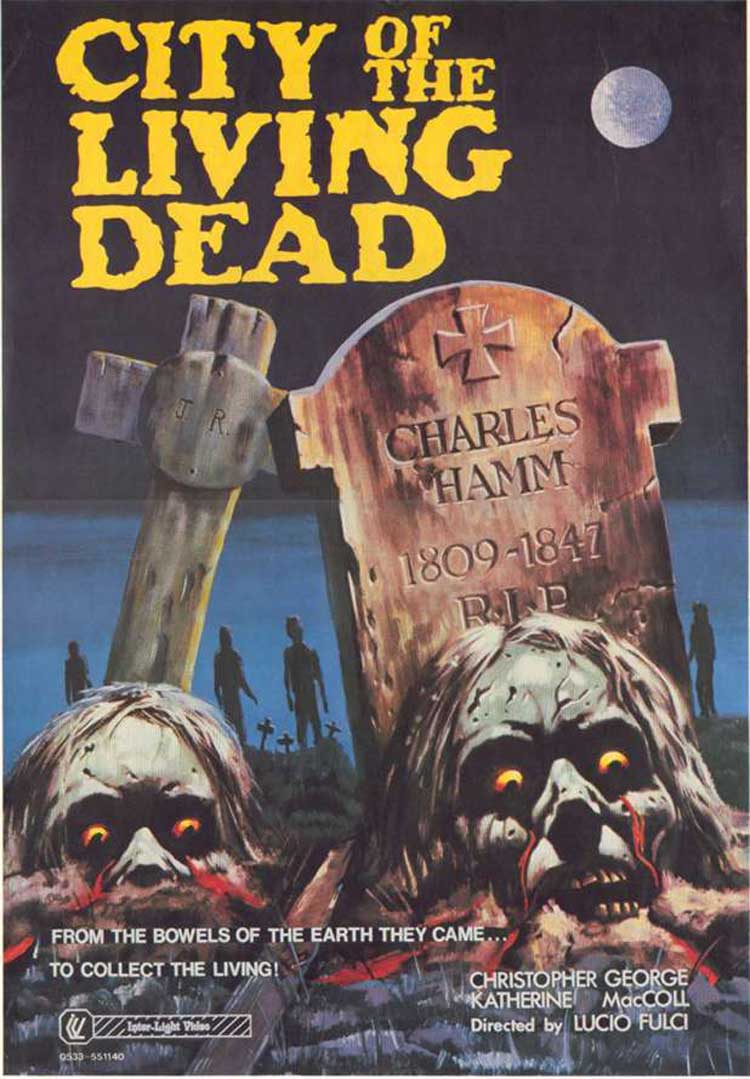
Up first City of the Living Dead (1980)

1-city_living_dead_posterAn Italian Zombie film made after George Romero’s Dawn of the Dead City of the Living Dead occupies a strange place in the zombie landscape. So many films copied Romero’s zombie take over of the world that it quickly became cliche. (Though still popular as seen in the hit tv show The Walking Dead.) City doesn’t go for the traditional Romero zombies not the traditional arc of action. Here there is a clear cause to the undead, a priest committing suicide in a cemetery, and a third act objective to resolve into a ‘happy ending.’ The film was made in Italy but is set in America. The dubbing is adequate and naming the doomed city Dunwich was a nice hat tip to Lovecraft, though nothing that occurs is inspired by his mythos.

Often discussed among fans of zombie movies is the subject which zombies are the worst to deal with. Romero’s original shamblers, Snyder fast runners, O’Bannon’s intelligent and nearly indestructible dead, but this movie presented one that is truly beyond them all. While they feed on the living, and even have a penchant for taking brains out directly through a skull, (the Italian films tend to be more graphic), these living dead unlike any other can teleport and kill you with a look. No crap, people end up very messily dead from zombie staring contests. They are easier to kill. (Impaling seems to be the required technique.) Plus the whole world ending plague can be averted if the right things are done to put king zombie — our transgressive priest – back in his place. Overall, I enjoyed the film but it is not on my buy list. You can stream it on Hulu.

Share

Bad Movie Review: The Colossus of New York (1958)

I will leave it as an exercise to my few readers to parse if I mean the a review of bad movies or that these reviews are in themselves bad.

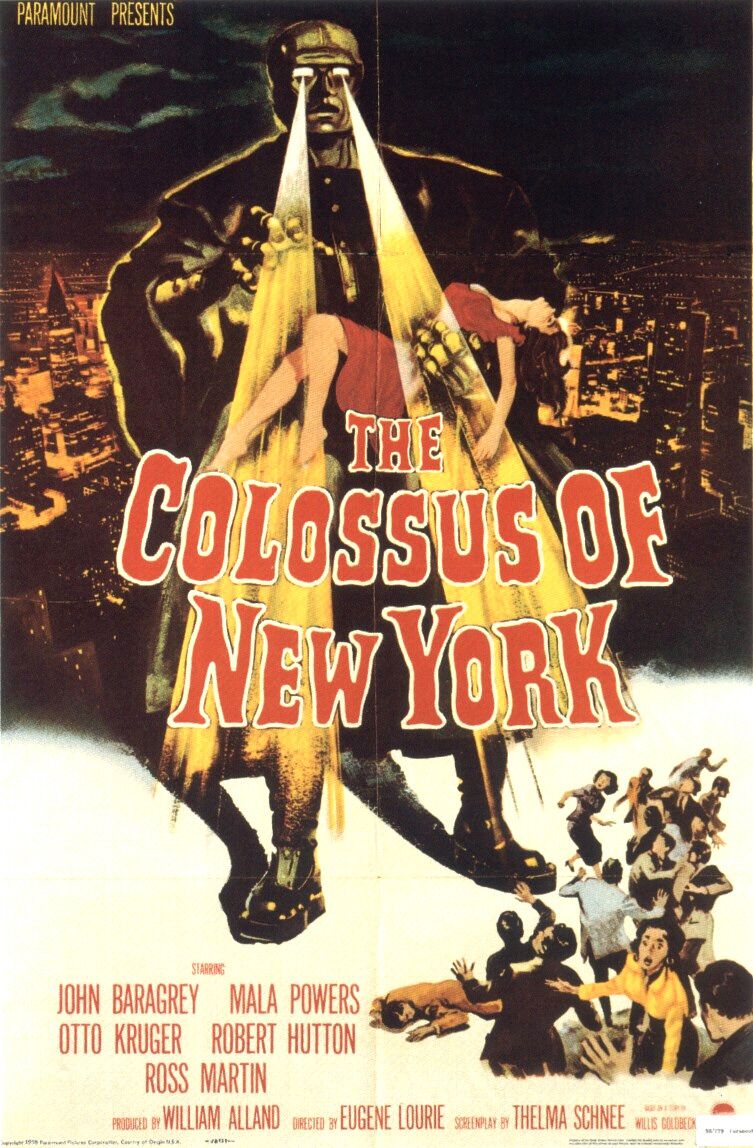
1-colossus_of_new_york_xlgA couple of weeks ago Paramount Studios launched a youtube channel the Paramount Vault. On this channel, they present clips from some of their most popular films and for older library titles with sparse home video value the have posted the entire movie. I certainly hope more studios follow suit. By way of this new channel, I watched The Colossus of New York a B SF movie from 1958 than until youtube I was only aware of thanks to Bill Warren’s Book Keep Watching the Skies.

Lots of spoilers ahead, but you really don’t care do you?


And here is the film you are brave and true:

youtube placeholder image

The plot is this predictable film is simple. First there is the brilliant scientist, Jeremy ‘Jerry’ Spensser. He’s really really smart. The movie starts with him winning the Nobel prize and this is just a stepping stone. He’s expected to be the salvation of mankind because of his good nature and utter utter brilliance. In fact, his family are geniuses, his father a surgeon unparalleled, and his brother Henry a master of automated machinery. But neither we are told hold a flicker of a candle to Jerry’s intellect.

Well, coming home from the Sweden, Jerry’s son loses his toy airplane to the wind and Jerry, that man with an unmatched mind, chases it into traffic and is hit by a truck.

Father Spensser can’t bear the world losing his saint-like genius son and removed Jerry’s brain, keeping it alive and functioning in a tank. He convinces Henry to build an android body for Jerry. Though henry has reservations about a man without a soul and all that he of course complies. (He also starts an affair with Jerry’s cutie-pie wife, He’s not really a sleaze. He cares about the kid and all that, but you can see where this will end.)

Jerry at first rejects his machine life but finally agrees to continue his work on making the Artic into Earth’s newest farmland. Sadly, Henry was right about that soul thing. Without one, just like in Buffy the Vampire Slayer, Jerry goes evil.

Now, you would think making Jerry a super strong machine man would be enough but apparently henry had to overcompensate in the robot’s design. Jerry can no hypnotize people with his flashing peepers. (Nope this ability is not established at all) Also when he does catch up with his brother on the whole cutie-pie front it turns out those flashing peepers are also a death ray. (Really Henry, what did you think you were designing?)

Manipulating his father Jerry goes to the UN and starts a killing spree. (He takes the high ground and this nasty eye are effective, even if he himself lacks any motivation for such slaughter.) In the end when confronted by the innocence of his son he realized the horror he has become and, because he can’t reach the switch himself, has his son turn him off.

I’ve watched  a lot of bad movies in my bay and this one joins the list.

Share

Movie Review:Crimson Peak

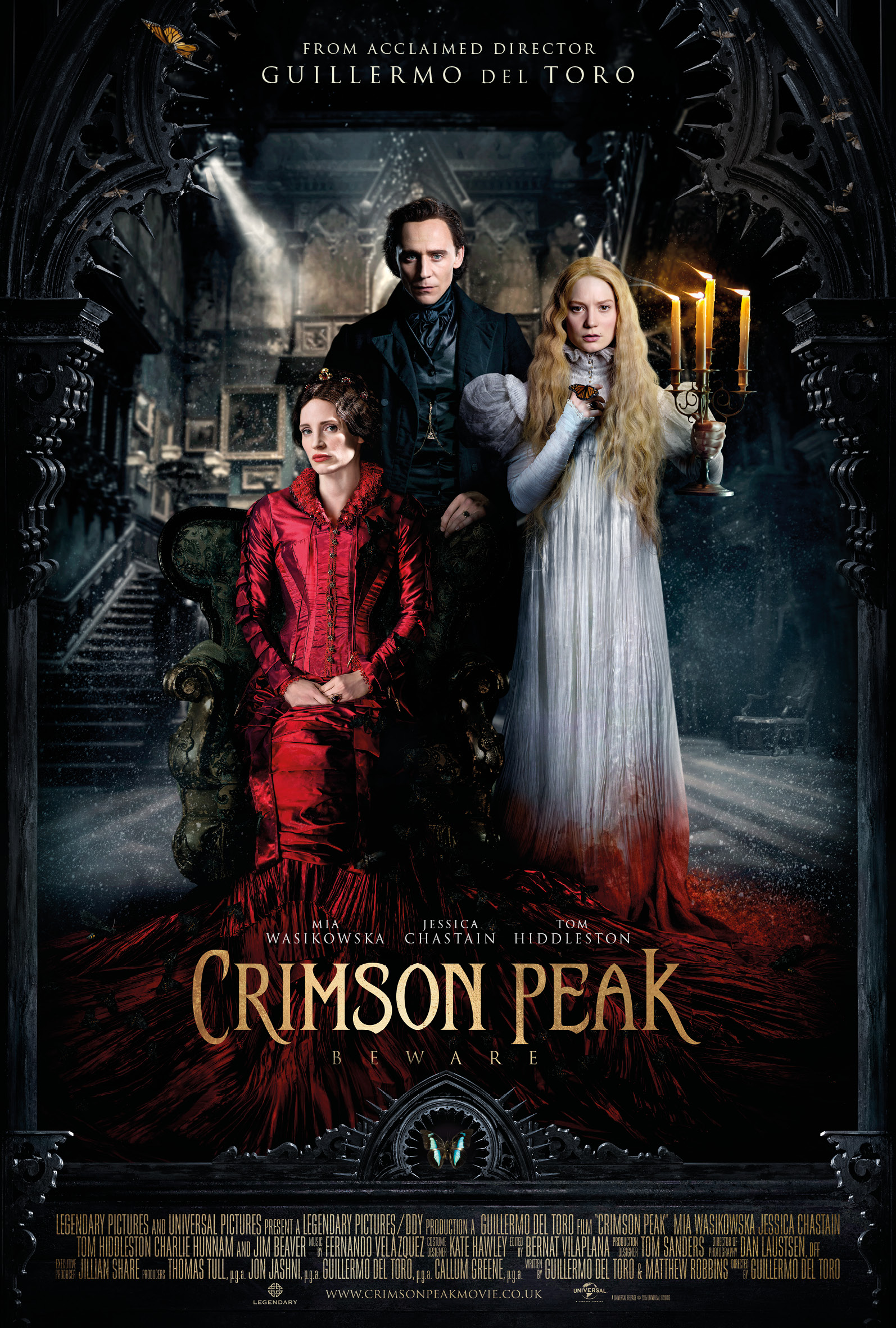
1-crimson-peak-posterLet say that I have been a fan of Guillermo Del Toro ever since I saw his film Chronos in the theater during its initial release. That is not to say I am a fan of all of Del Toro’s films, the first Hellboy didn’t work for me and the same can be said for Pacific Rim. It a happy circumstance that I can say I truly loved Crimson Peak.

Crimson Peak is under-performing at the box office and if you have a desire to see this on the big screen you should probably move quickly. before I give a non-spoiler review of the film let me tell you what this movie is not.

Crimson Peak is not a horror film and it is not a ghost story. Certainly looking at the trailers, posters, and images you could easily come away thinking it is both those things, but that would be a mistake Crimson Peak best fits the genre Gothic Romance. (That is a genre I am not overly familiar with and I am told that Peak inverts the tropes of that genre. this I have to take on faith.)

The movie is a story about a headstrong, capable woman, confident in herself and her arts suddenly courted and swept up in passion for a tall handsome European noble. (Yes, I did just call and Englishman a European, he can live with it.) She soon is off to be married to the dashing dreamer with a dark soul and a dark sister. The mood of the film is carried off perfectly, the imagery is haunting and like a masterpiece painting, the cast are wonderful and play their characters believably.  Now, I found I did predict the twists and turns of the plot, but I also consider plotting to be one of my strengths as a writer and it is the rare script that can justifiably surprise me in its plotting.

The film is violent, but not gratuitous or exploitive in is depiction or use. This is not a film that insists upon an on-screen death every ten minutes. There are ghosts, but it is not a ghost story. To quote the movie ‘It is not a ghost story; it is a story with ghosts.’ It is not for those easily upset by imagery or violence and it continues with Del toro’s persistent theme that the truly monstrous is the truly human.

If you are a fan of his work such as Pan’s Labyrinth this is worth seeing.

Share

Bad Movie Review: Death Ship (1980)

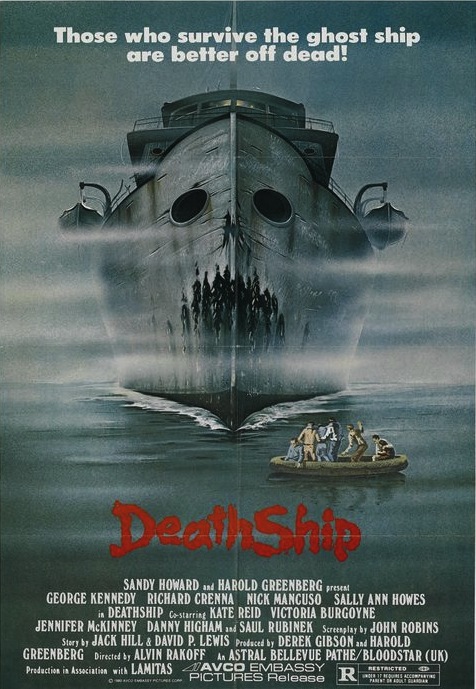
death_shipI have no idea why this movie suddenly popped up into my thoughts. I do remember that I had seen it during its initial theatrical run. That would be a difficult event to not remember. I was 19, in the Navy, and just getting seriously into RPGs. On that weekend Friday night me and my friends started a marathon AD&D game. We did not sleep but gamed right through the night and on into Saturday. by later Saturday we decided on a break in the game and went to the movies — Death Ship. After the movie we went back and continued gaming. Ah, the energies of youth.

I do remember I was not impressed with the film and tiny bits and pieces have stayed with me but really nearly off the movie was dumped by my data storage. Now, 35 years later I found myself thinking about the film and wondering what it really was like. Find a copy to watch proved to be a task, but one I completed sucessfully and earned out some e.p.

Death Ship is the story of a band of people who survive a cruise ship collision and find themselves adrift on debris in the Atlantic Ocean. Unfortunately for them the cause of their collision is the aforementioned Death Ship and when they spot it the next morning(?) (Not sure about that the lapse dissolves used after they are adrift makes any reasonable time estimation impossible.) They climb aboard its old and rusting hull. At once the ship proceeds to start killing them, throwing the Jewish comedian overboard.

A series of events pass when bad things happen to the survivors and one become possibly possessed by the ship, or perhaps simply enamored with it. the distinction is never made clear. There are psychotic breaks, or breaks in space/time, again the distinction is not clear, and eventually some of the survivors escape to rescue.

I made a post recently about the difference in my opinion between story and plot. This film is all plot, and very bad plot that is illogical and acausal, without any story. There are no characters of note, only the thinnest cardboard cutouts doing things to make the next scary event occur.

It is not surprising that I remembered so little of the movie as it contains nothing memorable.

Share

Story vs Plot

Lately I’ve been thinking about the intersection and differences between have a plot and have a story. What follows is necessarily just one person’s opinion and so take it or leave as you will.

Here are my basic definitions. A plot is a character with an objective and an intervening obstacle. A story is about a character in transformation, a character who is progressing through an arc and is changed irreversibly by the arc.

I’ll illustrate the differences between with two James Bond films, Moonraker and On Her Majesty’s Secret Service. (Naturally there will be spoilers)

Moonraker is all plot and no story. Bond has a series objectives, Discover what happen to the stolen shuttle. Survived the attempts on his life by the villain Hugo Drax. Uncover the plot to destroy all human life, and finally prevent the nerve gassing of the planet. He succeeds at all of this, saves the world and has space nookie. The key thing that makes this all plot and no story is that James Bond in the first reel is exactly the same person as James Bond in the final reel. He has endured no tests of character, only of skill. You can replace him with any super-humanly competent secret agent and the events will transpire in essentially the same manner. James Bond himself makes no difference to the outcome only his skills.

On Her Majesty’s Secret Service is a story with a plot. Bond has a series of obstacles to overcome, infiltrating the villain’s lair, discovering the threat to world agriculture, saving the world. In this aspect it is not very different than Moonraker, just with a less ludicrous set of events. However in this film Bonds meets Tracy and falls so hard for her that he marries her and resigns from the service. Blofeld, thwarted in his scheme, attempts to kill bond and kills only Tracy. Bond is shattered and broken in the movie’s final scene muttering over his wife’s corpse ‘We have all the time in the world.’

This is a story. Replace Bond with some other super-competent agent and while the world may be saved and the plot resolved, the character transformation will be missing. Tracy and James, quite unlike most other Bond girls, make this a story about choices and loss.

There in a nutshell is I how to cleave the difference between story and plot.

Share

Movie Review The Living Skeleton (1968)

Sorry about the scarcity of posts here lately. I’m engrossed in writing a new novel and that has taken up quite a bit of my new word output. So here’s a review of a film I streamed from Hulu.

1-LivingSkeleton_originalThe Living Skeleton is a 1968 Japanese horror film. I stumbled across it while browsing Criterion’s Catalog on Hulu. It promised an atmospheric, maritime-centric, ghost story. That sounded like a film worth at least a look-see. I am particularly fond of ghost stories and found several from Japanese cinema that worked quite well for me.

The story is about a freighter that is taken by pirates. (modern day freighter, not sailing ship.)  The crew are murdered and the ship considered lost at sea.  The film skips over a number of years to the sister or a woman murdered on the ship. She lives near the sea, working for a priest, and involved with a young man. The lost ship reappears on a foggy night and the young woman ventures aboard.

The story starts following the fate of the pirates as one by one they meet their deaths. All in all up to the point the film had been working for me. It is well acted, nicely photographed, and has plenty of atmosphere. My only quibble is editing. It lacked mystery because of the linear plot line. I would have favored an approach that started well after the pirate attack and brought the viewer up to speed with bits and bites of information.

*Spoiler Warning*

The film falls apart in the third act. After several well handled twists and very nicely staged ghost scenes the story reveals that there was no ghost. The ‘dead’sister survived the attack and managed to describe her attack so well that the surviving twin could track down the pirates and by her mere presence cause them to panic and die. The plot takes another terrible turn when it is revealed that not only did the ‘dead’ sister survive, but her groom did as well. Both have lived aboard the derelict ship, he as some sort of mad scientist inventing fantastic acids for bad guy disposal and third act ticking clocks.

The bad guys are killed, the sisters are killed, the mad scientist groom is killed, and the boyfriend is left alone and terribly confused.

This was a decent movie that had me buying in until they cheated and switched the genre. SF author Nancy Kress in her writing guides puts forth the idea that at the start of a story the artist and the audience enter into a contract, a promise, about what sort of thing they are going to experience, and that breaking this promise is a sure way to anger your participants. This film is an example of that failure.


Share

Movie Review: The Man From U.N.C.L.E

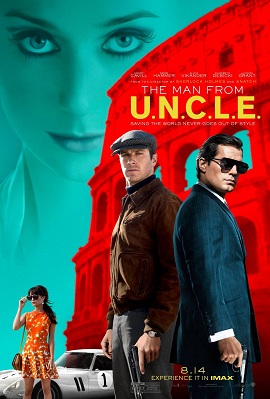
1-The_Man_from_U.N.C.L.E._posterWhen talking about books and movies about spies I find it helpful to divide the genre into two large sub-genres; Secret Agent stories and Espionage stories. Espionage stories are more grounded, more like reality, that are more often about the careful work of deception and the moral grayness of the field. John Le Carre’s work, such as Tinker Tailor, Solider, Spy is an excellent example of this sub-genre. The Secret Agent stories are not about reality. They deal with fantastic, often impossible gadgets, uber-competent heroes, fantastic plots and plenty of thrilling action. The platonic ideal for the Secret Agent story is of course James Bond. Neither style or approach is superior to the others, that are matters of taste.

The Man From U.N.C.L.E., the original television series and the 2015 feature film, belong quite solidly in the Secret Agent landscape. I will admit that the few episode I have seen of the original series did not win me over and I can not be counted among the fans. That said, I did go along with my sweetie-wife on Sunday morning and watched the feature film adaptation.

I very much enjoyed this movie. Guy Ritchie, one of the credited writers and the director, walked the line between credible threat and campy fun perfectly. The story has been dinged as rather simplistic, but personally I think this works in the movies favor and not against it. Set properly during the cold war in 1963 A former NAZI scientist has developed a new and easy method of enriching Uranium. Said Scientist has vanished it is is thought a new independent player has arrived on the field, threatening to upset the balance of power between the U.S. and the Soviet Union. The global adversaries must work together to investigate and neutralize this threat. America’s best agent, Napoleon Solo is forced to partner with the Soviet’s best agent Illyan Kuryakin. From elements at the start of the film both men have reason to distrust and hate the other, but both men also have needs beyond their respective services.

The movie is a  romp through a James Bond that is having fun with the material but not winking so hard at the camera as to shatter disbelief.  The comedic moments are perfectly timed and the reversals and reveals move the pace and plot along with a brisk momentum. This is an origin story, but it is one that gives the characters a chance to grow into their final forms. Director Ritchie also handles digital effect far better than most working in the industry. Using digital camera to create swooping impossible tracking shot he keeps the geography fixed in the viewers mind during a cross mountain chase without losing any sense of the speed or danger in the pursuit. His use of split screen to convey the impression of a massive battle without slowing the film was also masterful.

In short I really enjoyed this film and heartily recommend it if you want some light summer fun.

Share

Sunday Night Movie:Xanadu A Flawed, Failed, and Favorite film.

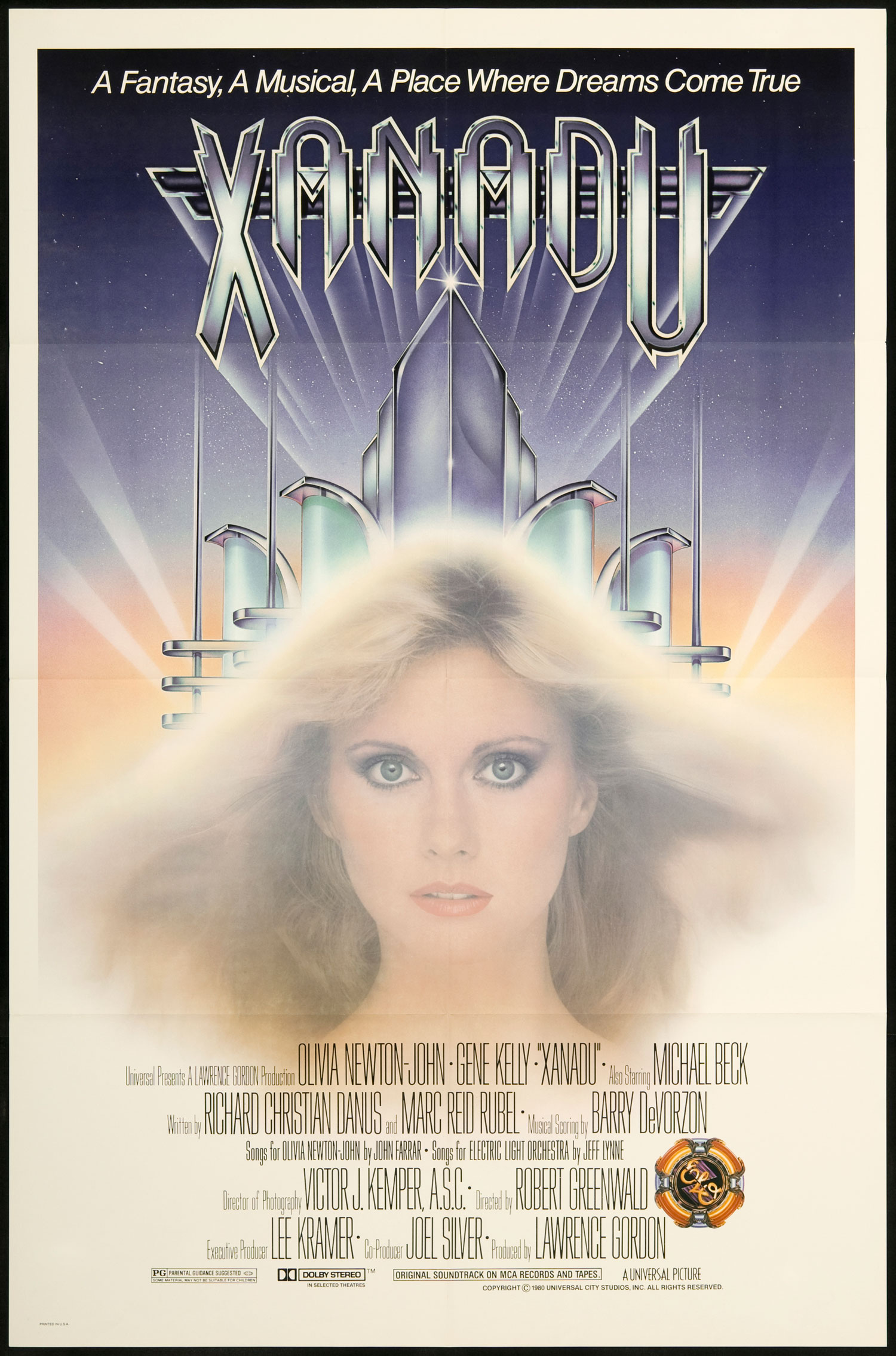
35 years ago the musical fantasy Xanadu arrived in theaters. The film failed to perform well at the box office, suffering for a number of troubles, mostly in the script, but survived by finding a dedicated fan base turning into a cult film and eventually into campy Broadway musical.

I saw the film in its initial release and it became my favorite film. It is the comfort movie I go to when I am down and the 1-Xanadudark walls of depression are closing in from all sides. That said this is not a well made, and particularly, it is not a well-written film. If you graph artistic quality on an axis, it is a mistake to lay emotional reaction on that same axis. It is possible to love a piece of art that is flawed. There will be spoilers in my essay.

As a writer, the script stands out to me as the most glaring failure of the production. The character Sonny has no strong arc through the plot and too many critical events — such as both instanced where he runs into Danny and forms a friendship — are the product of coincidences. Coincidences are to be banished from your plot, everything should proceed from the characters and the choices that they make.

In the film, Sonny works as an artist duplicating album covers into giant posters for promotional purposes. When we meet him he is returning to Airflow records because his attempt to go pure artist has failed and he is again broke. Kira comes into his life, she is a Greek goddess, a Muse, (remember this is a musical fantasy) and her job is to inspire him. However the backstory is that he always had trouble with his bosses, adding more the pictures he’s supposed to be duplicating because as he says ‘he sees more than what’s there.’ Sounds to me like he already has inspiration. The writerly fix would be to make him the cynic at Airflow records, deriding others who want to chase ‘art’ but secretly it is his heart’s desire. Kira can then arrive and cause the hidden artist to flourish. There, no you have an arc. I could go on, there are lots of troubles in the script. Too many scenes lack conflict. People just show up and do things. That’s not a script, that’s boredom. (Bonus points for anyone who sees what I did there.) I am not going to go over all the flaws, the static camera, the choices in casting, because I am already conceding the filmmaking to be bad.

So why do I love it?

Two reasons dominate that landscape. The first is the theme. Like another cult film, The Rocky Horror Picture Show, Xanadu is a deeply anti-cynical film. Both movies are about dreams and dreamers. RHPS could be boiled down to the line ‘Don’t dream it, be it.’ and Xanadu’s theme can be distilled down to the lines ‘<Sonny>Dreams die. <Danny> No, no, No, Not by themselves. We, we kill them.’ Your dreams end when you give up on them. it is not surprising I am a fan of both movies. I am a dreamer. I am trying to be it, and I will not kill my dreams. It helps I love the music – I had been a fan of Olivia Newton-John’s singing for years before this film arrived, but for me the theme seals the deal.

The second reason is who I discovered the film with. It was a special time and special woman. The years have passed on, but happiness can live forever in memory. Like dreams, remembered happiness only dies if we kill it.


Share

The Two Most Influential SF Films of the 1990s.

If you are new to my blog, and I recognize it’s traffic is primarily friends and family, I have had an occasional series on the two most influential SF movie by decade. Of course, this is no objective listing but purely by spitball take on the films that had a lasting impact on movies beyond any box office success.

I covered the silent era, quite unfairly I am sure, in a single post, and then proceeded by decade covering the 1930s, 1940, 1950s, 1960, 1970s, and the 1980s.

Now I will continue into the 1990s.

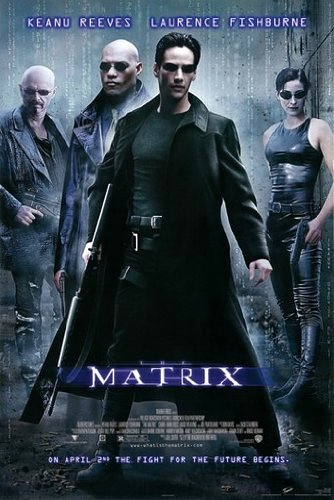
The MatrixThe Matrix – (1999)Personally this is a film that did not work for me. The tropes concerning what is or is not real are old hat and many of the aspects of the plot make little to no sense. (If there is no sunlight, then people are dead and the 100 or so watts you can get from them are hardly worth harvesting.) My biases aside this film, in addition to spawning a franchise with  sequels heavily influence the look of film for the next decade and beyond. ‘Bullet time,’ the hyper slow-motion with a moving camera, stunned audiences in 1999 and many filmmakers quickly copied the stylistic look of the Wachowski Siblings.

Visual style for SF films ceased being the domain of art-house productions and moved into the mainstream.  Love or loathe it, The Matrix influences films to this day.


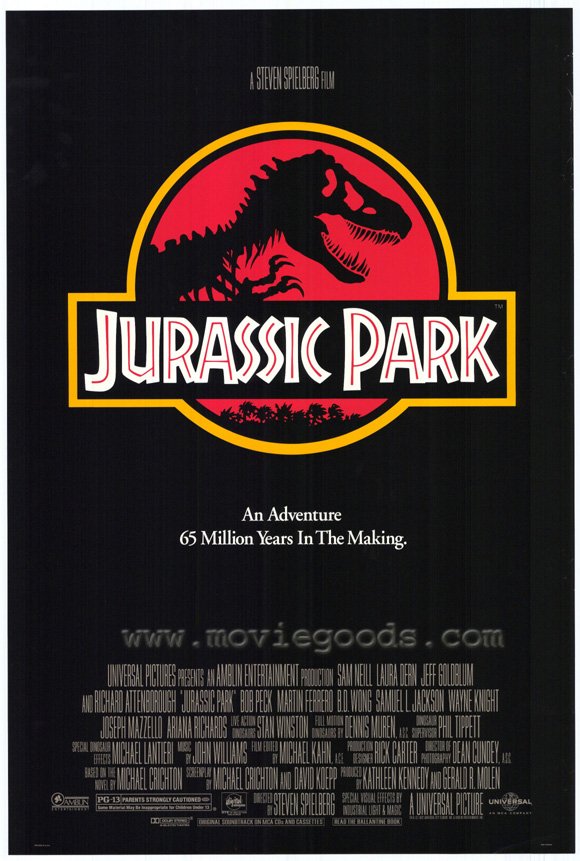
jpJurassic Park (1993) Arriving earlier in the decade than The Matrix Jurassic Park’s impact on filmmaking is difficult to understate. When production began on the adaptation of Michael Crichton’s novel the filmmakers had planned on using traditional stop-motion animation to bring their dinosaurs to life, a technique that goes back the 1933’s classic film King Kong. However during pre-production the computer graphics team at Industrial Light and Magic demonstrated photorealistic CGI dinosaurs and the world changed. Influencing every special effects film follow, Jurassic Park freed the images on the screen from physical photography to anything that could be envisioned. Every summer is now swamped with good, bad, great, and terrible CGI animation. Studios are learning that great CGI can not save a film and that CGI stunts quickly bore the audience. This year’s Mad Max: Fury Road and Star Wars: The Force Awakens in part are rebelling against the CGI revolution started by Steven Spielberg with Jurassic Park.

Share