Author Archives: Bob Evans

Classic Film Review: Strangers on a Train

While I love film, and I love noirwith its dark cynical tones there are many classics that I have not seen. As a youth I was drawn only to genre films and that has left a gapping hole that I still work to fill-in. Strangers on a Train is a part of the missing education which I was fortunate enough to not only see last night but experience on the big screen at the local art house as part of their week of classics.

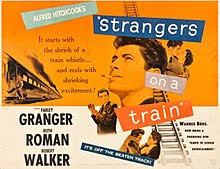
Released in 1951 and from the master of suspense (should there be a trademark there?) Alfred Hitchcock, Strangers, is about tennis pro Guy Haines (Farley Granger), trapped in a marriage to a woman who not only cheats on him, but has the gall to get pregnant while doing it as well. A chance encounter on a train with the mentally imbalanced Bruno Antony (Robert Walker) leads to Bruno murdering Guy’s wife as part of Bruno’s harebrained scheme for a perfect murder. Not only does Guy end up with a dead wife and himself as the prime suspect, Bruno expects Guy to murder Bruno’s father as part of the deal that Guy never accepted. With the police watching his every move and Bruno burrowing into his life like a murderous tick, Guy is trapped with little hope for escape and vindication.
Spoilers from here on out.

I can’t judge the plotting of the novel that the screenplay was adapted from but I can say that the script display’s Hitchcock’s preference for suspense over logic. Hitchcock cared more the mood of a piece, for its emotional impact than any moments that failed make sense when considered at one’s leisure. The third act revolves around to elements, Bruno’s plan to plant Guy’s lighter at the scene of the murder to implicate him and Guy’s need to quickly win his tennis match so he will have enough time to get there ahead of Bruno. The use of the lighter is a classic example of Hitch’s ‘macguffin’ an item that drive the plot by compelling the characters’ action but in this case it’s rather weak especially when one takes a moment and realizes a much more power item of evidence was displayed and discard in the film, the glasses the murdered woman was wearing when Bruno killed her.  Glasses that Bruno brought to Guy as a ‘gift.’ Finding those in Guy’s possession is far more damning than the fact his lighter was found near his wife. Yet this very damn bit of evidence, once handed to Guy, is dropped and never visited again during the rest of the film. Second, if Guy, fighting for his life against Bruno’s plot need to get out of the tennis match quickly, rather than trying for a fast win, throwing the game and loosing serves his needs far better. Frankly if I am trying to avoid an unjust murder conviction I’d be willing the lose a match.

With Hitchcock one expects these sort of logical inconsistencies and setting those aside, and the very clear ‘queer coding’ for Bruno, the film Strangers on a Train is fun experience, though not one I need to at to my library of movies.

Share

Recovering Nicely

Two weeks ago today I underwent a minor surgical procedure. Anyone who has met me knows that my eyelids droop and that my right eyelid dipped much farther than my left. During an eye exam last year it was discovered that the lid was drooping far enough to begin to interfere with my vision and it was suggested that I have an operation to correct it. Being that the surgeon was booked up for months and my day-job was hitting its busiest period of the year we delayed the surgery until this month.

I live just a couple of miles away from the hospital where he performed the surgery. It was an interesting experience/. They used a local to make sure I felt no pain or discomfort and a sedative to make me relaxed but there was no general anesthetic, throughout the entire operation I was awake and aware.

We started, after I closed my eyes, with the doctor making marks on my lids to guide his incisions. I could tell, even though there was no discomfort, when he switched from inking up the area to slicing it with a scalpel. As he worked he listened to Motown and R&B songs prompting me to think about the scene Doctor Strangewhen we are introduced to character in a surgical theater. Occasionally either he or someone else would ask me to make sure I was doing well and no feeling any pain and aside from the bride lighting, which penetrated my lids, I was comfortable.

I spent about an hour and half in post-op and recovery, exhibited no signs of any adverse reactions to the drugs they had administered and by late afternoon I was sent home.

The first several days with tedious, ice packs applied every hour to my eyelids and pretty much stuck in a reclining chair unable to do any of my normal activities. The doctor had instructed me to stay home from the day-job for a week and that is what I did.

Now I have been back on my feet doing things normally and everything is healing as expected. My lids are dis discolored and inflamed but I am able to work, read, and most of the time simply ignore the slight discomfort they present.

Share

There Was No Detailed Plan

A sub-set of Star Wars fans, those who consider the last two installments of the franchise a crime against the greater myth, have clutched to the concept that George Lucas possessed a gran plan for the series of movies and if those had been made everything would be to their love.

In my opinion there never was a detailed gran plan for the interconnected stories of Star Wars. I was a teenager who the first film hit the theaters of 1977 and I remember desperately waiting for the film to come to town so I could see it. In those pre-internet days and before the time of 3000 screen opening weekends, movies opened in big cities and slowly, over the course of the entire summer, moved into new markets. Since I was stuck waiting for the movie to arrive I read the novel. While credited to George Lucas, the talented Alan Dean Foster, who worked closely with Lucas on that manuscript, wrote the novel. In the novel the Emperor is describe as someone who has become capture by the bootlickers and yes men of his court simply another cog in the great machine that is the evil empire. Lucas had no grand design for Palpatine and his role in the coming story. During the famous cantina scene, when Han shot Greedo from under the table, we are treated to the point of view from others watching who were bemused that Greedo allowed Han to get that hand under the table because that sort of ambush shooting was something Han had done to others. And yet when the 1999 Special Edition came out Lucas defended his re-edit with Greedo shooting first as his original vision and that poor editing, way to throw you ex-wife and her team under the bus, cause people to be confused as to who actually shot first.

Moving away from the novel, in the film Obi-Wan tell Luke that Vader betrayed and murdered father, then helped the Empire hunt down and destroy the Jedi. The father bit is Obi-wan being tricky, but when we get to Revenge of the Sithwe’ll learn that Vader killed the children, Jedi in training, while storm troopers dispatched the mighty Jedi by shooting them in the back.

When The Empire Strikes Back hit theaters the scope of the canvas grew and the story deepened. I think it was clear that Lucas always intended for Vader to be Luke’s father. The groundwork for that had been laid down in the first film, but it seems to me that Lucas had no clear conception of Vader’s relationship to the rest of the empire. In the first film Lea refers to Tarkin as ‘holding Vader’s leash’ and yet from the second film onward Vader is the Emperor’s man and carries his authority wherever Vader goes, hardly someone on a leash. Also the Emperor has now morphed from a bureaucrat to a powerful force master.  By now the Emperor had become a central story element but from that description in the novel it is clear he was originally conceived in that role.

In The Return of the Jedi we are told that when Obi-wan first met Anakin Skywalker he was already a great pilot and that Obi-wan was amazed at how powerful the force was with Skywalker. He though he could teach Anakin the ways of the force as well as Master Yoda, but he was wrong. A power story of hubris that is contradicted by the events in the film The Phantom Menacewhere Obi-wan is a student himself, Anakin is a child/slave, and it is Obi-Wan’s master who wants to train young Anakin.

The conflicting story elements between the first trilogy and the prequel one makes it clear that there was not only no detailed plan for the events but that Lucas didn’t hold even a passing interest in continuity. I find it strains credibility to believe that he had a detailed outline for the next series of movies. And would not have flow by the seat of pants, as his history shows was his most preferred method.

Share

Movie Review: Throne of Blood

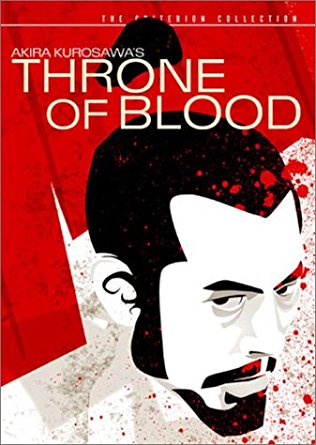
Monday night a local art house theater showed the classic Japanese film Throne of Blood, Akira Kurosawa’s 1957 reimagining of Shakespeare’s Macbeth into feudal Japan. I had planned on going to the screening as Throne of Blood is one of my all-time favorite films but by the evening I was in a foul mood, my back hurt, and I was quite tired, so I stayed home but I want to discuss the masterpiece just the same. As I have it on Blu-Ray disc I will likely watch it this week anyway.

This was one of the first, if not the first my memory is a little hazy, Kurosawa movies I ever watched and surprisingly it was also the first time I had been fully exposed to the story of Macbeth, which has become mu favorite play of the Bard’s. If you know Macbeth you know the story, an ambitious warrior noble, here played with fierce masculinity by Toshiro Mifune, after receiving a supernatural prophesy betrays and murders his lord assuming his title and position. Naturally this does not go well and the warrior noble comes to a justifiably bad end.

Macbeth translates exceptionally well to feudal Japan with only minor changes required to adapt the story to a different culture. Under Kurosawa’s masterful hand the desolate landscapes, the foreboding forests and the unearthly spirits have both a stark realism and a simultaneous dreamlike quality. Isuzu Yamada creates my second favorite Lady Macbeth performance, passed only my Jeanette Nolan in Orson Welles’ 1948 film production. (If you can find the Korean import DVD for the Welles’ film you’ll get the original dialogue soundtrack with the actors performing in their Scott accents.) While Yamada lacks the seductive sensuality of Nolan’s performance her moves and performs with a stylized, and I think Noh inspired manner, that carries a subtext of threat and concealed power in every scene. Kurosawa’s interpretation of Birnam Wood is one of the most haunting images in the history of cinema and plays both realistically and in supernatural slow motion.

I despondent that I was not feeling well enough or in a good enough mood to see this film again on the silvered screen but it remains one of the best motion pictures I have ever watched.

Share

TV Series Reviews: HBO’s Barry

For the last week I have been nursing my eyelids as they recover from last week surgery. The procedure went well and I have encountered only the run-of-the-mill issues as the incisions heal. Over the final days of the week I watched the HBO series Barry. The entire first season is a short eight, roughly half-hour, episodes for the new dark comedy so I can review the complete season.

The premise of Barryis simple, Barry, a former Marine who has been guided by a familial authority figure into being a hit man, is experiencing an existential crisis when he discovers that he wants to become an actor. Suddenly thrust into an acting class filled with quirky characters Barry’s life is a collision of dark deadly duties and he own inept stage abilities. Set in Los Angeles the show has a sharp eye critiquing the life of aspiring actors and some of the low-life’s that prey upon them. It is an interesting choice that for both sets of characters, the showbiz and the criminal underworld everyone is from somewhere else seeking to make the mark in their profession in the city of angels.

The show hits quite a few comedic marks, including one very narrow cast ‘Leroy Jenkins!” gag that had me laughing quite loudly. The difficulty in material like this is the balance between the dark nature of the character and their history and keeping the audience identifying with the character. Breaking Badhad a similar issue but came from a place where we got to know and empathize with Walter White before his actions became violent and predatory. With character like Barry Berkman we are introduced to him when he is already a paid killer and that can be a difficult hurdle to clear as the story progresses. Have Barry be too nice too remorseful and suddenly the ‘previous Barry’ become unreal and you’ve lost the engine you hope would drive the story. Cross the line the other direction and, at least for me, there is no more sympathy for the devil and the audience wants or even needs to see the character face the music for their actions.

Part of the trouble with the film musical Little Shop of Horrorsis that the main character commits to murder and pays no price for that decision. The ending is not earned. Barrydoes not make the same forced error but it does end in a very dark place. In episode 7 the character crosses a line that in my opinion there was simply no way the bring him back from. Once he took this action, at least as far as I am concerned, justice needed to be visited upon his head. The creators recognized this quite explicitly within the narrative and even used it to show Barry’s emotional growth but it would seem that the needs of a continuing series overrode the moral requirement for justice.

Do not misunderstand me, I not someone who bemoans the death of the production code and as a lover of film noir I adore well-drawn dark characters but you have to earn your ending. Breaking Badalways was going to end in Walter’s death, ultimate judgment was coming for him; I do not get such a sense from the makers of Barry.

Of course your mileage may vary. You may tune out before episode 7 or you love the entire thing. It’s worth a watch, it’s well made, well acted, and possesses a sharp wit, just be aware that its moral center is quite squishy.

Share

Going Off Line

Today is the day I have a minor surgical procedure. It’s outpatient and I should be back home this afternoon. As it deals with my eyelids I suspect that for the next several days I shall not be posting on this blog.


Have a good time everyone

Share

Names are Identity

Initially, we have no choice in our names. Our parents, by whatever method they agreed upon, select and bestowed them on us. But as we grow up, form our own sense of whom we are, we claim names for ourselves. Sometimes that means accepting the names we were given at birth, sometimes that means modifying our given names into some sort of nickname, and sometimes it means abandoning our given name entirely for one solely of our choosing.

This process is one of the myriad ways in which we assert out autonomy and our unique identity of self. Personally I have always been sensitive to the name issue and it irritates me when people abuse others by refusing the most elemental courtesy of calling them by their preferred name. This matters in close personal spaces between friends and it matters in large public spaces such as politics.

George H.W. Bush has as his vice president Dan Quayle, but that’s not really his name. His full name is James Danforth Quayle. We can set aside his politics and any argument over his qualifications or lack thereof for the office that he held, that’s not the point of my essay. He preferred to be called ‘Dan,’ that was his name, a nickname drawn from his middle name. I remember at their convention his political opponents referring to him a ‘J. Danforth Quayle.’  Not James, but that peculiar construction endemic to elite society, the initial, middle name, surname, format, such as J. Paul Getty. It was a pretty transparent attempt to use the man’s name as a bludgeon for political purposes.

If you do this sort of thing you’re an ass.

I’m pretty set on that concept. Disagree with people, argue the facts and the assumptions that operate with politically, but belittling them through deliberate abuse of their names and you are an ass.

That’s independent of your political stance. Currently an academic becoming very popular with conservative is Jordan Peterson. One of the ways he has catapulted to rightwing celebrity status is be his refusal to call transgender persons by their preferred name or pronoun, a direct assault on their identity for political points.

Mind you, Peterson isn’t in a heated national election trying to sway millions of people into voting for him. (Though that does not excuse the example with Dan Quayle’s name.) Peterson acts this way in personal one-on-one interactions and he is smart enough to understand exactly what it is he doing but he does it anyway, a petty, political, and pointless performance.

In my book Jordan Peterson is an ass.

Share

Thoughts on 2001: A Space Odyssey

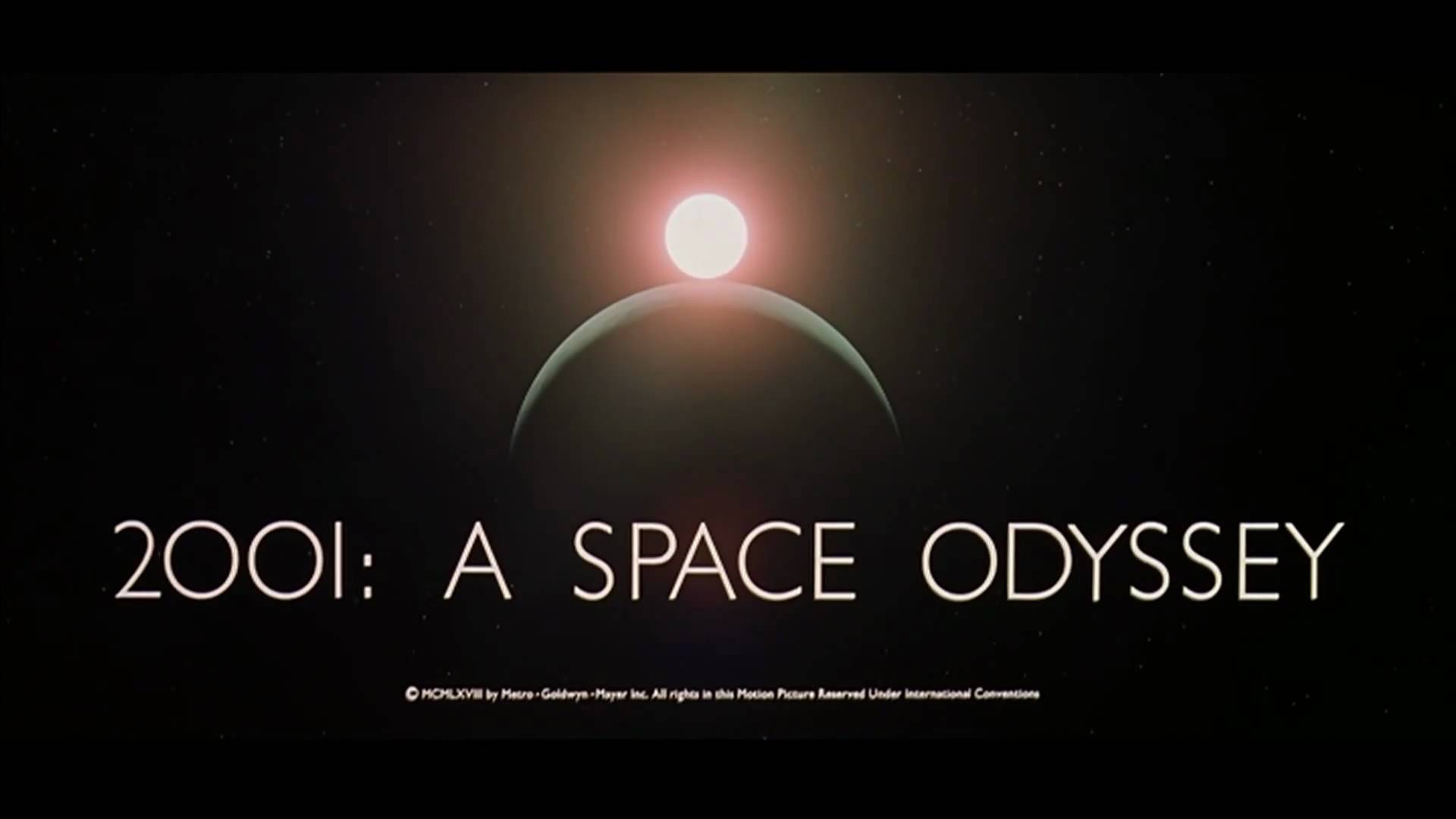
Last night I attended a 70mm screening of the classic science-fiction film 2001: A Space Odyssey. Released in 1968 2001 represents what might be considered the pinnacle of cinematic SF before the K/T event eight years later, Star Wars. While there continued to be released a number of low brow monster and invasion films throughout the 1950s and 1960’s, cinematic SF was, until Star Wars, moving towards a more idea centered adult focused set of stories.

Directed by Stanley Kubrick and written by Kubrick and Arthur C. Clarke, 2001 deals with the gigantic themes of the origin of humanity and our possible fate. In other essays I have discussed the difference between story and plot with 2001 I want to introduce another approach, the Idea Centered Narrative.

Where story is chiefly concerned with the evolution of a character and that character’s eventual change, and plot is focuses on objectives and the barriers impeding the achievement of those goals, idea driven narratives are concerned with big thoughts and exploring theoretical landscapes. With less focus on individual characteristics idea centered narrative are often more symbolic, impressionistic, and, particularly with film, strikingly visual. This definition fits 2001perfectly.

2001 can be broken down in five acts; 1-The Dawn of Man, 2-Clavius, 3-The Discovery, 4-The Horror of Hal, and 5-Jupiter and Beyond the Infinite. Others has noticed that each act makes a reference to birthdays and births a central and recurring motif throughout the film as it deals with the up-lift of humanity, symbolically shown by way of Bowman’s transformation, into a post-singularity species. Across the five acts there is no single character to follow, Bowman is in three but only in two acts does he service as an audience Point of View. Instead of a singular character, 2001, presents humanity as a whole as its character and the vehicle for its ideas. Humanity transforms, first from a pre-intelligent hominid into a thinking and reasoning animal, then into a complex but divisive species cooperating and competing as individuals and nations, and finally into the cosmic, alien, and unknowable ‘star child.’ This is a movie that is not concerned with any individual’s problems or challenges, not Moonwatcher the hominid, not Hayward the administrator, and not the doomed astronaut Bowman. Rather the central ‘character’, much like how a landscape or a city can be a ‘character’ in a film, is humanity itself and these various individuals stand in for humanity at key moments in its evolution, an evolution that is directed by unseen, unimaginably power, alien intelligences. I find it fascinating that of the five acts it is act that where Kubrick swore off the Hollywood mainstay, the close-up. Bring the camera right into the subject’s face has been thoroughly accepted mechanism for creating intimacy and empathy between the subject and the audience. Across the entire film we have close-up of our heroic astronauts, Bowman and Poole, of non-human characters such as Hal and Moonwatcher, but not when we are with the most human centered aspect of the movie, the discovery of the lunar monolith and the elaborated conspiracy keeping it secret. Instead keeps us at arms length, emotionally distant from all of these characters. I am not sure what I think about this choice; it’s one that I shall ponder for quite awhile.

There’s no doubt that 2001: A Space Odyssey deserves if venation as a cinematic masterpiece. One of the most thoughtful and though-provoking films of any era 2001 stands as giant and seeing it in 70mm was a real treat.

Share

Truly A Terrible President

To me it is an inescapable observation that Trump is a terrible president. Hot-headed, shallow in thought and knowledge, indulgent, petty, mean, vindictive and with a fragile ego he possessed no quality that qualifies him for the responsibilities of his office. I say this as someone who has voted for more Republican presidential candidates than Democratic ones.

This week we learned that from a leaked letter that Trump and his people have argued that it is impossible for the President, because he is, by virtue of his position as the head of the executive branch, the vehicle of justice in this nation, to obstruct justice. He cannot be subpoenaed, indicted, and possesses the power to pardon fully himself. Utilizing laws passed to ensure that the nation’s military can command critical resources during an emergency, he has taken personal power with the potential of greatly impact the national and world economy. He has abandoned the norms of American political power, dismissing many who refuse to be cowed yes-men, going so far as to suggest, albeit in his own sense of jest, that perhaps he should stay on past the constitutionally limited two terms. He has suggested at Article 5 of NATO isn’t important. He keeps his finances opaque while foreign nation pour money into projects in which has he has a financial interest. He distances us from our Allies has be gets friendly with dictators and tyrants.
And yet it would seem that there are vast number of people who do not seem to see the same defects in Trump as I do. It is always possible that I see through a bias and they do not, the first element of wisdom is humility in certitude and recognizing the possibility of error. However facts are stubborn things and I can see no reasonable narrative constructed from the known facts and observations that lead to any other conclusion. Many of the same people who now find Trump an adequate president found spurious fault easily seen in the previous president, seriously undercutting their observations of Trump as an acceptable president.

This is poisonous partisanship. This is the end result of my team is always right. This is the threat to self-governance that we must face. Yes, this tribalism exists on both sides, I have seen numerous distortions and false stories spread by those who see only evil in the conservative parties, but truly their transgression are far less than those defending this presidency, this graft, and threat to our way of life. These times will not only try our souls it will try out nation’s.

Share

Navigating Beta Reads

Getting feedback on a narrative piece is always tricky. It starts with the fact that all art is opinion and all feedback on art is opinion, none of this is quantifiable or subject to objective measurement such as say the Speed of Light or the rate of radioactive decay. A piece of art, no matter how terrible or great you may value it has those who love and those who hate it. Given that starting point what I look for in feedback is consensus. If several people tell me ‘X’ then ‘X’ is more likely something that will resonated across more readers than if one person holds that opinion. This is why having a diverse group of readers is so very helpful and why every person’s opinion is valuable.

Honestly that part is the easy part, what is more difficult is maintaining a distance between yourself and the actual feedback. It is easy to become dejected at a harsh critique, one where the feedback found very little to praise or recommend, and the natural inclination to avoid that dejection is a total rejection of that feedback, but this serves no one well. Even if that critique is an outlier among the rest it represents a point of view that others in a wider readership are likely to hold and should be considered and not dismissed out of hand.

Equally dangerous is the critique that praises. These can induce joy and elation and present the danger that they are valued over other feedback. Just as with the harsh criticism it is important to maintain some level of objectivity and see what elements you may or may not agree with in the feedback.

There are no right answers, there are no wrong answers, this is all personal taste and the waters of beta reads are filled with treacherous shoals ready to wreck to unwary.

Share