Author Archives: Bob Evans

The Bill Always Comes Due

Entropy drags the universe relentless towards chaos and debts always come due. This is a truth for politics as it is for anything else and no matter of hand-waving, wishful thinking, and verbal evasion can indefinitely forestall the bill.

It was many years ago when I started constructing a fiction setting where the USA had become a third rate power, trapped by its political passions and blindness into an interstellar power barely worthy of that title and here in 2018, though the reasons have changed the prospect has only grown.

Civilization grows from the bottom up. Billionaires, political leaders, and other elites rarely think of trail blaze radical new systems or methods. That which unsettles the status quo is that which endangers the current top of the pyramid and so the revolutionary change comes, most often, from those with great gains ahead of them and not from those with great losses on their minds.

To grow in ways that benefits society and not destroy or hinder it requires that the gains come from a desire to expand our horizons and not from a place of fear, rage, or hate. If you construct a system to traps people, robs them of hope, leaves them with only burning resentment and no hope for themselves or their children, then you reap a whirlwind of destruction when the system can no longer contain their passions.

If you leave people with only bad choices do not be shocked when the choices they selected are the ones that cause you the most pain, the most suffering, the one that fulfill rage.

You can protect your own, you can steal the food and the medicine, and the wealth, but eventually the bill comes due. Unless people feel that they have a fair chance they will eventually lash out and when that time arrives it will be too late to salvage society.

Share

Streaming Review:Trilogy of Terror

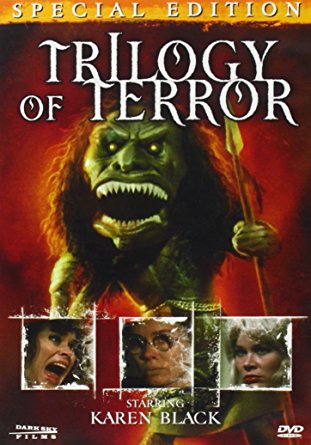
Part of my usual unwind just before bed is to watch either short videos, such as on YouTube or to watch a feature film in sections. Trilogy of Terror is perfect for this, while it runs an hour and a half; the trilogy section of its title comes from that fact that it is comprised of three short films. Trilogy of Terror was a made-for-TV movie broadcast in 1975 and starring Karen Black in all three stories. If you were old enough, as I am, to have watched the original broadcast you undoubtedly remember one aspect of this program, the Zuni fetish Doll. The story of Amelia chased about her apartment by the murderous puppet seared itself into popular culture and more than twenty years later when Joss Whedon scripted the episode Hush of Buffy The Vampire Slayer, he was hoping to craft the shock and terror that the Zuni fetish doll created. Truly the Zuni fetish doll is an exciting and generally scary bit of filmmaking. Lacking the budget for any sort of animation the production masterfully made do with fast editing, in a time before one could edit on a computer, strong point of view camera work, and, an aspect I think that gets overlooked for just how much it added to the film, Walker Edmiston’s fantastic, and un-credited, vocal work as the inarticulate raging voice of the doll.

But what about the other two short film that make up the trilogy?

While I remembered the Zuni warrior chasing Karen Black around her apartment, as will anyone else who has seen Trilogy of Terror, the other stories are literally forgettable. One deals with a mousy professor and her student that becomes obsessed with her, drugging her and forcing her into a sexual relationship until the inevitable plot twist. While the second story is about two sisters, locked in a terrible cycle of hate and revenge that also ends with a twist that was telegraphed from over the horizon and surprised no one who had seen these sorts of stories before.

If it had not been for the Zuni fetish doll this made for TV movie would have disappeared from out collection consciousness along with the made for TV remake of  Double Indemnity or the series Casablanca.

Share

The American WIP

Art is never finished, only abandoned. -Leonardo da Vinci

Anyone who has hung around writers or artists is familiar with the concept of WIP, the Work In Progress and da Vinci’s quote when coupled with the idea of the WIP leads us to the conclusion that all art is a WIP until it is abandoned.
While an artist is crafting their piece they may go through a number of drafts, revisions, and alterations as they search for the right expression of the motivating ideas. A work in progress has flaws, expression that in conflict with the ideals of the piece, sometimes you have to wave your hands around the troubles, sometimes you have to cut them out entirely, and sometimes you have to incorporate them, turning defects into admirable qualities. The artist must struggle to maintain a clear vision of their art, neither refusing to be dragged into despair by the faults nor allowing the beauty to blind them to the required work and corrections.
The United States of America is a social and political work of art and like all art it remains a work in progress. More importantly America is a collaborative work, all of use, left and right, majority and minority, are the artists working together crafting this monumental, lasting, and inspiring project. We suffer the same pitfalls of any artist as work. It is easy to see only the flaws in our history the terrible crimes committed by the artists before us and feel the temptation to burn the canvas in defeat and despair. It is also easy to see only the shining moments of greatness, to see only the ideals and be blind to real and continue pain falling short of those ideals inflict upon others. Both views are necessary and seeing the work in only one aspect leads to walking away, either because you hate the flaws or because you refuse to see the work that lies ahead, but the work waits for us. It is up to us to continue the craft of this amazing piece, this inspiring project, and to pass on to another generation of artists the vision of what is the United States of America,
Let us not abandon this art.

Share

Blast From the Past

For some reason today I got thinking about a submission from 1978. In 1977 Star Wars exploded across the nation and with a single blast from its turbo laser both reinvigorated media science-fiction and charted a new course. Part of that new course was a flood of space opera type adventures, including the 1978 television series Battlestar Galactica. At the time Galactica was the most expensive show ever produced on network television.

For several years before Star Wars, I had been writing and submitting SF short stories. I had also read, more than once, David Gerrold’s account of the production of the Star Trek episode, The Trouble With Tribbles.

Inspired by his tale, and shooting way way above my class. I wrote a treatment for an episode of  Galactica and using the library’s copy of the Writer’s Market, sent it off to an agency. It came back with a kind note informing me that the series had been canceled. What has caught my attention today is how similar in themes that early story idea is to some of my most current work.

Split into an A and  B plot the story opened with disaster befalling the fleets hydroponics vessels, a fungus that killed off all their oxygen generating plants. The story followed Starbuck piloting an expedition to a nearby system to acquire new plants with which to regenerate their stocks. (Apparently I hadn’t considered seed banks.) The expedition was under the command of Starbuck’s girlfriend, Cassiopeia. (Ignoring the fact that in the pilot she was a prostitute the series had turned into a ‘life tech.’) The main character conflict rose from Starbuck having trouble taking orders from a woman and having to learn a lesson on that front. The B plot followed a number of the main characters that had been evacuated from the Galatctica. (In order to save Oxygen reserves on the vital capital ship.) Forced to live among the crowded, barely tolerable conditions that the rest of the fleet endured, Apollo and others get a tastes of the depravation the rest of fleet suffered while they enjoyed comfort aboard the flag ship. The central conflict of course was between the less fortunate refuges and the Galacticians with a resolution that centered on the need for common sacrifice.

Looking back on that early story idea and on some of my most recent work I can see the common themes of sacrifice, and the need to set ego aside. It’s interesting what stays the same even after so many decades.

Share

Rejection is Baked In

Yesterday I got the word that I had not scored one of the few spots at the Viable Paradise writing workshop. Certainly that disappointed me but I also moved on fairly quickly. If you are striving in this writing gig an aspect that is baked into it from the very start to the very end is rejection. It says so right on the tin.

Everyone understands that when writers are starting out that there are loads of rejections. Many writers save every slip they get, often finding creative ways to deal with the pain, such as turning them into wallpaper. In general I don’t save mine. However once you establish yourself that’s over right?

Nope.

Editors may bounce books proposals, anthologies might invite you but still find the story not quite what they had in mind, second runs will get turned down, critics will reject your art, awards will overlook your brilliance in the same manner those editors did at the start of a career. Rejection is a writer’s constant companion; it is neither a mark of shame nor an indication of a lack of quality. Except for expressed comments and critiques all a rejection tells you is that the piece in questions did not work for that editor on that day.

Acceptance always tells you very little except that the story worked for the editor. As they say with financial prospectuses past performance is not indication of future performance. A string of rejections does not mean the next one to that same editor will also be rejected. I had a long strong of ‘did not place’ rejections from Writers of the Future and then skipping over Semi-Finalist and silver Honorable mentions, I scored a finalist.

Conversely a string of sales doesn’t mean the next submission to the same market will sell. Each and every piece lives and dies on its own.

When you get that rejection if there are comments, listen to them, then submit the piece a new editor, and move on to the next project.

Always writing, always submitting, that is the writer credo.

Share

The Volatile Man is Gone

Yesterday the world received the news that author Harlan Ellison died. Depending on who you are and particularly your age you are likely to have wildly divergent feelings about the man’s passing.

He lived a provocative life rarely keeping his tongue or in some cases his hands to himself. I think he was a tremendously talent artist but a flawed individual and a perfect example and warning to people to never confuse the art with the artist.  His writing is powerful stuff and he composed with a ‘take no prisoners’ gusto to what he saw as truth. From The Outer Limits, Star Trek, to Babylon 5 and I have No Mouth and I Must Scream; he left an indelible mark on speculative fiction.

I met him on one occasion but we were not acquaintances. It was at a room party for a Chicago bid to host the WorldCon. One fan, holding a hotdog from the party’s offerings, commented that these were good hotdogs. Harlan reached over, and with his fingers plucked the sausage from the bun, commented that the hotdogs were crap, and then replaced it back into the man’s bun.

Undiluted opinions served without consideration for your feelings, wrap it up in a towering talent and I think you’ll get fairly close to who Harlan seemed to be.

Share

The Norms Are Gone

There is a style of game playing that is best describe with the phrase ‘Find a rule to stop me.’ It is an approach that seeks to find every weakness in the rule, exploit them to the player’s maximum advantage and not just disregard but destroy any spirit of the game in the all out drive for victory. This has been the Republican Party playbook for some time and if the Democratic Party wants to get anywhere they are going to have to adopt it.

The most recent example of this is of course when Scalia’s SCOTUS became vacant. Sensing, correctly it turned out, that the seat could remain in conservative hands if he held up the nomination until after the election Senate Leader Mitch McConnell stalled the processed and ran out the election clock. No law, no provision of the Constitution prevented this action only the political ‘norms’ of behavior, which the Senate Leader was more than willing to sacrifice for a victory. No amount of shaming, no amount of pleading would ever dissuade McConnell from this course and that is a lesson the Democrats need to learn. You cannot win if you are fighting by a different set of rules. For quite some time now the liberal party has been bringing a knife to a gun fight its time to get properly armed, to fight the war as it being waged.

The seat being vacated by Kennedy is lost to the Democrats. They have no power and no option at all to stop McConnell and Trump from filling as they wish. There is no filibuster for SCOTUS anymore and fear of the base rising up will make the few remaining GOP moderates fall into line. That seat is gone and with it very likely Roe vs Wade.

So what should the Democrats do to fight back?

First off VOTE. If the democratic voters had turned out in 2016 as they had in 2012 this would not have happened. Vote in every single election, local, state, midterm, and presidential, every election matters.

If the Democrats can win the House, that’s within reach, and the Senate, that’s a stretch but not impossible, then they have to fight the way the Republicans fight. There’s plenty of corruption to investigate, launch a committee for every single one. Eradicate the damned filibuster.

Looking further ahead, should the Democrats capture the White House in 2020, dust off FDR’s Judicial Reform Bill. There is nothing in the law or the constitution to prevent a Democratic Administration and Congress from adding five more seats to SCOTUS and McConnell has already proved that ‘norms’ are history. FDR’s attempt failed because his own party rebelled at the court packing, those days are gone.

Those are suggestions for how the liberals can counter the conservatives, but what would be best for the country is for rational and sane political parties, but I don’t see that in the next ten years. If we had those we could possible craft from sane reforms, something like constitutional amendments for direct popular vote elections for President, and fixed 10 or 14-year terms for SCOTUS and all Federal Judges. That’s not in the cards though and we have to deal with the reality on the ground and that’s a reality that produced the current president.

Share

Finalist

In 2003 I entered the Writers of the Future contest for the first time. I think, though I am not certain, I entered the story The Station on the Edge an attempt at cosmic horror.  The story placed as a semi-finalist and I foolishly thought that it would be a short trip to the winner’s circle.

Here’s how the contest works. The cycle is quarterly so every three months they receive thousands (they do not release the exact number but only ‘thousands’) of stories from around the world – though the stories must be in English. With all author identifying information stripped away the coordinating judge reviews the stories.  Most do not place and you get a form rejection letting you know that. Another group of 20-30 get an Honorable Mention these writers get a nice little certificate, a handful are awarded Semi-Finalist, these get a certificate and a short as to why their story failed to make it to Finalist. Six are named Finalists and these six stories are passed from the Coordinating Judge to the Quarterly Judges, a rotating panel of professional writers in the SF and Fantasy field. From the Finalist the Judge selected three winners, 1st, 2nd, and 3rd place. Once all four quarters winners are determined the contest arranges a weeklong workshop for the 12 winners, and from the 4 1st place quarterly winners 1 grand prizewinner is determined.

So you can see how scoring a semi-finalist on my first try boosted my confidence and my ego. Skip ahead 15 years, I have not entered every quarter but I have entered a lot and in those 15 years, and in those 60 quarters I scored 5 semi-finalists and a little more than that in Honorable Mentions. It’s a very tough competition among writers who have not yet achieved professional status. If fact it’s been quite a few years since I scored anything more than an Honorable Mention.

Until yesterday.

My most recent entry has placed as a Finalist. It is one of the six stories from which the three winners will be selected. (And no that does give me a 50% chance. As the great editor Gardner Dozois once said from a panel “It’s NOT a lottery!” My chances depend on the style and quality of the other stories and the tastes of the Judges this quarter.) This is closer to winning than I ever achieved but I am preparing myself for a loss.

Still, this is very exciting.

Share

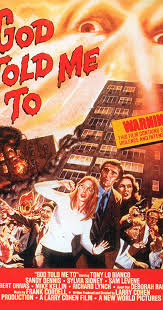
Streaming Review: God Told Me To

Over the weekend while I was alone, tired, but unable to sleep, truly an unpleasant combination, I skimmed over the streaming menus on Amazon Prime and stumbled upon this film God Told Me To.

The movie was not a total unknown to me as I had heard a brief discussion about it on the podcast Cinema Junkie as the Host interviewed and reviewed the career and films of Larry Cohen. With my interest already sparked by that episode of the podcast I started the movie.

In God Told Me To random people in New York City suddenly and inexpiably engaged in spree killing. The detective, Peter Nicholas a devout Catholic, investigating the seeming disconnected series of murderous out bursts learns that each person felt compelled by God to commit the horrible acts. Propelled by his own crisis of faith Peter investigates their history, uncovering a common connection between the attacks in the form of a young blond man, a man with a face that no one seems able to remember. Peter’s investigation uncovers religious cults, crooked cops, and other worldly encounters, ultimately bringing Peter face to face with the mysterious young man and a terrible truth about Peter himself.

Honestly when I started the playback I suspected I would watch a bit of the film and most likely complete viewing it, if I did at all, the following evening, but instead I watched the entire feature, ignoring my exhaustion, intrigued by the story as it continued to unfold in unexpected directions. By the end all relevant mysteries were resolved and I found the film fascinating and well worth the time.

If you have Amazon Prime and quirky films appeal to you this is something to consider. I can’t properly categorize its genre; it’s part religious horror such as The Omen and The Exorcist, its part Science-Fiction, and its part mystery. Above all it is unique.

Share

Recognizing Evil in a Political System

A couple of weeks ago two and friends and myself watched a 2008 Norwegian historical film Max Manus: Man of War. It tells the story of Max Manus a leader and fighter of the Norwegian underground fighting the invasion and occupation of the Norway by the Germans in World War II.  From what I could tell the film stayed fairly close to the historical events and told a compelling story about the dangers and costs of fighting an asymmetrical war against an occupier. In the second act of the film one of Max’s best friends is killed in an ambush and another resistance fighter is captured. The Nazi’s start a round of torture on the captured freedom fighter but when they return him to his cell he hangs himself.

This past weekend the same friends, after an evening of board and cards games, and I watched this year’s film The Death of Stalin. Adapted from a graphic novel and inspired by the scramble for power following the dictator’s death, The Death of Stalin, a dark satirical comedy, is less rigorous with its history but it does depict the brutality of the communist regime, a system rife with murder, terror, and torture. In a bid to have sympathetic protagonists the movie tends to push most of the brutality onto the shoulders Stalin and the head of his secret police Beria (who actually did not hold that position in 1953) but the system before, during, and after Stalin was rotten with torture.

It should be intuitively obvious that torture is an evil. A captive is a person, a human being, who existence is entirely dependent upon the good will of their captor. This places ethical responsibilities upon those captors. Torture is the absolute rejection of those responsibilities and the morality that is their foundation. Torture is not amoral it is immoral. Both of the examples are governments, political philosophies that murdered millions.

A political philosophy that embraces torture is capable of anything.

Share