Author Archives: Bob Evans

Getting Out the Vote – Digital Edition

While listening to a podcast – Vox’s The Weeds– I heard an advertisement for an app to help you get your friends out to the polls this election, Vote With Me.

The app uses your contact list to search public records and produce for you a snapshot of how diligently your friend attend the polls. Your vote is a matter of public record, who or what you actually cast your ballot for is secret. In addition to knowing if your friends skipped the last midterms the app will also let you know if their district is considered a toss-up or not so you can target your efforts to those area where it will matter the most.

The data goes back to the year 2000 so it can provide an interesting peek into political leanings you may have been unaware of in your friends. Again whom they voted is unknown but if they voted in closed primaries that is public knowledge. I was a little surprised to discover who in my contact list had participated in a Libertarian primary. Here’s a couple of screenshots to give you an example of the type of information you can gleam from this app and very publically available data.

The first is from a friend of mine and I have redacted out their name, even though this is public data without specific consent I’ll keep their identity under wraps. The second is my own data and so no need of redaction and you can see when I switched my party affiliation.

I don’t recall anything like this at all for the last election, though it may have already existed and I simply did not know about it. Statistician Nate Silver, who founded and runs the data driven news site fivethirtyeight.com, had said that if the polls have a consistent error of 2-3 points biased either for the Democrats of Republicans, then either party could have a strong showing and take both the House and the Senate. I can’t help but wonder what sort effect this app or others like it will have on the election.

This, of course, is only the start of our big data culture. Even those of us who avoid Twitter and Facebook leave a digital trail through the world and the ability to gather, process, and interpret this data is only getting easier.


Share

The Challenge of ‘Pantsing’ It

In the real of writing authors can be divided into two major camps, plotters and pantsers. Plotters outline their works before starting a project while ‘pantsers’ start writing and follow the impulses of their muses. Neither approach is inherently right or wrong; writers need to utilize the technique that works for them. Even the broad categories themselves are somewhat misleading as often pantsers have some idea where their story is ultimately going and plotters often discover twists and turns not revealed by the outlining process. My novels tend to be highly plotted and outlined, the last project had an 87 pages outline but when it come to short fiction I am much more of a hybrid author. I know where the story starts and I know the ending, I cannot begin without that ending for me it contains the point of the story, but I will often discover my middle like a pantser.

My most recent short fiction was following this pattern but stalled when I discovered that while I knew what critical information had to be revealed to both the first person protagonist and the readers I was utterly stuck on how to do it. I have work-shopped the opening of this story and it’s gotten good feedback, I know not just how it ends but the final line of the piece and I would say that about 80 percent of the plotting is taken care of, but this one element, this vital element, had stalled the project for months. Every time I think I have found the solution when I consider it more closely it falls apart.  I have set this story aside and drafted complete shorts in the interim but still this tale remains uncompleted.

Until last night.

While I stood at the sink and did the dishes, (we do not use the dishwasher, saving the energy it consumes.) my mind explored the blank areas of this story. Suddenly as I imagine scenes between characters, exploring their motivations, some of which were to be entirely subtext, the answer appeared. I had been coming at it from the wrong character, insisting that my protagonist go out and seek the information that would torment her when I had an already existing character that would revel in supplying the information and torment her with it.

My weeks of being stuck have ended and the story should be finished in first draft soon. As a bonus I even, finally, found the title, ‘Savior Complex.’

Share

These Bombs are not a Surprise

I am late getting my blog post up this morning because I had an early appointment with my talent chiropractor but here at lunch I can take a little of my fiction writing time to comment on the breaking but not surprising news that mail bombs were sent by persons unknown to several politicians and prominent people.

I do follow the adage that you know the nature of the perpetrator by knowing their victims and the fact this morning’s murderous attempts targeted liberals and other ‘enemies’ of the right certainly is consistent with the person or persons who constructed the devices belonging to the conservative side of the debate. After years of crafting elaborate conspiracies around these person, about their birth, their motivations, and ascribing all manner of evil to them it hardly unexpected that somebody would take it upon themselves to ‘do the right thing’ and fight back. Of course having a President that labels a free press as an enemy of the people, phrasing better suited to Stalin than to our Chief Executive, and whose rallies incite violence contributed to this bitter news. To me there is a direct line from ‘enemy of the people’ to this morning’s attacks. Violence is always preceded by violent thoughts. Once violence becomes an acceptable method of political discourse the future becomes dangerous.

Had those bomb been delivered to Trump, Paul Ryan, and Senator McConnell I would just as quickly draw a line from ‘punch Nazis’ to those same hypothetical attacks. Once the rabid dog of political violence is unleashed it obeys no master.

There are those who are going to try to take this morning’s news to silence all discourse and criticism of the administration, drawing a false equivalency between vocal reprimands and actual threats. These people need to be rejected as solidly as those who advocate physical violence.

Of course this also exactly what enemies in the Kremlin want to see. They fanned the flames of political hatred, inflaming the division that already threatened our society’s fabric, with the hopes of causing us to defeat ourselves. Don’t help them. Don’t share, false, mean, or spiteful memes on Twitter and Facebook. Too often these are the weapons meant to weaken us and it is one reason why I try to avoid name-calling and insulting attacks.

Civility does not require servility, we can fight for everyone’s rights, we can fight the hate without deploying more hate, and we must do this if our country is to not only survive but come closer to that more perfect union, to come closer to its ideals.

Share

The Time is Drawing Nigh

As I write this the morning of October 23rd with the midterm elections just two weeks away the political site fivethrityeight.com is giving the Democratic Party an 82.8 percent chance of taking control of the House of Representative and the Republican Party an 81.0 percent chance of retaining control of the Senate. (With an additional 80 percent chance that the Democratic Party with gain either one seat or lose none.) This election cycle the statisticians at the site have included a model for the various Governors elections and they current favor the Democratic Party to win the top executive positions in thee states of Illinois and Florida with George and Ohio being rated as toss-up and Arizona leaning towards the Republicans but not a safe lock.

Some of this movement can be attributed to the normal US electoral process of the midterms swinging against the party that won the last Presidential elections and some of it is also a reaction to the specific presidency of Donald Trump. Within the Republican Party itself Trump remains very popular and many GOP candidates across the country are emulating him making his style and positions the Republican brand. Whether this is merely a strong reaction the current President, his policies and his party’s adoption of these planks or a genuine ‘blue wave’ that could be strong enough to sweep the opposition party into power in both the House and the Senate will not be know for a fortnight. Even a modestly good showing by the Democratic party, taking the House and several governorship while leaving the Senate in GOP hands, will dramatically influence the future American landscape. With the House the Democrats will be able to launch investigations into suspected corruption at the heart of the presidency and with governorship of large important states they will be able to use the 2020 redistricting to mitigate the GOP gerrymanders from the 2010 census. These gains, even just the modest ones, will also begin the rebuilding of the Democratic bench that was destroyed during the Obama administration when the party ignored state and local contests, surrendering the field to GOP control, a mistake the Democratic party now seems to have finally recognized.

It is ironic to consider what world we would likely be facing if the 2016 presidential election had turned out differently, if the ‘blue wall’ had held and Hillary Clinton had won that contest. A second Clinton presidency would not have provoked a ‘resistance’ and aside from unhappy ‘Berrnie’ supporters the Democratic Party would have mostly asleep at the switch. The House and Senate, safely in GOP control, and despite a strong economy, the midterms would have most likely eroded President Clinton’s number in both chambers, while an un-energized base would have left the states and local control uncontested, teeing the GOP for another round of favorable gerrymandering following 2020. Even if Hillary won her reelection bid, incumbency is a powerful in any election; it is probable that by 2024 would have seen a procedural bias strongly in the Republican’s favor.

I am not arguing that the election of Trump was a good thing. He has done too much damage to our institutions, our political norms, and our standing in the world for his election be considered a good thing. His administration’s drive to defined transgender person out of existence will make Washington D.C. the Nuremberg of the Potomac. His admiration of dictators and his blind eye towards their crimes makes a mockery of our morality and his corruption debases the very concept of the rule of law. Trump is doing serious, lasting, and possible permanent damage to the Union but there is hope and despair is only for those who can foresee the future with perfect clarity.

Share

Halloween Movie Review: Halloween 3: Season of the Witch

This year I decided to revisited some horror films that had not worked for me when I watched them the first and see if with a different set of eye and life experiences if these film had been unfairly judged the first time I viewed them. I continued that last night with Halloween III: The Season of the Witch.

Released in 1982 this movie has the distinction of being the only Halloween franchise film that does not present silent, psychotic, slasher Michael Myers as it’s principal terror. Producers John Carpenter and Debra Hill has intended to created an anthology series of horror film under the Halloween banner that Season of the Witch represents the one and only example of that concept. Had they not created a direct sequel to Halloween which continued with the night Michael Myers came home they might have achieved their anthology objectives but by the third installment people’s expectations were set and it was too late for that major of a course correction. Their aims were also hampered by this entry being a particularly poor horror film.

Moving away from the slasher sub-genre Season of the Witch follows the investigations of Doctor Dan Challis as he tried to determine why a patient was gruesomely murdered in his hospital. He quickly finds himself teamed up with the victim’s adult daughter, Ellie Grimbridge and they follow an trail of obvious clues back to a small town whose sole industry is a novelty and mask factory owned by Irish industrialist Conal Cochran, played by veteran actor Dan O’Herlihy the only artist bothering to give any real life to their performance.
It did not help the other lead actors, Tom Atkins and Stacey Nelkin, that the script gave them so little to work with. In a story scenes can serve Plot, Character, and Mood and ideally a scene should further all three aspects simultaneously. In this movie nearly every scene is one that moves the plot along and ignores all other aspects of good story construction. Dr. Challis wants to know who killed his patient and why without every speaking to a police officer or detective he launches his private investigation because the filmmakers want the plot to move are loathe to waste time on the logical consequences of the events. Challis and Ellie go to the distant and tiny town, during the drive their conversation is only about the mystery, nothing said illuminates character or gives any sort of interaction between the pair that doesn’t serve the plot, and yet when they arrive at the motel they becomes lovers. Why? because it will raise the stakes for the characters when things turn lethal not because it is an outgrowth of the characters and their emotional interior lives.

The only aspect of the film that contains even a spark of originality is Conal’s motivation. A devotee of the ancient pagan religion his disgust at their holy night, Halloween, at having been turned into a night for children to go begging candy, feels honest and real and as something that could drive someone to murderous revenge. This is the only aspect I suspect that survived from un-credited writer Nigel Kneale’s concepts. In the end there is a big ending that the production did not have the budget to realize and an ending that is both incredulous, (what one number could you call to have three different networks yank programming in real time?) and ultimately unsatisfying.

My original reaction remains unchallenged, this is a horror film to skip.

Share

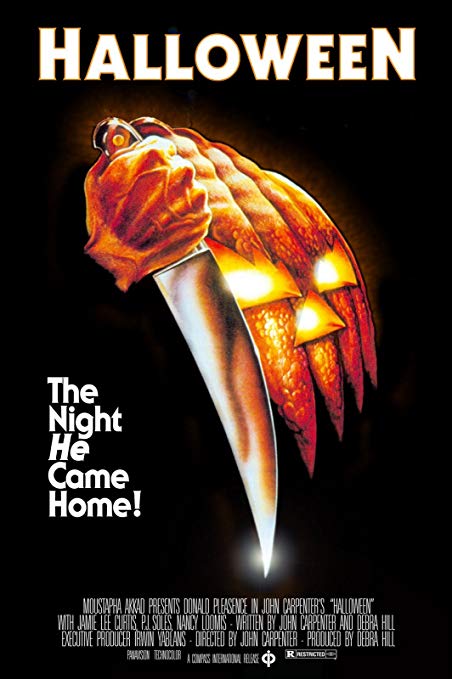
Halloween Movie Review: Halloween (1978)

Despite this movie having came out while I was in high school I do not think I have ever sat down and just watched it all the way through in one sitting. And I still haven’t.

Credited with kicking off the modern slasher film, though it owes quite a debt to both Psychoand Dementia 13, Halloweenpresents for the audience a rather simple premise. Michael Myers, who murdered his sister when he was just six years old, has escaped from a high security psychiatric hospital and with his doctor desperately trying to recapture him before it is too late, returns to his hometown on Halloween night intent on a rampage of murder. With a budget of $300,000 and a box office of 70 million dollars, Halloweencatapulted the careers of its director John Carpenter and its star Jamie Lee Curtis.

I watched it streaming from Shudder over two nights and while I had seen the entire movie in bits and pieces, a scene here, an act there, this was my first time just settling in to give it a proper screening. I believe what Carpenter was going for was a slow burn build up but for me the front two thirds of the film is mostly tedium and repetitive set-up. The characters and their interior lives are sketched at best, certainly not enough to draw me in emotionally and as such Michael’s mayhem lacks any real power of poignancy. The movies spawned by the success, Friday the 13thand such would skip much of the attempt at a slow burn, barely taking any time to establish the characters before unleashing the slaughter and thus failed emotionally in entirely the opposite direction, substituting sensationalism for story. I love a good slow burn horror film; both The Exorcistand The Witchtake their time getting to their frightening final acts but en route to those climaxes they present relatable, engaging characters.

There’s no doubt that I am out of step with the popular opinion about this movie, after all there have been something like nearly a dozen sequels and reboots with a fresh one hitting theaters this weekend, but I found myself mostly bored.

Share

The NAZIs Were not of the Left

Lately I have been seeing a resurgence of the idea that the National Socialist Workers Party, the NAZIs, was a product of the left and should not be considered as an aspect of rightward politics. This is a patently ludicrous position. Oh I can understand if you were utterly unfamiliar with the NAZIs, their rise to power, their targeted enemies, and their social position how the words ‘socialist’ and ‘workers’ might lead you astray, but anyone can slap words on something in an attempt to disguise its true intent or nature. However the situation with the NAZIs was a bit more complex than branding, though that did play a factor. It should be remembered that Hitler did not found the NAZI party, but rather was recruited by it and at the time he joined it was already riven with competing and warring factions. One such division within the NAZIs was the Strasserist faction led by Greggor Strasser. Strasser and his wing advocated a much more socialist and anti-capitalist ideology direction for the NAZI party. They shared the party’s central dogma of anti-Semitism but not from a racial war prejudice but because they blamed the Jewish faith for the excesses and evils of capitalism. (Both views are irrational, conspiratorial, and disgustingly racist.) When advocates of the ‘NAZIs were leftists’ arguments produces quotes and official party positions to defend their premise these come from the Strasser faction. The Strasser wing was ruthlessly eliminated from the party during The Night of the Long Knives.

Another avenue of evidence often offered to support the position that NAZIs were truly left and not right were policies pushed by the NAZIs. I have even heard that since NAZI Germany had unemployment insurance as ‘proof’ of their leftist nature, ignoring not only that the program predated the NAZI regime but also predated the Weimer Republic and the entire twentieth century. Under the NAZIs work programs existed but never on the massive scale as they are usually presented as evidence and the grand German project the Autobahn predated the NAZI’s rise to power. The NAZIs, while they did eventually go to a full war footing, did not nationalize their major industries and they destroyed trade union, sending their leaders to the concentration camps. Perhaps the most dishonest and insulting ‘evidence’ is that the NAZI compelled abortions in the ‘undesirables.’ This offensive line does double duty, insinuating that person’s on the left want abortions for abortion’s sake and not from a position of personal liberty and choice and it ignores the ban on abortion for ‘Aryans’. The NAZI were in many respects well ahead of the curve in public health, such as proving that tobacco use promoted cancer, but they only cared to promote the ‘Aryan’ race and its mythical supremacy. Even on the oft repeated and erroneous issue of gun control the NAZI did not behave as politicians of the left. The Weimer Republic had fairly tight gun laws, as you might expect of a system with hundreds of political assassination and political parties rioting in the streets, the NAZIs loosed gun control for most of the population while striping undesirables, such as the Jewish population, of the rights to weapons.

On any number axes the NAZIs consistently fall on the right side of the spectrum.

Soverign Relations, National vs. International: The left favors international institutions the World Court, The UN, etc, while the right favors domestic sovereignty. The NAZIs were clearly nationalistic.

The Arts, Traditional vs. Avant Garde: In General those with left leaning are more tolerant and welcoming of experimental arts while those on the right favor already accepted artistic expressions. The NAZIs, while embracing new technological distribution and methods such as radio and film, rejected content that was not seen as wholesome traditional arts. They considered avant-gardeas degenerate and destroyed such art while looting Europe of classical forms.

Social Mores Traditional vs. Expansive: Persons on the left tend to be more accepting of people who refuse to follow established social mores and customs, expanding the range of publicly tolerated behavior while on the right their is a reverse for established conduct and a suspicion of modes of expression that violate community morals. The NAZIs condemned, destroyed, and murdered member of communities that diverged from accept social norms, declaring such person as degenerate and destroying scientific research that did not conform to the party philosophy.

Even as some try to argue the position that the NAZIs and fascists were of the left we can see in real time that this is not the case. Neo-NAZIs and fascists when they engaged in our modern politics nearly invariable do so by aligning themselves with conservative parties and appeals to the ‘right.’

In my opinion any published political commentator who pushes the line that Fascists and NAZIs were of the left is at best ignorant and more likely disingenuous as they try to put distance between their own political philosophy and it’s murderous extreme.  (It should be noted that all political and religious philosophies have murderous extremes and that those extremes exist in no way invalidate position, which are not out there on the fanatical zealot frontiers.)

p.s.

If you are going to make a comment make it your own and not just a link to a Ben Shapiro lecture ….

Share

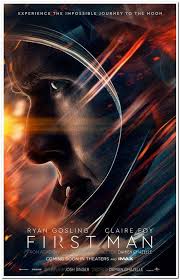
Movie Review: First Man

First Man is the biopic about Neil Armstrong, the first person to step onto the surface of the moon. Biopics are a particularly difficult beast, real life rarely fits into a conventional three act structure and people are complex amalgamations of conflicting impulses, drives, and justifications and as such the genre often turns to reduction and simplification to craft a satisfying narrative and First Man is no different in that regard. Rather than attempt to cover the entirety of film focuses on a period of about ten years covering Armstrong’s from X-15 pilot to the Apollo 11 lunar mission. An additional challenge in this story is that Armstrong was a famously reserved man who disliked the glare of public life and rarely spoke of himself. Ryan Gossling does an excellent job of portraying a man who spoke little but yet it is clear that he not only thinks but also feels quite deeply. Damien Chazelle understands the power of subjectivity. While there a few glamour shots of the craft in the vast void of space the majority of the scene are shot from a point of view restricted to the interiors, putting the audiences in the squarely into the emotion truth of being trapped in a tin can surrounded by an lethal environment.

The comparison that leaps to mind is Apollo 13 and while both films are true-life events their tones are vastly different. Apollo 13 is a story of triumph, of amazing survival against a terrible disaster and its climax, truly a great achievement for a film whose ending is well known, is designed to induce cheers. First Man is not about the fantastic voyage but it is a story about faith, how one can lose it, and the redemption when it is regained. This movie is, like its subject, a quiet study of a deeply internalized person and that is not going to appeal to everyone. However I enjoyed the film and if you go see I highly recommend you do so in an Imax theater.

Share

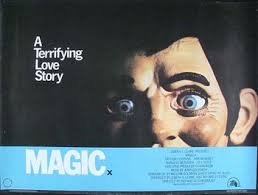
Halloween Movie Review: Magic (1978)

Long before he shot to international stardom for his chilling performance as Doctor Hannibal Lector in 1991’s The Silence of the Lambs, Anthony Hopkins played the lead in numerous films but the first place I recall seeing him was 1978’s Magic. The film’s tag line billed it as a terrifying love story.

Playing Corky a stage magician whose act includes his foul-mouthed ventriloquist’s dummy Fats. On the eve of his break out as a major star and with Networks wanting him to star in a series (It was 70s and at that time that actually gave prime time shows to mimes.) Cork panics, shocking his agent/manager Ben Greene (Burgess Meredith) by bolting from the city and vanishing into parts unknown. Cork flees to his childhood home in the Catskills and reconnects with the Peggy Ann Snow (Ann Margaret) the girl he had a crush on in high school but never asked out. Peggy, trapped in a failing marriage, connects with Corky but unfortunately for everyone involved, Fats has his own ideas.

Existing in that liminal space between thriller and full out supernatural horror film Magic, directed by Sir Richard Attenborough, is a taunt psychological script by William Goldman, adapted from his own novel of the same name. For those who only know Goldman from the delightfully charming The Princess Brideor the conventional action thriller The Marathon Man, this movie may come as quite a shock. Magicworks it spell not by way of gruesome kills and spectacular make up effects, techniques that would come to dominate the horror genre following that massive success of the following year’s film Halloween, but through in-depth character work and marvelous performances. The movie is currently available for streaming on the horror dedicated service Shudder and at just under two hours it makes for a treat if your taste for horror turns more on character than on blood.

Share

An Argument Against the Electoral College

Recently I have seen the map displaying the concentration of the U.S.’ population versus the area of the states utilized as an argument in favor of the Electoral College, affirming the position that the College protects the rights of smaller states, preventing a tyranny of the majority. That is certainly the intent of our entire Federal system, including the Electoral College, but we have drifted far from intent and it is best to deal with our current reality. How we drifted from intent is really a product of two factors, one which was evident but ignored by the framers of US Constitution and the other unknown to them but clear now.

The Constitution’s architects had hoped to avoid the rise of political parties but immediately upon the Constitution’s adoption they split into two factions, the Federalists and the Anti-Federalists and our two party system was off and running. It would have been a blessing if right then and there they had recognized their error and made adjustments to account for parties but locked in their own bitter battles they passed onto the future generations a system designed against factions powered by the two parties.

The second factor was the changing nature of our identities. I believe that a strong argument can be made that the identity of ‘an American’ was truly born not in 1776 with our independence but in 1865 with the crushing of the states’ rebellion. Before the Civil War a person’s principal sovereign identity lay with their state and post Civil War that identity transferred to the United States of America. Today, while states have their own unique cultures and temperaments, it is the exception that a person identifies as by their state identity over their national one. Combined with the direct election of Senators the Federal system of advocating states interests has been weakened significantly since the adoption of the Constitution.

Today we live in the confluence of these two factors; a political system ill suited to parties with a winner-take-all system of elections and dissolution of state identity that has left the states mapped directly to one party or the others. This has yielded not only plurality presidents but also president who won a minority of the popular vote. It is interesting how those who most loudly reminded everyone during the 90s that Bill Clinton failed to win a majority of the votes have fallen silent as a president assumed office with 3 million votes fewer than his opponent.

For these reason and the ones I put forth in my other post I believe we must move to a popular vote presidency.

Share